


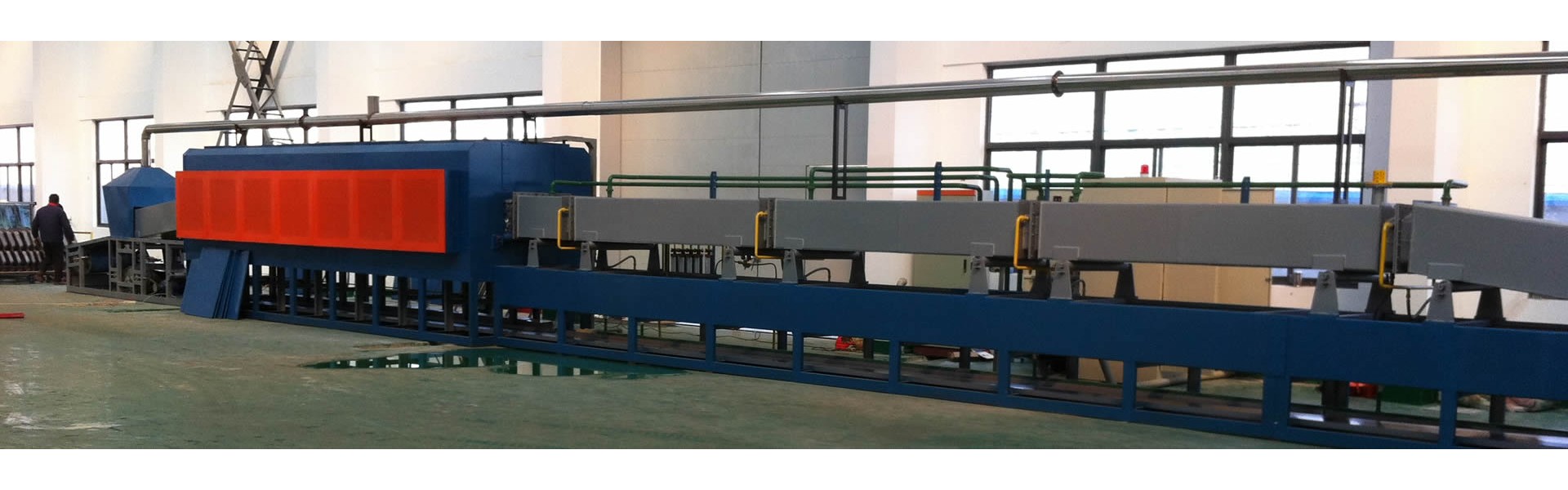

Soldering FurnaceMost products are imitations of imported ones. For instance, the brazing furnaces used for aluminum radiators and other aluminum products are almost identical to imported models, a result of Nolock's technological limitations. However, some manufacturers, in an effort to reduce investment, have requested that the research units simplify the process. For example, a manufacturer in Hubei Province requires the application of flux, blowing clean air, and then drying the workpieces before placing them outside the furnace for processing. After treatment, they are directly introduced into the brazing furnace for welding. Despite this, the majority of users in our country find the investment in such equipment unaffordable. As a result, a company in Northeast China developed a single-chamber discontinuous brazing furnace to meet this demand, significantly reducing investment. However, this comes at the cost of reduced efficiency and stability in quality. It can be said that there is no other way around this. brazing aluminum products requires high-precision temperature control and uniformity in the heating zone. It is still challenging for domestic research institutions to develop such brazing furnaces. To address this, a research institute in Northeast China has chosen to collaborate with a Japanese company. However, due to the technology and key components being sourced from Japan, the cost reduction is minimal, and the price advantage is not significant. To develop a brazing furnace with satisfactory performance and an acceptable price that meets user demands, it is necessary to absorb advanced foreign technology and pursue domestic production. Currently, a research institute in Tianjin has adopted this approach. Compared to imported products, the steel component brazing furnaces have the following distinctions:
(1) The protective atmosphere for imported brazing furnaces is primarily composed of liquefied petroleum gas. However, in our country, most still use ammonia decomposition gas. In fact, in economically developed Western countries, the protective atmosphere generally employs the following two types: a) Liquefied petroleum gas; b) Nitrogen-based atmosphere. The nitrogen-based atmosphere holds great potential for social development. Currently, the energy crisis management is not only severely threatening our country but also the entire global network. We need to be aware that nitrogen, accounting for 78% of the air, is inexhaustible. The main issues with our country's current use of ammonia decomposition gas are twofold: first, the preparation method for ammonia decomposition gas is simple; secondly, due to insufficient domestic promotion of nitrogen-based atmosphere and limited understanding among students and general users, it has affected market expansion.
