


In recent years, two terms have gained increasing attention in the food and oil industry: MOSH and MOAH. MOSH stands for Mineral Oil Saturated Hydrocarbons, translated as "saturated hydrocarbon mineral oil" in Chinese. MOAH refers to Mineral Oil Aromatic Hydrocarbons, which is "aromatic hydrocarbon mineral oil" in Chinese. Both types of mineral oils are considered harmful substances in food and vegetable oils.
In the early 1990s, a public laboratory in Zurich, Switzerland, detected contaminated baked goods and candies with mineral oil content as high as 0.1% (1000 ppm). These foods absorbed paraffin oil from production surfaces and processing utensils. Additionally, packaging materials for products like rice and powdered milk were found to release mineral oil, such as the fibers of jute bags and the printed inks on cardboard. By 2014, the Swiss laboratory had also conducted a study on the accumulation of saturated hydrocarbon mineral oils (MOSH) in the human body. The content of hydrocarbons in human tissues and breast milk samples ranged between 50 and 200 ppm.
Swiss Food Watch Laboratory analyzed hundreds of products. As of 2019, "Food Watch" found that 16 baby formula products contained aromatics mineral oils (MOAH) at concentrations of 2 to 3 ppm.
A new study reveals that the average concentration of hydrocarbons in tropical plant oils remains relatively high. The European Food Safety Authority (EFSA) reviewed the analytical results of 7,840 samples conducted by food associations and various laboratories between 2011 and 2021. According to EFSA's statistics in 2023, this table displays the upper and lower limits of the average concentration of hydrocarbons in tropical plant oils:
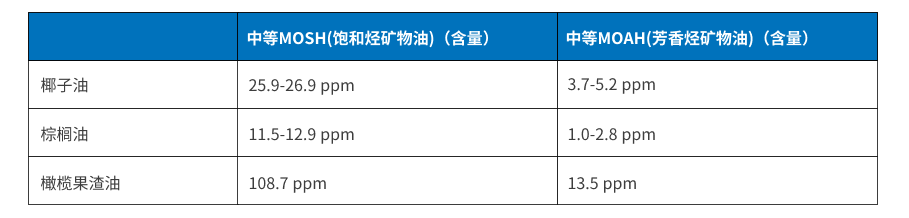
The MOSH in olive pomace oil reached 108.7ppm, while the MOAH was 13.5ppm.
MOSH (Mineral Oil Saturated Hydrocarbons) and MOAH (Mineral Oil Aromatic Hydrocarbons) encompass a broad range of molecules, including hydrocarbons with 10 to 50 carbon atoms (C10-C50). Smaller molecules typically evaporate during the refining and deodorization of oils. Compared to MOAH, MOSH components pose less harm to human health.
Long-chain aromatic hydrocarbon mineral oils (MOAH) with 3 to 7 rings are considered to be carcinogenic and mutagenic. In 2020, the European Union set limits on the concentration of aromatic hydrocarbon mineral oils (MOAH) in baby food, and recently, these limits have been expanded to cover all food categories. The permissible concentration of MOAH in edible oils is 2 ppm. Reducing the MOAH aromatic hydrocarbon components poses a significant technical challenge.
Removing saturated hydrocarbon mineral oils (MOSH) and aromatic hydrocarbon mineral oils (MOAH) through short-path distillation is highly challenging. The short-chain hydrocarbons in MOSH/MOAH have a lower boiling point range, allowing for efficient separation with relatively high yields via short-path distillation. However, the long-chain hydrocarbons are in a similar vapor pressure range to many other valuable components in the product, making their separation much more difficult.
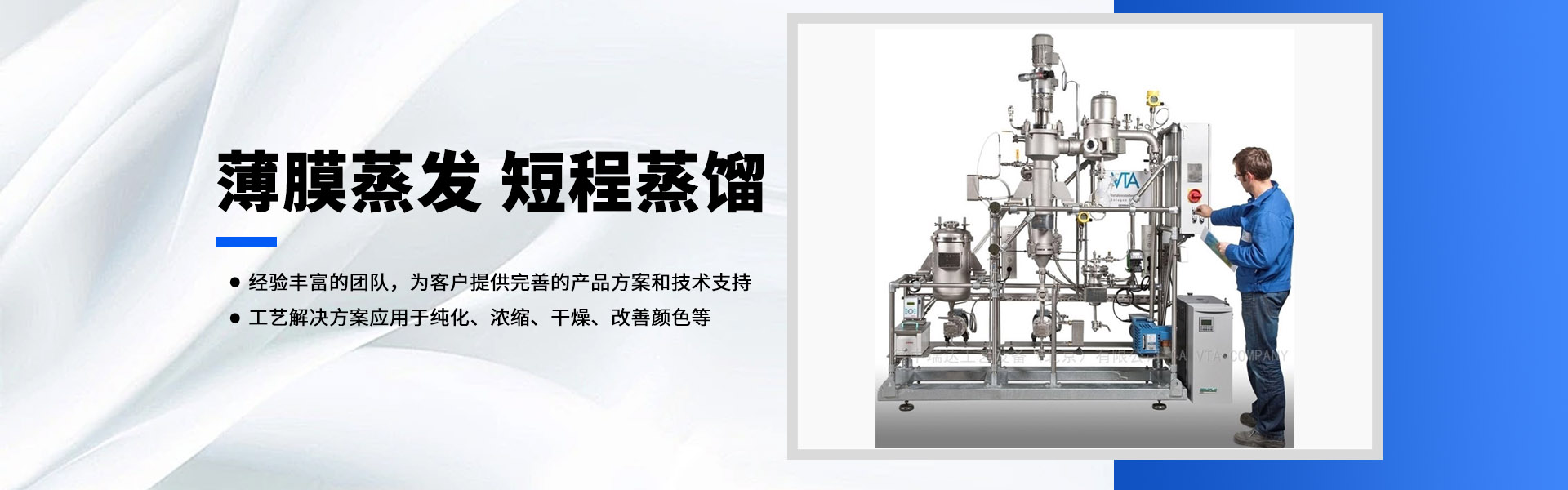
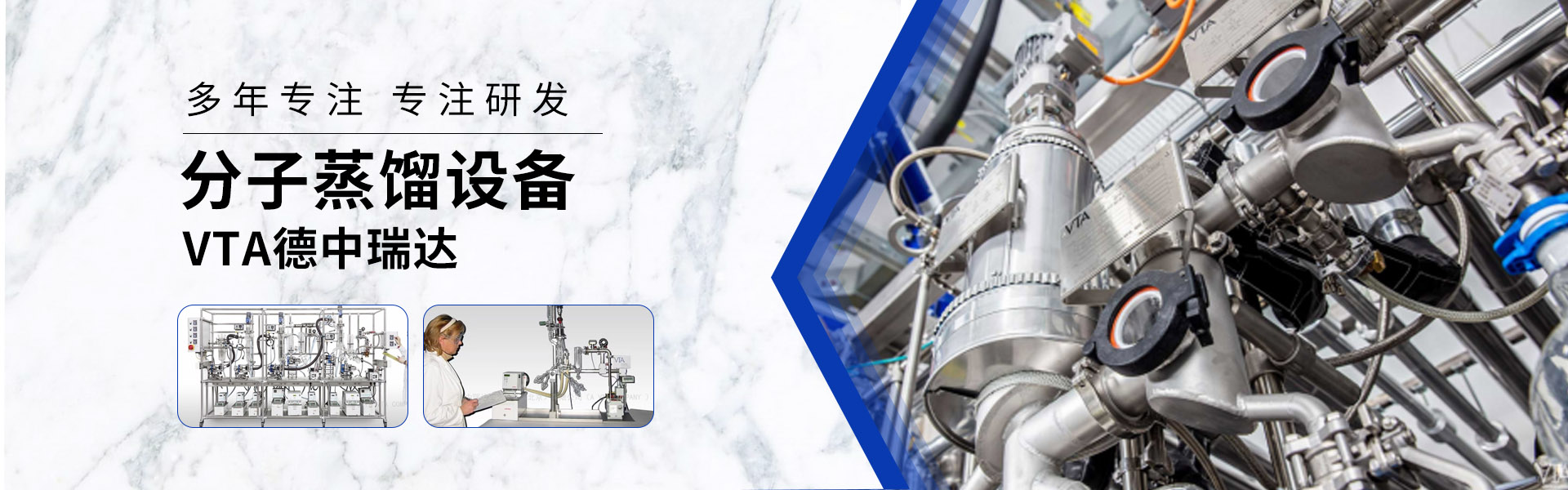
Nutriswiss, a Swiss-based specialty oil company, produces a range of functional oil products for the food and cosmetics industries using both animal and plant-based ingredients. The company is also expanding its refining business through the introduction of new short-path distillation equipment on an industrial scale. In 2020, Nutriswiss successfully developed and scaled up a short-path distillation unit (SPD) using VTA technology for the removal of mineral oil saturated hydrocarbons (MOSH) and aromatic hydrocarbons (MOAH) processes.
The distillation unit was delivered as a complete skid-mounted package, including various instruments, pipelines, valves, steel structures, and control systems. Delivering these units in pre-assembled modules allows for a rapid and efficient installation and startup process. The process has been optimized to reduce the content of free fatty acids, 3-chloro-1-propanol (MCPD), glycerol esters (GE), pesticides, and mineral oil residues (MOSH MOAH) from various crude edible oils. Due to increasingly stringent regulations, the demand for refining oils using short-path distillation technology is significantly on the rise.
