Environmental equipment, instruments and meters, robots, ...

I. Overview
Short-circuit impedance is a critical parameter of transformers. The short-circuit impedance method is a traditional approach to assessing winding deformation. According to GB1094.5-2008 and IEC60076-5:2006 standards, the change in short-circuit reactance is the sole criterion for determining whether transformer windings are deformed. Measuring transformer winding parameters is also an effective means to evaluate the manufacturing process of transformers and to determine the adverse effects of transportation on transformer windings.
Low-voltage short-circuit impedance tests are a direct method to check whether the windings of a transformer are deformed due to the impact of short-circuit currents during operation, or after mechanical force impacts during transportation and installation. This is of great significance in determining whether a transformer can be put into operation and is one of the bases for deciding if a transformer requires disassembly inspection.
The Transformer Short Circuit Impedance Tester is designed for low voltage load impedance testing during the manufacturing, major overhaul, pre-commissioning, and handover tests of electrical transformers (single-phase or three-phase). It is a fundamental item in conventional testing projects. The principle involves testing the short circuit impedance (%) of electrical transformers on-site and comparing it with the rated or factory values. This enables the detection of defects such as winding displacement and deformation caused by severe fault currents during transportation, installation, and operation after the factory tests.
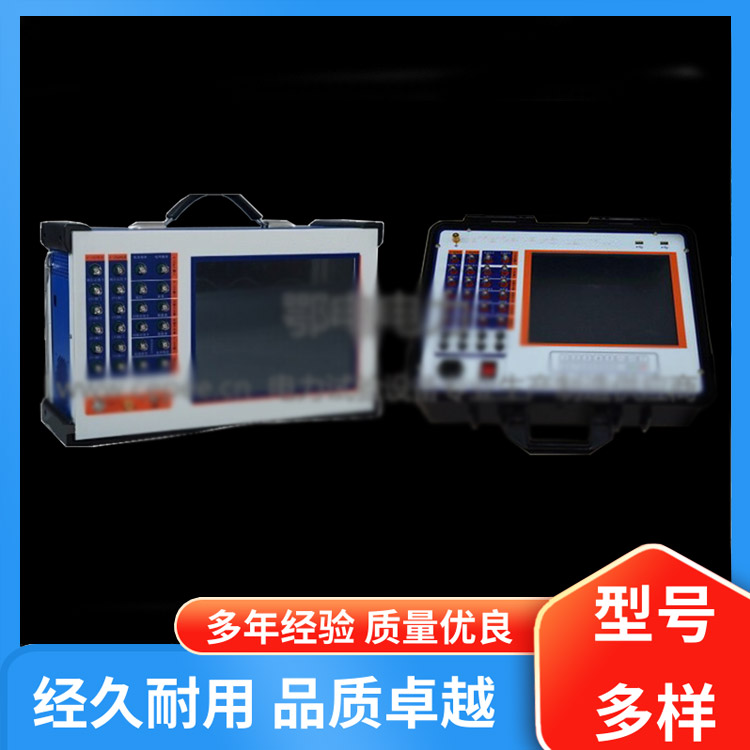
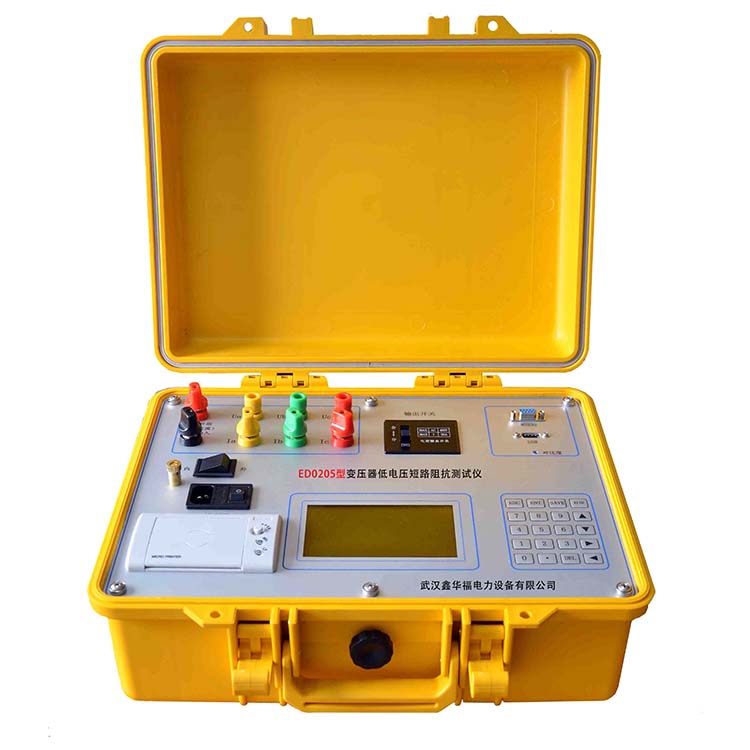
Our independently developed Transformer Short Circuit Impedance Tester is designed for low voltage short circuit impedance measurements on main transformers of 35KV and above, both in field and laboratory conditions. The instrument boasts a clever design and superior performance, utilizing a new single-chip microcomputer testing technology and digital signal processing for accurate measurement data. It features a 7-inch touch color LCD screen displaying Chinese operation menus, offering convenient touch operation. It is also equipped with a thermal printer and storage function, facilitating data printing and storage, with the ability to transfer required data to a computer via USB. The compact size of the instrument makes it easy to use and carry in the field. With the input parameters, the instrument can perform single and three-phase tests and automatically calculate the transformer impedance error percentage, providing a very intuitive test result. It is a fast testing instrument for determining whether there is winding deformation in transformers on-site.
Section II: Safety Measures
Always read this manual thoroughly before using the instrument, especially adhere to the warnings and precautions.
2. The instrument is suitable for both indoor and outdoor use, but should be kept away from rain, corrosive gases, and similar environments. The gauge should be protected from剧烈 vibrations to prevent any impact on the test data.
3. Maintenance, care, and adjustment of the equipment should be performed by professionals; unauthorized disassembly is prohibited.
4. Ensure that the selected menu items match the actual test items and wiring.
During the testing process, it is prohibited to dismantle the mobile test clips or interrupt the power supply lines.
III. Performance Features
The instrument utilizes a 220V AC low-voltage power supply, applying current to the single-phase and three-phase transformer windings (AB, BC, CA) via manual and automatic modes. In addition to measuring the percentage error between the transformer's short-circuit impedance and rated impedance, it also allows for the measurement of transformer impedance, reactance, resistance, and inductance values for easy data comparison. The test results are highly intuitive.
2. The instrument can perform single-phase testing as well as three-phase testing; it can be manually tested or automatically tested.
3. Single-wiring connection, automatically completes three-phase testing without the need to reverse the test wires.
4. Measurement of the tested item can be performed without the need for an external voltage regulator.
The instrument not only displays the percentage of impedance error, but also shows values such as applied voltage, applied current, measured power, short-circuit impedance, short-circuit reactance, coil inductance, and short-circuit impedance voltage.
6. Zero-sequence impedance is applicable to transformers with star-connected primary sides and neutral points, with the instrument capable of simultaneously measuring zero-sequence impedance, zero-sequence reactance, zero-sequence resistance, and zero-sequence inductance.
The instrument can be powered by either internal or external power sources.
The instrument features a 7-inch color touch LCD screen with Chinese operating menus, offering more convenient touch operation. It is also equipped with a mini printer for real-time data printing.
9. Equipped with an RS232 interface, test data can be transmitted to the backend.
The unit can store 100 test records, with data storage indexed by the test save time.
11. Equipped with a USB interface, test data can be saved to a USB flash drive.
The instrument features an in-built clock function, which can be self-calibrated.


www.114global.com © Zhongshang 114 Hebei Network Technology Co., Ltd.Address: Room 6009, Oriental New World Center, No.118 East Zhongshan Road, Qiaoxi District, Shijiazhuang City, Hebei ProvincePlatform Service Hotline: 4006299930