
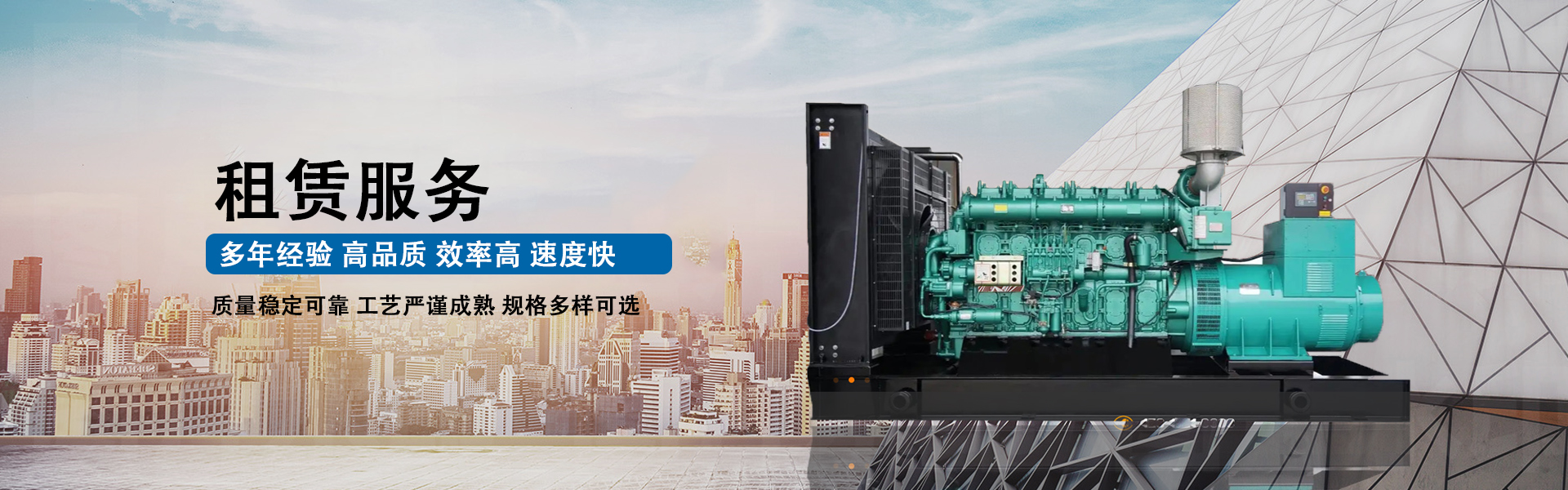

Generators are widely used in the production of industrial and agricultural enterprises, as well as in the daily learning and life of technology companies. There are various types of generators, all operating on the principles of electromagnetic induction and force. Consequently, the general structural principle is that appropriate magnetic and electrical materials can be used to form a magnetic circuit and a circuit that interact to study electromagnetic induction. This enables the development of electromagnetic power, achieving the goal of enhancing energy conversion.
What is the main structure of a rented generator?
Generators typically consist of stators, rotors, end caps, and bearings.
The stator is composed of key components, including the stator core, insulated winding, brackets, and other fixed assets, all jointly contributed by the research framework members.
The rotor is composed of components such as the rotor core winding (or pole, magnetic resistance), protective ring, central ring, slip ring, fan, shaft, etc.
Through the assembly of bearings and end caps, the stator and rotor of the generator are connected, the rotor rotates within the stator and cuts magnetic lines, generating induced electromotive force, which is then induced through the terminal and produces current after passing through the relay circuit.
What are the classifications of rental generators?
Generators are categorized into the following types:
Generator Types: DC Generators and Alternating Current Generators
Communication and Generator Minutes: Synchronous generators and asynchronous generators (rarely usable)
Alternators can also be categorized into single-phase and three-phase generators.
Generators come in many varieties. Principally, they are categorized as synchronous, asynchronous, single-phase, and three-phase generators. In terms of generation methods, they include steam turbine generators, hydroelectric generators, diesel-powered generators, gasoline car generators, and more. They are also classified by energy source, such as thermal generators and hydraulic generators.
Invention History
In 1832, the city of Cremieux, France, invented the manual direct current generator, which altered magnetic flux by rotating a permanent magnet, thereby generating induced electromotive force on the coil and outputting direct current voltage.
In 1866, Germany adopted the direct current generator invented by Siemens, marking the introduction of the enterprise incentive system.
In 1870, Graham of Belgium invented the circular armature, leading to the creation of the circular armature generator. This generator rotated a generator rotor using hydraulic power. After continuous research and improvements, by 1875, it achieved an output signal power of 3.2 kilowatts.
In 1882, Gordon in the United States produced a massive generator with a power output of 447 kilowatts, standing 3 meters tall, and weighing 22 tons.
In 1896, Tesla's two-phase AC generator began operating at the Niagara Power Plant, transmitting 3,750 kilowatts and 5,000 volts of alternating current to Buffalo, 40 kilometers away.
Diesel Generator
The diesel engine powers the car's generator, converting diesel energy into electrical energy.
Inside the diesel engine cylinder, clean air filtered through an air filter is thoroughly mixed with high-pressure atomized diesel fuel. Under the compression of the piston, the volume decreases and the temperature rapidly rises to the ignition point of the diesel. The diesel is ignited, causing a剧烈 gas combustion, allowing the volume to rapidly expand and push the piston downward, which is referred to as "work" in China.
