
Prior to construction, the quality-compliant fill material should be manually mixed uniformly and transported to the bottom of the pit, where it should be loosely spread to a thickness of 40cm. Before applying static pressure, water should be applied to keep the fill material moist (with a moisture content of 8-12% being sufficient). Subsequently, use a vibratory roller to apply static pressure twice, followed by 8 passes of vibration compaction. During compaction, start by traveling along the lengthwise direction, and then supplement pressure on the shorter sides that were not initially compacted, ensuring that the cobblestone fill material receives uniform compaction to the specified number of passes.
The base surface of the underlayer should be laid at the same elevation. If the depths differ, the subsoil should be excavated into steps or sloping overlaps, and construction should be carried out in the order of deeper to shallower, with the overlaps compacted densely. During segmented construction, the junction should be sloped, with each layer offset by 0.5 to 1.0 meters, and should be compacted. When constructing a cobblestone underlayer on the land, to prevent localized damage to the soft soil surface at the foundation pit bottom, a layer of sand (0.3 meters) should be laid at the bottom and sides of the pit before laying the cobblestone underlayer.
No organic debris such as grass roots or garbage is allowed in the gravel filling.
When constructing below the groundwater level that is higher than the bottom of the foundation pit (trench), measures should be taken for drainage or lowering the groundwater level to maintain the pit (trench) without any standing water (such as during construction using water-vibration or vibration insertion methods, controlled watering or drainage should be applied).
Prior to laying the subgrade, the foundation trench should be inspected first. Pay attention to removing any loose soil, and ensure the slope is stable to prevent soil collapse. If any cavities, ditches, wells, or other depressions below the foundation are found near the sides of the foundation trench (pit), they must be addressed.
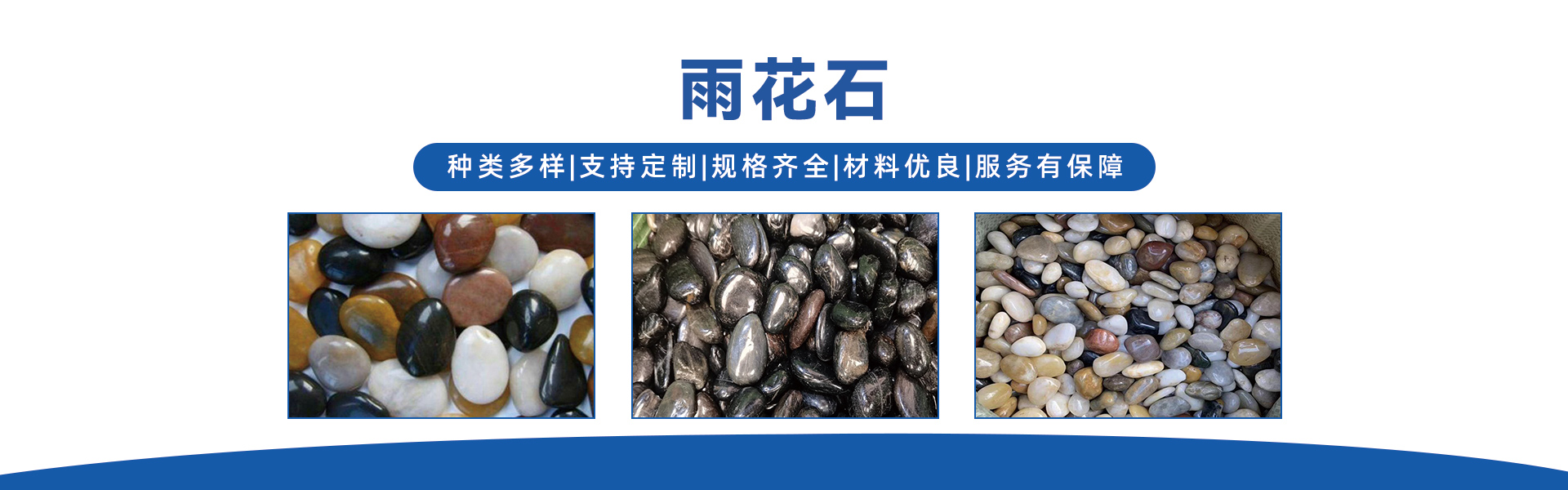
Jinrui Yu Hua Stone introduces the standardized method for cobblestone paving.
1. Cement and sand are mixed in a specific ratio, with a small amount of water, and when held in hand, they do not spread to the assembled material, commonly known as dry-mixed mortar.
2. Spread the dry mortar evenly, followed by a level, real-time shot of the wooden surface after filming. The pebbles should be laid out uniformly, with the requirement that the pebbles be embedded into the mortar by 1/3 before using a small board to flatten them.
3. A uniform layer of cement powder is sprinkled onto the flattened cobblestones, followed by spraying water until all the cement powder on the cobblestones is thoroughly cleaned. The cobblestone pavement, cleaned and maintained in a dense and tidy manner as per the above method, will not come off. This is because the excess water from the cement powder sprinkled on the cobblestones washes away, leaving the stones' pores empty, allowing for the formation of a cement slurry that flows smoothly upon curing. Not only does it provide stability to the cobblestones, but it also makes cleaning easier and more efficient.