

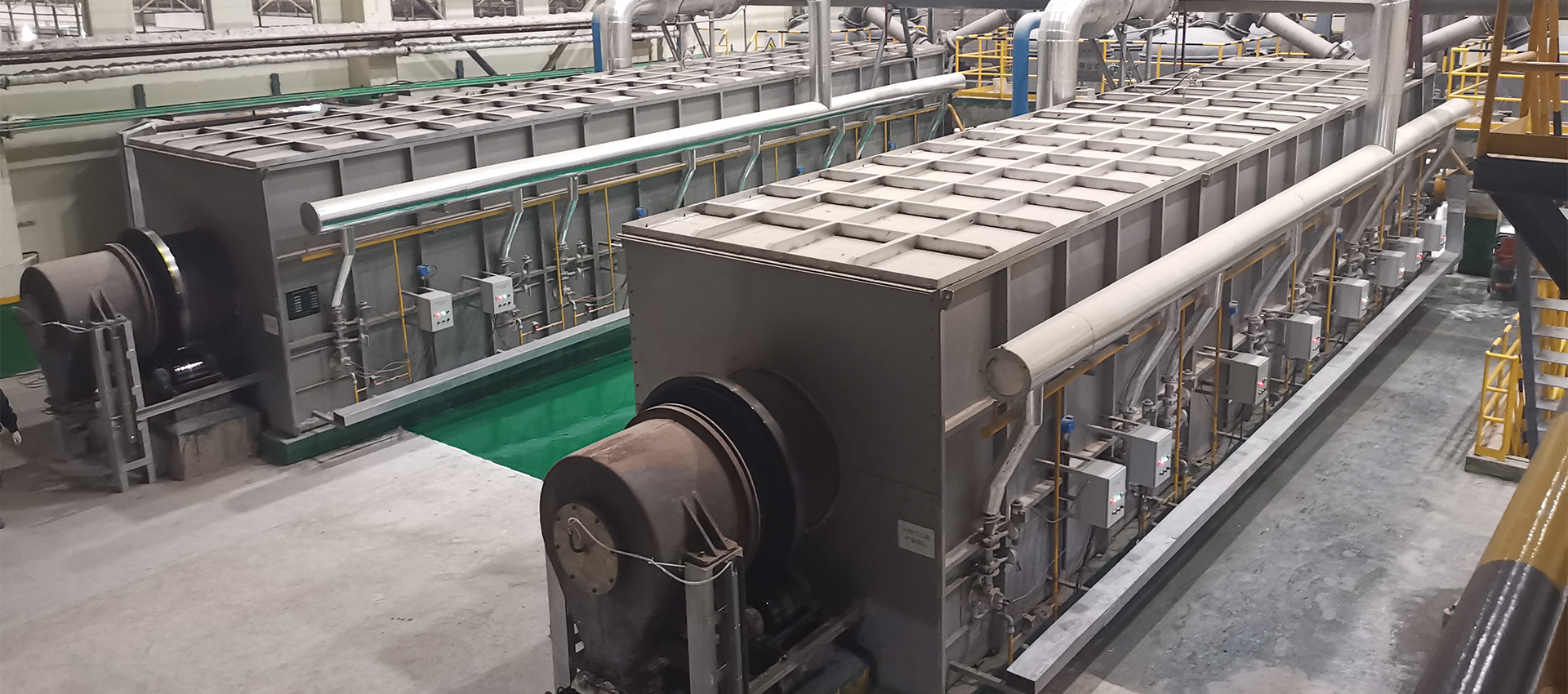
The custom nitriding furnace features low processing temperatures, short times, and minimal workpiece deformation. It boasts high fatigue limits and excellent wear resistance. Nitriding process: Ammonia gas is introduced into a vacuum-sealed stainless steel container within the custom nitriding furnace, heated to 520°C, and maintained for an appropriate duration, ranging from 3 to 90 hours depending on the workpiece material and desired nitriding layer, to achieve a nitrogen-rich strengthening layer on the surface of the nitrided workpiece, resulting in high hardness, high wear resistance, high fatigue limits, and good wear resistance.
Principle of Operation for Nitriding Furnace
Non-standard nitriding treatment utilizes ammonia to decompose into active nitrogen atoms at certain temperatures (500-600℃), which then penetrate and diffuse into the surface layer of steel, forming iron-nitrogen alloys. This process alters the mechanical properties (such as enhancing wear resistance, increasing hardness, and improving corrosion resistance) and physical and chemical properties of the steel workpiece.
Non-standard Nitriding Furnace Applications
The non-standard nitriding furnace is primarily used for the heat treatment of various steel mechanical parts, automotive cylinder heads, gears, motorcycle brake pads, molds, and more through gas nitriding. In the non-ferrous industry, it can be applied to copper tubes, copper plates, copper wires, copper bars, and other copper materials for bright, oxidation-free annealing under protective atmosphere. Alternatively, it can be used for thin-walled seamless steel tubes, long shafts, and various metal components in vacuum nitrogen protection for oxidation-free tempering heat treatment.
Non-standard Nitriding Furnace Maintenance and Care
Operators must undergo training and be familiar with the various alarm signals and operational processes of the equipment. They must pass the assessment before they can operate the non-standard nitriding furnace.
2) Parts must be arranged according to the illustration, with the rings positioned to the specified dimensions as shown. The arrangement should be flat and no tilting is permitted.
3) Ensure the trolley position is correctly aligned before entering the furnace; only then can the loading procedure be initiated.
During the loading and unloading process, no personnel are allowed to stand or move near the furnace door. Operators must be on-site for monitoring.
5) After loading and unloading, operators must conduct further confirmation. Upon loading, they must verify if the main furnace has cooled down. Upon unloading, they should confirm the sound of the sliding chain, as well as the smoke and oil temperature during quenching, to ensure the effectiveness of the operation.
6) Operators must inspect the equipment every 45 minutes, meticulously record and adjust the gas flow to ensure the effectiveness of the process.
7) Operators should check daily that the three-phase currents are balanced, that the three temperature gauges are consistent, and that the cooling water for the equipment is flowing properly. Any anomalies should be reported immediately and the product isolated.
Non-standard Nitriding Furnace Precautions
1. Pre-ignition Checkpoints for Non-standard Nitriding Furnaces:
1. The furnace cooling water circulation must be activated (the valve is open when horizontal, closed when vertical).
2. The vacuum pump butterfly valve must be in the closed position.
3. Ammonia and CO2 cylinders must be kept in the closed position.
4. The anode quick connector should be connected to the furnace body (the green wire connector attached to the water cooling tube).
5. On the black pulse control panel, turn the "Voltage" and "Duty Cycle" knobs to the left to their minimum values.
6. The yellow ammonia gas directional valve handle is in the middle (up) position.