



 通过中商114认证

With the emergence of various issues derived from manual processes, such as high yield requirements, significant production speed increases, and the inability to achieve precision, products that are indispensable for industries with high levels of automation in the future are even more crucial.

Currently, the application of the alignment platform is primarily in industries with high-speed and high-precision requirements, such as wafer cutting and packaging inspection in the semiconductor industry, as well as exposure machines, screen printers, laminators, and press machines in PCB manufacturing. It also extends to mobile phone manufacturing, LCD/LED panel manufacturing, and solar panel silver wire printing in the solar industry. These industries are just the pioneers of alignment platform users. With the growing trend of increasing automation, more industries will adopt this "CPU of automation equipment" known as the alignment platform in the future.
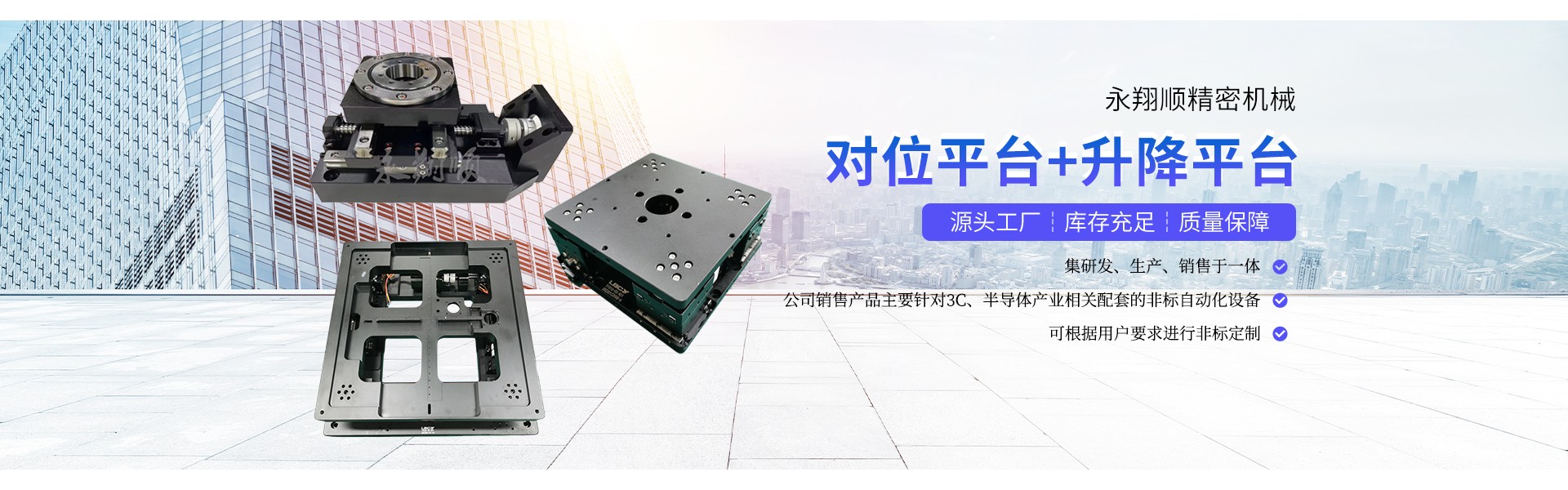
A positional platform is a mechanism that combines two working objects by utilizing moving units in the XY direction, coupled with minute turning at a θ angle.
Its methods include
XYθ Alignment Platform: This is a platform consisting of a set of X and Y-oriented modules stacked together, with a rotating mechanism installed on top, forming an XYθ alignment platform, which generally has lower precision.
2. The UVW Alignment Platform: Consists of two X electric modules and one Y-directional electric module stacked together, with an electric rotating mechanism placed on top, forming a UVW alignment platform with higher precision than the former.
3. XXY Positioning Platform: Consists of two X-axis electric modules, one Y-axis electric module, and one free-axis module.XXY Positioning PlatformHe can utilize the rotary disc installed within the axis module to produce a minute rotation at a θ angle while the XXY axis is moving, with high precision.
The XXYY Alignment Platform: As the name implies, it consists of two electric modules along the X-axis and two electric modules along the Y-axis, forming the XXYY alignment platform. It boasts high precision, alignment speed, and rigidity compared to previous products, with a higher manufacturing difficulty as well.
The Positioning Platform originates from Germany, utilizing a method that employs pin needles to activate magnetic switches on the fRame allows stationary glass to be combined with the lower frame. In Japan, it was renamed the UVW platform, named after the three electrical axes. Engineers then scaled it down significantly, reducing its height, and created the now commonly seen XXY alignment platform. The original magnetic switch evolved into a single module assembly with guides or cross guides, and into a high-precision alignment platform powered by three-axis or even four-axis motors.
