



In industrial and agricultural production, as well as in daily life applications, it is often necessary to automate the control of liquid levels (water levels) within containers. This includes automatic control of water storage in tanks, pools, basins, boilers, and other containers, such as the automatic refilling control of toilets, automatic electric water heaters, and automatic water supply control for electric kettles. Although the technical requirements and precision of various liquid level control technologies differ, the basic control principles can all be summarized as general feedback control methods. The main differences lie in the methods of liquid level detection, the form of feedback, and the differences in the controllers.
1. Mechanical and electrical control water level regulation
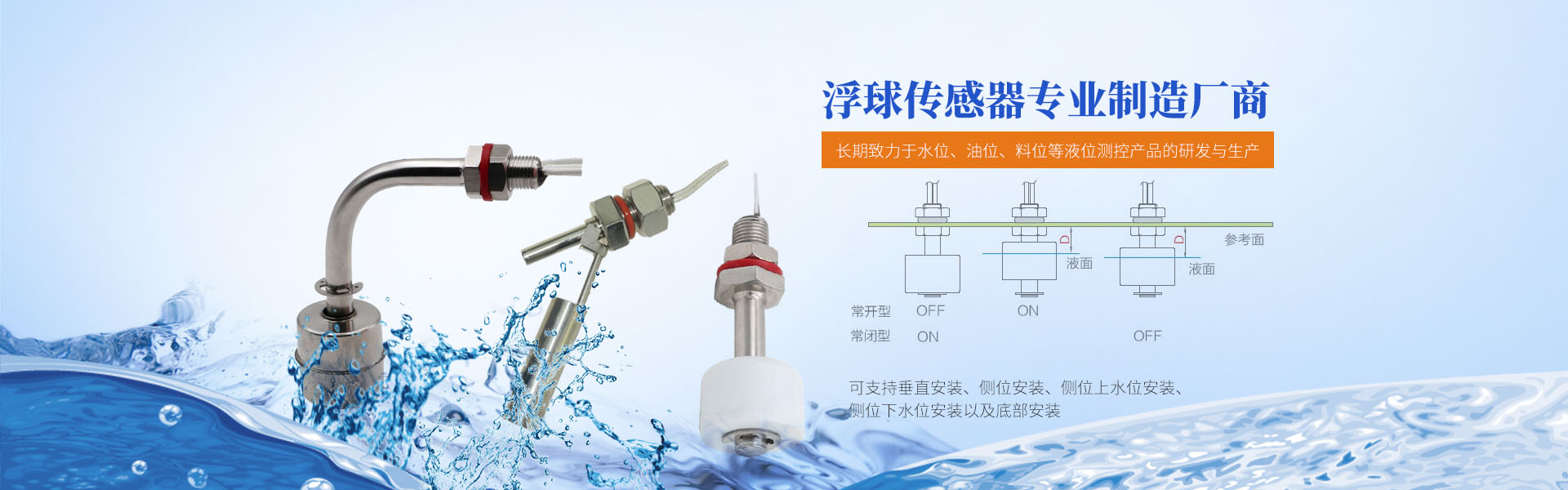
The buoyant ball floating on the water surface is connected to the "sensing mechanism" within the controller via a linkage mechanism. As the water level changes, the ball's up and down movement drives the "sensing mechanism" to displace, which can directly drive the valve to close or open the inlet and regulate the water level. If the water valve to be controlled is large and the buoyant force of the ball is insufficient to drive the control of the water valve, an electro-mechanical control driving device can be added between the "sensing mechanism" and "valve control." The specific control process is as follows: ① The displacement of the "sensing mechanism" first drives a displacement switch to activate; ② The displacement switch controls the rotation of the motor; ③ The motor drives the water valve.
This control method is structurally complex, but it can regulate large water storage facilities, hence it is frequently applied in industrial and agricultural production.
2. All-mechanical water level control method
The home-use flushing toilet employs a typical all-mechanical structure for water level control. After the flushing operation by the user, the water in the storage tank is drained, causing the float ball to drop. This signal is then transmitted to the incoming water valve through a linkage mechanism, causing the valve to open and replenish the storage tank. As the water level rises, the float ball gradually moves upwards until it reaches a pre-set water level, at which point it is able to close the incoming water valve, halting the water supply.
In this water level control system, the float ball equals the water level sensor (transducer), the linkage mechanism equals the controller, and the "setpoint" of the water level is set by the relative position of the inlet valve with the linkage mechanism.
3. Ancient Water Level Control
Planting rice on mountainous slopes differs from plains, requiring the construction of terraces that rise step by step along the hillsides.
This terraced structure serves at least two purposes: first, it maintains each field as a flat surface for ease of cultivation; second, irrigation water is introduced from the upper level and then gradually filled and distributed downwards in layers. Thus, when there is an ample water supply, as long as the drainage outlet heights on each tier are properly adjusted, the water levels in each field can be kept moderate. The water level control employs an automatic open-loop control method.
If the water source is insufficient, water levels must be maintained moderately through manual control with minimal water usage. The process of water regulation is as follows: due to varying daily evaporation rates and the differing water consumption of rice growth (interfering factors), the farmer observes (detects) the bottom outlet water volume, judges the overall water supply status of terraced fields (feedback, comparison, control), and adjusts the top inlet water volume to achieve regulation. At this point, it becomes a closed-loop manual water level control system.
4. Simpler Automatic Water Level Control Device
In factory-style poultry farming, due to the limited space for raising the birds, the density is high, and water troughs cannot be excessively large; otherwise, they will be trampled upon by the poultry, leading to contamination of the water supply. However, it is necessary to maintain an adequate water supply with continuous automatic replenishment of fresh water. The solution to this contradiction is to implement an automatic water level control system, ensuring that there is always water in the small and shallow troughs with the water level remaining consistent.
Due to the lower air pressure in the sealed space above the water storage barrel compared to the external atmospheric pressure, the water level in the barrel can remain higher than that in the trough. When the water in the trough is consumed, external air enters the sealed area above the barrel through the opening at the bottom of the barrel, reducing the pressure in the sealed area. This causes the water level in the barrel to drop, replenishing the water in the trough until the water level in the trough is higher than the opening at the bottom of the barrel.
This water level control system is reliable and straightforward; does it not seem to require the detection devices and feedback mechanisms previously mentioned?
In fact, the system ingeniously uses the change in air pressure as a "detection signal," with the edge height at the bottom of the water storage tank serving as the "setpoint" for water level; the air inside the sealed area above the tank is the "feedback signal." Through the air's feedback, the system achieves control over the water level, a very clever design.
5. Insight:
The various common water level control methods provided above have shown that in certain special application scenarios, simpler structures actually embody ingeniously clever design ideas. They are not only cost-effective but also highly reliable.

