
Research, manufacturing, sales, and installation of gener...

Low-quality ironing can lead to customer dissatisfaction, but it also reflects the low efficiency of laundry pressing and issues that can be addressed by production managers or laundry engineers. While suppliers guarantee high-quality ironing when selling irons, many laundries can only achieve 60-70% of the guaranteed effect in practice. Experts have provided detailed explanations and solutions for common ironing issues to improve both quality and speed.
Misalignment causes tablecloths and bedsheet covers to deform.
Customers prefer square or rectangular bed sheets and tablecloths over diamond shapes. To achieve a regular shape after ironing, the front end of the linens must be straight and aligned with the direction of movement when feeding the fabric into the ironer. If an automatic fabric feeder is used, this can be achieved by accurately setting the feeder, which is easily done in most laundry facilities.
However, if the fabric is delivered manually, operators who lack adequate training often misalign the fabric. Therefore, it is crucial to train staff to ensure that the fabric is properly aligned every time it is delivered.
In addition to aligning the linens properly, attention should be given to the coverage of the linens and the speed of the ironer. If the ironer's speed exceeds the operator's feeding speed, it's time for an adjustment. If the ironer speed is 40 meters per minute and the linen coverage (referring to the surface of the ironer that the linen covers) is only 40%, then the ironer speed should be halved. This will enable the coverage to reach 90%, thereby also ensuring productivity and quality.
Operators should continuously monitor the fabric coverage area. If the fabric feeding speed cannot keep up with the ironing machine, adjust the ironing machine speed to maintain a small gap between the fabrics and keep it consistent. This will facilitate better fabric feeding, prevent errors, and ultimately increase the ironing speed.
Prevent wine glass-like creases
Typically, a series of small semi-circular creases found on items like bed sheets and tablecloths are also referred to as "cupple" creases. The presence of such creases not only detracts from the aesthetic appeal of the fabric but also indicates poor roller fitting on the ironing machine.
This "cup-shaped" crease is typically caused by oversized roller dimensions. Oversized rollers are inherently difficult to fit with the烫slot, and as the fabric thickness increases between the roller slots, the fit becomes even more challenging.
The slot-type iron should be equipped with a set of felt belt (or fixed belt), each belt being made of metal and featuring two grooves. The appropriate belt fits snugly around the roller. If the belt size matches the roller diameter, the distance between the two grooves after wrapping should be 1*2 millimeters. Some irons have rollers of the same size, requiring only one type of belt. Others have rollers with varying diameters, necessitating different size belts for each. Some belts are exactly the same size as the roller diameter, so when wrapped around the roller, the ends of the belt align perfectly.
Many roller sizes are slightly larger when initially covered with felt, but after placing them in the felt槽 and trimming the overlapping felt, the roller dimensions need to be exactly as required. Modern felt-laminating technology is evolving towards using two layers of thicker and stronger materials. This technique improves the porosity of the felt, thereby enhancing drying speed.
Proper roller dimensions prevent wine glass-like creases. The fabric edges also fit more easily into the flattener's insertion slot, resulting in a better and consistent ironing effect.
Textiles are gradually deforming.
Blended fabrics have once again become a common choice in the linen rental industry, yet they tend to deform easily.
Large commercial laundries often use 10 kg of steam pressure to achieve good ironing effects. However, the temperature of 10 kg of saturated steam reaches 184°C, exceeding the softening temperature of some polyester fibers. Although stretching and ironing with a multi-roll ironing machine can produce better ironing results and is less prone to wrinkles, when the temperature of the ironing roller exceeds 180°C, the polyester in the ironing machine will soften and elongate when stretched and ironed.
The consequence is that with each ironing, the linens are stretched slightly in one direction, and these minute changes may go unnoticed for one, two, or even half a year. It's only when customers complain about "sheets not matching the bedding" or "the comforter peeking out of the case" that such issues are discovered.
Comparing deformed linens to new ones, the shrinkage area only accounts for 5-6% of the total linen area, which is relatively normal and within the acceptable range of market regulations. However, even so, the shape of the linens after several washes and ironings still looks quite different. (When flat sheets and duvet covers are ironed, they are usually placed horizontally. After the linens are stretched out, the length naturally becomes shorter and narrower, leading to the "shrinkage" phenomenon.)
If linen ironing is done by the conventional method, that is, with the long edge in front (laid horizontally), the linen may become 12% shorter and 15% wider than its original size.
To address such issues, when ordering linens, consider both the ironing process and the dimensions. This ensures that even after being stretched by the ironing machine, the linens maintain their original size.
The tablecloth develops diamond-shaped creases after being folded.
Hotel managers are increasingly stringent in their demands for the cleaning quality and finishing effects of tablecloths. Managers may specify that tablecloths are不合格 if they exhibit diamond pleats at the folded intersections when unfolded after being folded.
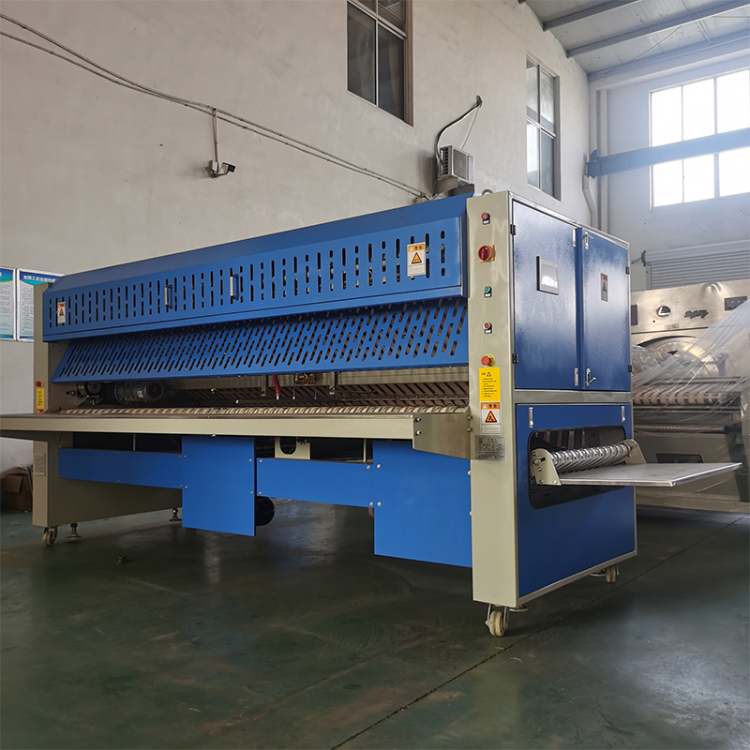
This error can sometimes be resolved by reducing the pleat folds, but this method is not suitable for larger or longer tablecloths. In most cases, to address such issues, one should observe the folding machine, adjust the pleating blade position, which allows the machine to better control the folding process, thereby eliminating or reducing diamond pleats to an acceptable level.
Additionally, be mindful that the humidity of the linens is also crucial. Linens that still feel slightly damp during folding are more prone to creasing when unfolded after folding, compared to those that are completely dry.
Excellent sizing can also make linens more resistant to wrinkles. Adequate sizing time, with quality sizing and appropriate temperatures, ensures a tightly woven and durable fabric. Some commercial laundries take this into account and specifically instruct the sizing process to be set for two chambers when purchasing a washing tunnel.


www.114global.com © Zhongshang 114 Hebei Network Technology Co., Ltd.Address: Room 6009, Oriental New World Center, No.118 East Zhongshan Road, Qiaoxi District, Shijiazhuang City, Hebei ProvincePlatform Service Hotline: 4006299930