

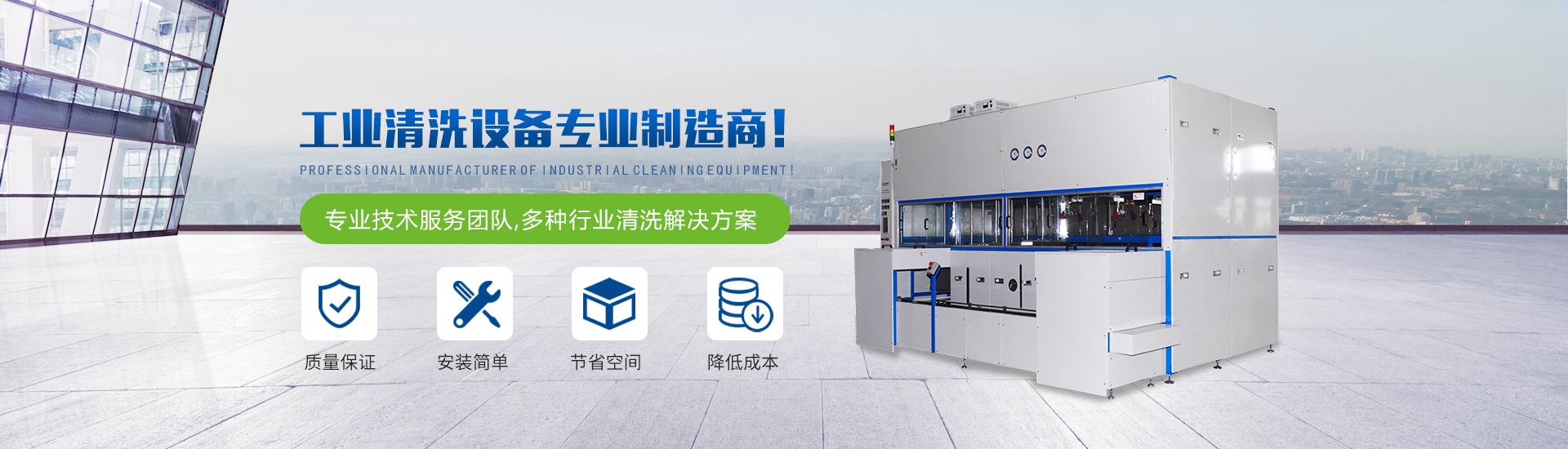

The fully automatic ultrasonic cleaner utilizes a transducer and ultrasonic frequency source to convert sound energy into kinetic energy. This enables the cleaning liquid in the cleaning tank to produce ultrasonic vibrations, thereby generating microbubbles. These microbubbles, through their impact and vibration, break and peel off the dirt on the surface of the item to be cleaned. The dirt on the item's surface is then dissolved gradually as it is enhanced by the accelerated stirring and diffusion, reinforcing the effect of the chemical cleaning agent.
The fully automatic ultrasonic cleaner is suitable for any area where liquid immersion and sound fields reach, particularly ideal for cleaning parts with extremely complex external shapes. Not only can the fully automatic ultrasonic cleaner reduce the usage of chemical cleaning agents and minimize environmental pollution, but it also operates through mechanical automation. The fully automatic ultrasonic cleaner consists of two parts: the cleaning tank and the ultrasonic generator. The ultrasonic cleaning tank is made of durable and corrosion-resistant stainless steel. The ultrasonic generator is connected to the transducer at the bottom of the cleaning tank, emitting ultrasonic waves that cause the cleaning agent to vibrate at high frequencies, thoroughly cleaning the item.
During the process, the fully automatic ultrasonic cleaner employs internal ultrasonic waves that undergo more than 20,000 compressions and decompressions per second, creating a liquid vacuum core bubble through this internal penetration. These vacuum core bubbles, under pressure, will冲击 and strip away dirt from the surface of the medium, achieving precise cleaning.
The ultrasonic waves of the fully automatic ultrasonic cleaner flow in the cleaning liquid according to the direction of sound. Under the action of this straight flow, the dirt and cleaning liquid are mixed, and their combination accelerates the dissolution of the dirt, allowing the debris to be removed.
The acceleration process of an automatic ultrasonic cleaning machine is driven by the liquid particles generated by the equipment. Generally, the cavitation process of high-frequency automatic ultrasonic cleaning machines is not very pronounced, at which point it relies on the acceleration process to impact dirt particles and achieve ultra-precision cleaning.
