
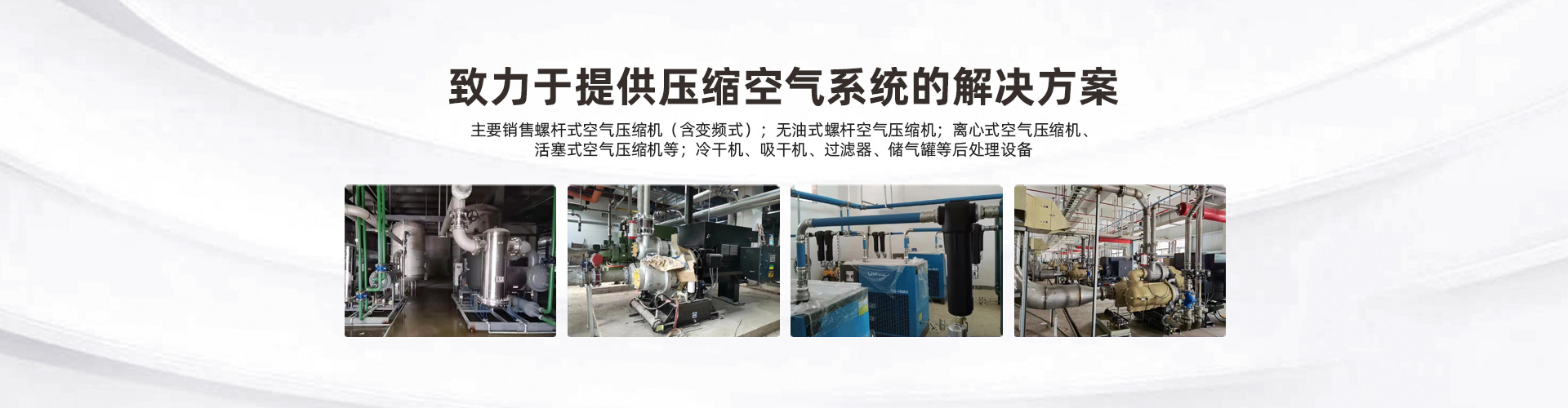
An centrifugal air compressor is a mechanical device for conveying gases, composed of a rotor, stator, bearings, etc. The rotor is made up of the main shaft, impeller, coupling, and sometimes also includes sleeve and balancing disk. The stator is composed of the casing, inter-stage seal and shaft-end seal, inlet chamber, and volute, among others.
Centrifugal compressors are a type of turbine compressor, differing greatly in working principle from piston compressors. They are a rotary-type blade mechanical device.
The operation process of the centrifugal air compressor:
As the motor drives the air compressor's rotor through a speed increaser, air is drawn into the air compressor after passing through a filter to remove mechanical impurities. The air is then compressed within the impeller and diffuser. Due to the increase in temperature after compression, this raises the power consumption of the air compressor, necessitating cooling through an intermediate cooler before returning to the compressor for further compression.
After the final compression, the air is sent to the air separation unit once the required pressure is achieved. The air compressor is supplied with lubricating oil by a dedicated oil station.
Centrifugal compressors are a type of rotary air compressor in which the high-speed rotating impeller applies centrifugal force to the gas, as well as expansion force in the expansion channel, thereby increasing the gas pressure. Initially, due to their suitability only for low to medium pressure and high flow conditions, they were not widely noticed. With the development of the chemical industry and the establishment of various large-scale chemical plants and refineries, centrifugal compressors have become crucial machinery for compressing and conveying a variety of gases in chemical production.
As advancements in gas dynamics research have continuously improved the efficiency of centrifugal compressors, coupled with the development of high-pressure seals, machining of small flow narrow impellers, and the successful creation of multi-oil wedge bearings, a series of issues facing the expansion of centrifugal compressors to higher pressures and wider flow ranges have been resolved. This has greatly expanded the application scope of centrifugal air compressors, enabling them to replace reciprocating compressors in many applications and significantly broaden their usage.
Industrial centrifugal compressors for industrial use have pressures ranging from (150~350)×10^5 Pa, while those used for offshore oil field gas injection can reach up to 700×10^5 Pa. Centrifugal blowers for blast furnace use have flow rates as high as 7000 m3/min, with power ratings up to 52900 kW, and their rotational speeds are generally above 10000 rpm.
Some basic chemical raw materials, such as propylene, ethylene, butadiene, and benzene, can be processed into important chemical products like plastics, fibers, and rubbers.
In petrochemical plants producing this basic raw material, centrifugal compressors play a crucial role and are among the key equipment.
In addition, centrifugal compressors are also critical equipment in industries such as oil refining and refrigeration.
What is the working principle of a turbo compressor? It is directly driven by an electric motor, causing the crankshaft to rotate, which in turn moves the connecting rod to make the piston reciprocate, leading to a change in the cylinder volume.
Due to the pressure changes within the cylinder, air is channeled through the intake valve, passing through the air filter (muffler) into the cylinder. During the compression stroke, as the cylinder volume decreases, the compressed air is forced through the exhaust valve and into the exhaust pipe, then through a one-way valve (check valve) into the air storage tank. The engine automatically shuts down when the exhaust pressure reaches the rated pressure of 0.7 MPa, controlled by a pressure switch.