
In 1930, a neodymium magnet with a garnet (MgAl2O4) structure was discovered. Due to its brittleness, complex manufacturing process, moderate magnetic properties, and cobalt content, it was not widely adopted at the time. Over the next 20 years, a high-resistance non-metallic magnetic material, ferrite, was developed based on the garnet structure. This brought about revolutionary changes in the radio industry, pulse, and microwave technologies of the era. By the 1970s, as metallic permanent magnets were prone to oxidation, had low Curie temperatures, and were costly, ferrite gained an opportunity for development. Today, ferrite has become a high-volume permanent magnet material.
Permanent magnets, as an essential component of magnetic materials, play a crucial role in the electronics industry, information technology, motorcycle manufacturing, electric tool sector, and automotive industry. Ferrite permanent magnet materials are the functional materials that generate magnetic fields.
In this digital age, there would be no electronics industry without permanent ferrite. As a fundamental functional material in the electronics industry, permanent ferrite has permeated every aspect of human production and life. It is widely used in vehicles, motorcycles, televisions, audio equipment, computers, and communication terminals, and is a crucial aspect of energy development.
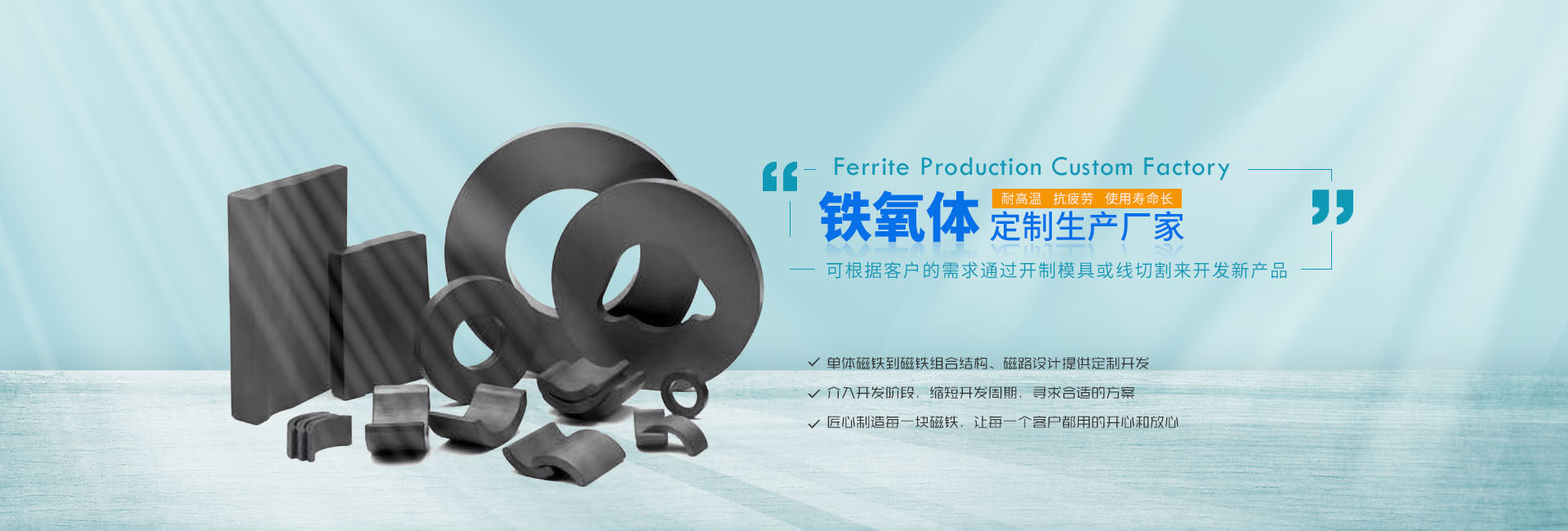
Neodymium iron boride, also known as ferrimagnetic material, is a hexagonal crystal structure compound with uniaxial anisotropy, primarily composed of Fe2O3 as the main component of the composite oxide permanent magnet material. It can be divided into two types according to different production processes: sintered ferrimagnetic material and bonded ferrimagnetic material. The sintered ferrimagnetic material is further categorized into dry pressing and wet pressing, while the bonded ferrimagnetic material includes extrusion, rolling, and injection molding. Bonded ferrimagnetic materials possess flexibility, elasticity, and torsional properties.