


(1) The primary construction materials are cement, glass, steel, and wood, all of which fall under the category of raw materials. New products made from these four main materials should be classified as new building materials, such as various new cement products, new glass products, and so on. These new products are also considered new building materials.
(2) Traditional bricks, tiles, lime, and sandstone were once the primary building materials in our country, but they no longer meet the needs of modern construction. Therefore, new varieties have continuously emerged, such as clay hollow bricks, various aerated concrete products, and various blocks. These new products are also considered as new building materials.
(3) Non-metallic inorganic new materials used in various building products are considered new building materials, such as various glass products, glass fiber products, etc.
(4) Various building products made from new raw materials, such as aluminum (Al) alloy windows and doors, various chemical building materials products, various thermal insulation and soundproofing material products, and various waterproof material products, all fall under the category of new building materials.
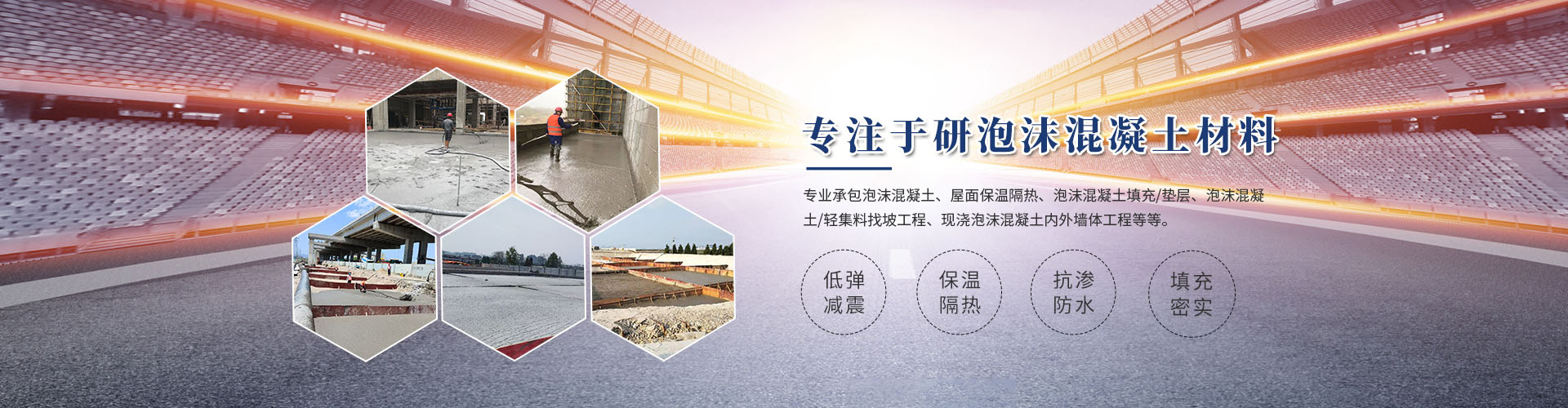
Foam concrete refers to a lightweight, cellular concrete produced by physically generating foam from a foaming agent and then incorporating it into a slurry made of cement, aggregates, admixtures, water, and sometimes admixtures. This slurry is then mixed, poured, and cured to form the foam concrete. The construction of a foam concrete energy-saving roof typically includes the structural layer, insulation layer, slope-finding layer, leveling layer, and waterproofing layer. The foam concrete roof system utilizes on-site casting techniques to replace the insulation, slope-finding, or leveling layers with foam concrete, streamlining the roofing process and forming a solid, integrated structure with the concrete roof. Clearly, foam concrete meets the criteria for both points, thereby solidifying its status as a new type of building material. Foam concrete is categorized into cast-in-place foam concrete (mixed and poured on-site) and foam concrete products (pre-fabricated foam concrete blocks or building components). These products are further divided into foam concrete blocks and foam concrete insulation boards.
Ready-mixed foam concrete is primarily used for backfilling and wall casting. In terms of backfilling, in China, there are mainly two aspects: compensation foundation and pipeline backfill.
Modern architectural design and construction increasingly emphasizes the free settlement of buildings during the construction process. Foam concrete is an important component of floatation, with minerals rising along with the foam. I. Foam Formation and Properties (1) Causes of Formation Foam is a coarse dispersion system with gas as the dispersed phase and solid or liquid as the dispersion medium. This section mainly discusses foam with aqueous solution as the dispersion medium. Due to the differences in the self-weight of various parts of a building complex, free settlement differences will occur during the construction process. During the building design process, it is required that the foundation of the building parts with lower self-weight be filled with soft materials to compensate for the foundation. Lightweight concrete can meet the requirements of compensation foundation materials well. For example, in the foundation of a section of the Beijing Tuanjiehu Building, in-situ concrete was poured with a thickness of 150mm.
The lightweight concrete with a compressive strength of 0.10±0.02 Mpa and a density under 200 kg/m3 has achieved excellent results. According to on-site tests, this low-density foam concrete maintains its strength well within the designed range and exhibits good compressibility. As for pipeline backfilling, it's common knowledge that abandoned underground oil tanks, pipelines (filled with crude oil and chemicals), sewage pipes, and other voids are prone to fires or collapses. Using foam concrete for backfilling addresses these issues at a reduced cost.
Lightweight concrete offers several advantages: Firstly, it is produced without pollution. The production of foam concrete equipment utilizes electricity, not coal or other environmentally harmful energy sources.
Secondly, the production utilizes industrial waste. The main raw materials for this equipment's production, such as fly ash and tailings sand, are primarily industrial waste products, setting an example of waste recycling and utilization.
Third, the lightweight, insulating, and heat-resistant characteristics of foam concrete greatly contribute to the green and low-carbon (Low carbon) orientation of buildings. The closed pore structure within foam concrete boasts excellent insulation properties, enhancing the building's low-carbon and environmentally friendly performance.
Foam concrete, used as an external wall insulation material (for industrial and architectural applications), features a foam-porous structure internally. Its dry density ranges from 120 to 300 kg/m3, with a thermal conductivity of 0.045-0.057 W/(m K), offering excellent insulation and energy-saving effects. The construction of foam concrete is completed on-site with a complete set of equipment, which includes systems for feeding, mixing, and the main unit. During construction, materials are fed, mixed, foamed, and then directly pumped through high-pressure hoses to the construction surface via an integrated pumping system. Its inorganic properties make it the top choice domestically; it can achieve over 65% energy saving without the need for additional insulating materials or air layers, becoming a new type of energy-saving building material.
