
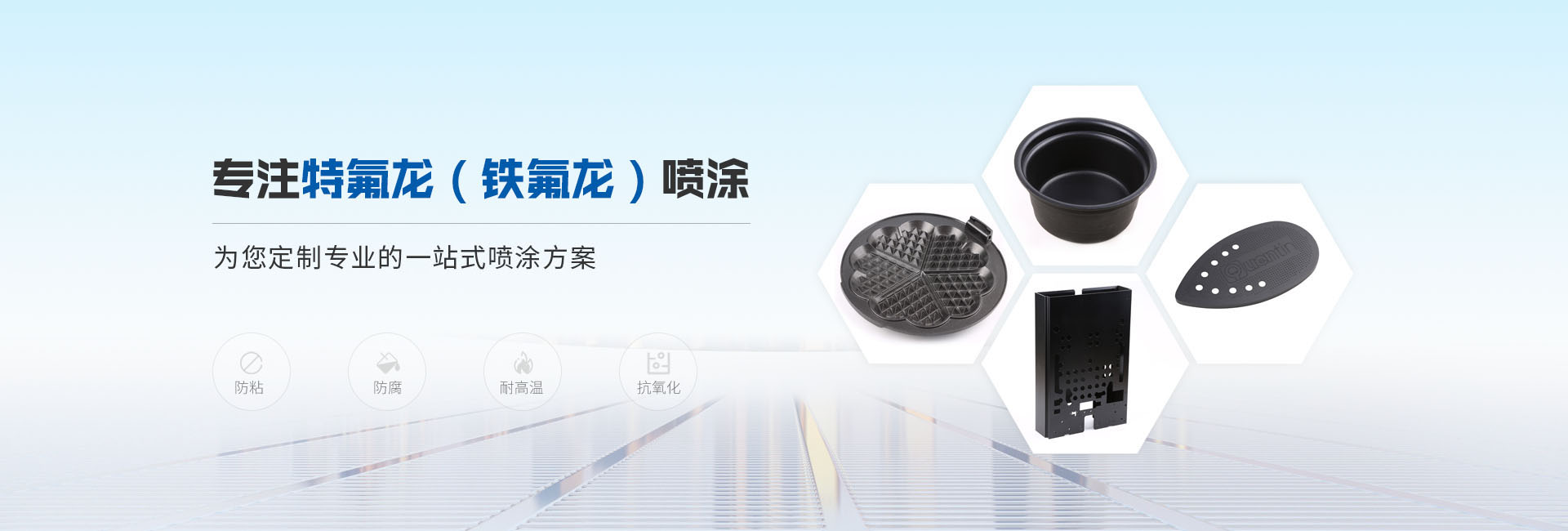


TEFLO coating, also known as Teflon coating, can be applied to various metal materials such as carbon steel, stainless steel, aluminum, copper, magnesium, and various alloys, as well as non-metallic materials like glass, glass fiber, and certain rubbers and plastics. The applications of Teflon coating typically combine its superior properties, including:
Teflon-coated surfaces have a low surface tension, thus demonstrating excellent non-stick properties. Very little solid material can adhere to the coating. While there may be some adhesion of gel-like substances to the surface, the majority of materials can be easily cleaned off.
Teflon coatings exhibit a low coefficient of friction on all solid materials, with a range of approximately 0.05 to 0.2, depending on surface pressure, sliding speed, and the type of coating applied.
Three, the fluorinated polyethylene coating surface has strong hydrophobic and oleophobic properties, making cleaning easier and more thorough. In fact, in many cases, the coating exhibits self-cleaning characteristics.
Four: Teflon boasts high insulation strength, very low dielectric constant, and high surface resistance over a broad frequency range. Through special formulations or industrial treatments, it can even possess some conductivity, making it suitable for use as antistatic coatings.
The coating exhibits strong resistance to high temperatures and fire due to Teflon's high melting point and auto-ignition temperature, as well as its low thermal conductivity. The working temperature of Teflon coating can reach up to 290°C, and intermittent working temperatures can even go as high as 315°C.
Typically, Teflon coatings are unaffected by chemical environments. The only chemicals known to affect Teflon are molten alkali metals and fluorine at high temperatures. Many Teflon industrial coatings can withstand extreme cold down to -270°C/-454°F without losing mechanical properties.