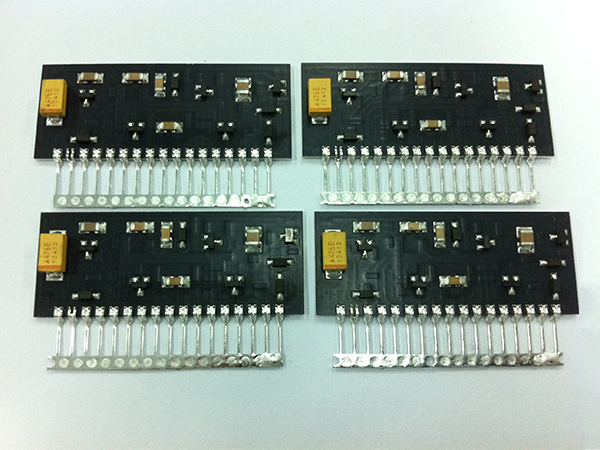


Thick Film Integrated Circuits refer to passive networks consisting of resistors, capacitors, and connecting lines, formed on ceramic substrates using thick film technology with thicknesses ranging from a few micrometers to several tens of micrometers. These networks are then equipped with diodes, transistors, or semiconductor integrated circuit chips to create circuits with specific functions. Manufacturing thick film circuits requires minimal investment, simple equipment, and is conducive to automation, primarily used for producing high-current power integrated circuits and low-cost radio and television circuitry.
Thick-film hybrid integrated circuits offer greater design flexibility, simpler processes, and lower costs compared to thin-film hybrid integrated circuits, making them particularly suitable for multi-product, low-volume production. In terms of electrical performance, they can withstand higher voltages, greater power, and larger currents. Thick-film microwave integrated circuits can operate at frequencies above 4GHz. They are applicable to various circuits, especially analog circuits used in consumer and industrial electronic products. Substrates with thick-film networks have been widely used as miniature printed circuit boards.

Based on the circuit diagram, several functional component diagrams are first divided, then converted into a flat circuit layout on the wafer using the flat layout method. This is followed by the creation of a thick film network template for screen printing via photolithography. The commonly used substrates for thick film hybrid integrated circuits are alumina ceramics with 96% and 85% content; beryllia ceramics are used when exceptional thermal conductivity is required. The substrate thickness is as small as 0.25 millimeters, with an economical size range of 35×35 to 50×50 millimeters. The primary processes for manufacturing thick film networks on substrates include printing, sintering, and resistance trimming. The most common printing method is screen printing.
The screen printing process involves first securing the screen onto the printing machine frame, then attaching the stencil to the screen; or applying a light-sensitive emulsion directly to the screen to create the stencil. Next, a substrate is placed beneath the screen, and thick film paste is poured onto the screen. A squeegee is used to push the paste through the screen holes, leaving the desired thick film pattern on the substrate.
During the sintering process, organic binders are completely decomposed and volatilized, while solid powders melt, decompose, and combine to form a dense and robust thick film. The quality and performance of the thick film are closely related to the sintering process and ambient atmosphere. The heating rate should be slow to ensure the expulsion of organic matter before the glass flows; the sintering time and peak temperature depend on the used slurry and film structure. To prevent cracking of the thick film, the cooling rate should also be controlled. The commonly used sintering furnace is a tunnel kiln.
To achieve better performance for thick film networks, resistance adjustment is required after the sintering process. Common resistance adjustment methods include sandblasting, laser, and voltage pulse adjustments.