
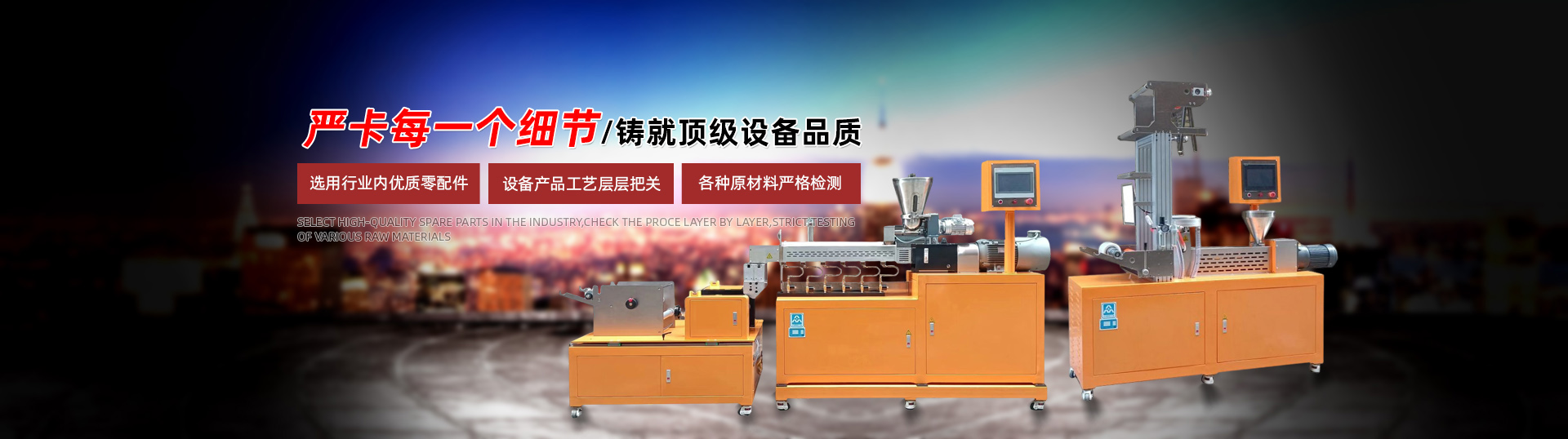

The twin-screw extruder consists of several parts, including the drive unit, feeding unit, barrel, and screws, with each component serving a similar function to that of a single-screw extruder. The distinction lies in the presence of two parallel screws within the "∞" cross-section barrel of the twin-screw extruder.
Twin-screw extruders for profile extrusion are typically tightly meshed and counter-rotating, although a few also employ co-rotating twin-screw extrusion. They are generally operated at lower screw speeds, around 10 rpm. High-speed, meshed co-rotating twin-screw extruders are used for blending, venting, or as continuous chemical reactors, with screw speeds ranging from 300 to 600 rpm. Non-meshed extruders are used for mixing, venting, and chemical reactions, and their conveying mechanism is quite different from that of meshed extruders, more akin to that of single-screw extruders, although there are fundamental differences between the two.
Operation Principle
In terms of the operating principle, the co-rotating and counter-rotating as well as non-interlocking types within a twin-screw extruder are distinct.
Co-rotating Twin Screw Extruder with Same-Direction Mating
These extruders come in two types: low-speed and high-speed. The former is mainly used for profile extrusion, while the latter is for special polymer processing operations.
Tight Mesh Extruder. The low-speed extruder features tight meshing screw geometry, where the external profile of one screw tightly matches the external profile of the other screw, forming a conjugate screw profile.
(2) Self-cleaning extruders feature high-speed, co-rotating screws with closely matched helical shapes. This screw design allows for exceptionally small screw gaps, enabling an enclosed, self-cleaning action. Such a twin-screw extruder is referred to as a tight self-cleaning co-rotating twin screw extruder.
2. Asymmetric Twin-Screw Extruder
The tightly meshed, counter-rotating twin screw extruder features a very small gap between the screw grooves of the two screws (much smaller than that of the co-rotating twin screw extruder), thus achieving positive conveying characteristics.
3. Non-intermeshing twin-screw extruder
The center distance between the two screws of a non-intermeshing twin-screw extruder is greater than the sum of the radii of the two screws.
