

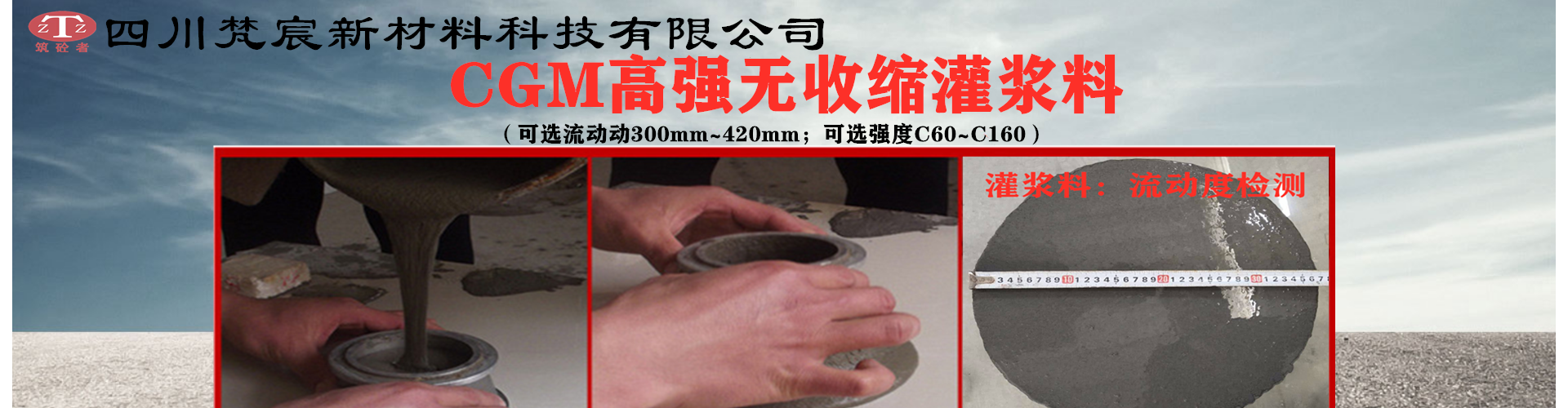


The primary technical specifications of high-strength grouting material are crucial for structural reinforcement and repair projects, due to their unique nature, which often demands effective reinforcement, quick construction timelines, and ease of application. Consequently, the requirements reflected in the grouting material include its fluidity, expansion rate, early and ultimate strength, as well as setting time.
1.1 Liquidity
There are three methods to indicate the fluidity of materials: the flowability method, the funnel method, and the slump method. Their respective limit values are: the flowability method's limit value is ≥240mm; the funnel method's flow time range is (8±2) seconds; and the slump method's limit value is ≥25cm. Currently, China commonly uses the flowability method to examine the fluidity of grout materials. To meet the self-flowing requirements of grouting construction, the flowability of the grout must be greater than 240mm. Overseas, the flowability index for grout materials is generally set at 240mm. Without adequate fluidity, it is impossible to fill narrow spaces adequately, resulting in an incomplete filling effect. Even if other properties are high, they are of no significance to the grouting project. Therefore, the flowability of grout materials is the primary criterion for evaluating the quality of grout materials.
The fluidity of the grouting material increases with the increase in water addition rate (water volume/dry material weight). However, excessive water addition can lead to bleeding phenomena and a decrease in compressive strength. The adjustable range of the water addition rate for the grouting material should be within 1%.
The fluidity of grout decreases with extended storage time. Therefore, during grouting operations, the mixed material should be continuously moved back and forth with bamboo splits to maintain its fluidity.
1.2 Expansion Rate
The expansion rate is one of the two main technical indicators of the grouting material. To achieve a full-filling effect after the grouting material hardens, it must possess an appropriate expansion property.
The "Technical Specification for the Application of Concrete Admixtures" (G ** 119-88) in our country stipulates that the 1-day vertical free expansion rate of grouting materials should be between 0.1% and 0.5%, and the remaining vertical free expansion rate after 6 months should be greater than 0.05%.
1.3 Compressive Strength
In structural reinforcement repairs, it is generally desired to have a high early strength to facilitate early use. The compressive strength of the grouting material should be greater than 20MPa for the 1d test. Currently, the compressive strength indicators for commonly used grouting materials in China are generally R1≥30MPa, R3≥40MPa, and R28≥60MPa. For the bonding strength of reinforcement, whether in repair reinforcement projects or equipment foundation grouting, it is necessary to ensure that the grouting material has sufficient bonding strength with the reinforcement to achieve integration.
The bonding strength of grouting material with smooth rebars should generally be greater than or equal to 6MPa, and with ribbed rebars, it should generally be greater than or equal to 30MPa. 1.5 Setting Time: Setting time is a crucial indicator affecting construction progress. For reinforcement and repair projects, it is often preferable to achieve strength as quickly as possible, i.e., to have as short a final setting time as possible. However, the initial setting time should not be too short, as it may reduce the fluidity of the mixture and affect construction operations and grouting quality.
The initial setting time for grouting material should generally be around 4 hours, with the final setting time typically around 5 hours.
2 High-Strength Grouting
The Application of Grouting Material in Structural Reinforcement and Repair Techniques: In order to fully utilize the technical performance of the grouting material and ensure the quality of the structural reinforcement and repair project, particular attention should be paid to the following points during grouting construction:
2.1 Thoroughly determine the casting plan; ensure the formwork is tightly set up
