
SummaryThis article addresses the electricity usage characteristics of university student dormitories and proposes a comprehensive digital safe electricity management system technical solution, integrating electricity management, metering, intelligent identification and control of harmful loads, and real-time tracking and detection—known as the Smart Power Control System for Student Dormitories.
KeywordsApartment恶性负载Safety Electricity Smart System
Introduction
In recent years, in response to the national call for the creation of a resource-saving society, with the rapid advancement of the socialization reform of后勤 services in higher education institutions, various universities across the country have adopted new management models for their existing on-campus student dormitories. By actively utilizing social capital through various channels, these institutions have constructed a batch of high-quality, high-standard student dormitories using a socialized approach. This has significantly improved the living and learning conditions for university students, earning widespread approval from both faculty and students. Within the dormitories,
The configuration has evolved from basic necessities of life in the past to now featuring electric water heaters, air conditioners, computers, and bathroom heaters, among others. The traditional power management approach for student dormitories, which limits current and implements scheduled power cuts, clearly fails to meet the usage demands of college students. What's more, appliances like electric kettles and "quick heat" products, known as malicious loads, pose significant safety hazards to the electrical systems in student dormitories, presenting a great threat to students' lives and property safety. To address the many issues of safe electricity use in university student dormitories, after extensive research, the author proposes a technical solution for a digitalized safe electricity use management system suitable for university student dormitories, based on the existing centralized electricity use system in student dormitories—the Smart Electricity Control Management System for Student Dormitories.
1. Basic System Requirements
(1) The illustration below is a block diagram of the smart power management system for student apartments. This system's digital control module employs intelligent mathematical model control technology, integrating advantages such as power management, metering, intelligent identification and control of harmful loads, and real-time tracking and detection. It serves as the core component of the smart power management system for student apartments.
(2) Networking Methods. This system employs a distributed unit control design principle, featuring a simple structure. It can utilize cost-effective RS-485 bus for networking, which requires minimal cabling, or can be networked within a university campus local area network, or even through China Mobile's GSM wireless network. Here, we analyze the first networking method from a technical standpoint.
(3) Basic System Configuration: CPU frequency of 1.7GHz or higher; Operating System: mainstream OS, such as Windows 2000/XP; Memory; Hard Drive; Monitor, etc.
2. Basic System Functions and Principles
(1) Basic Function of Unit Control Module
1. Data collection, transmission, and intelligent identification and control of malicious loads. 2. Integrated circuit chips. The unit control module must have the function to interpret and execute system microcomputer instructions. Each unit control module is responsible for managing 8 room control modules, utilizing ultra-large-scale integrated circuit chips, integrating independent CPU units and data processing units. Even in the event of faulty data transmission lines or power outages, data loss will not occur. The unit control module must internally set up reliable power detection circuits, watchdog circuits, and data storage protection circuits. It should have overload shutdown, automatic power recovery after shutdown, and lightning and overvoltage protection measures. Additionally, it must implement data backup, data verification processing, data block protection processing, and instruction redundancy in the system management program to ensure the entire system operates stably and reliably.
(2) Basic Room Control Module Functions
The room control module sends metering pulse signals to execute metering tasks.
2. Control: The room control module executes commands from the unit control module, connecting or disconnecting the main power supply to the room. The key component of the module is a relay, which can be optionally a new type of magnetic latching relay with high current electrical contacts, driven by positive and negative pulse signals at 12V voltage.
(3) Basic Principles of Intelligent Identification and Control of Malicious Load
1. Establishing a Mathematical Model: The intelligent electricity control management system for student dormitories builds a mathematical model based on the dynamic power consumption parameters of electrical appliances used by students. It categorizes appliances into resistive loads and inductive loads according to their power consumption characteristics.
2. Automatic Identification and Control: The system's CPU program automatically tracks and detects the size of the power point during the momentary power-on of electrical appliances, and issues control commands after analysis. As shown in the figure below, if the system is set to identify harmful loads at a power of 300W, when a resistive load greater than 300W (such as an electric stove or "quick heat") is used, the system detects and identifies it, then issues a command to cut off power to the room. When the room is using inductive loads (such as computers or chargers), the system detects and identifies them as normal power consumption loads, and all normal loads will not accumulate. When the room is using a 1500W electric water heater, the system's CPU program tracks and detects in real-time that the momentary power-on power point of the electric water heater is within the open range, and it will also be identified as a normal power consumption load.
(4) Basic Functions of the Electric Power Inquiry Manager
1. Query Management, Controlled Individually. The Electric Utility Query Manager is set up at each student dormitory building, serving as the central control unit for that building.
2. Integrated Circuit Chips: Utilizing the latest industrial computer design principles, these chips incorporate a CPU, memory, RS232 and RS485 interfaces, and a watchdog clock control chip to prevent program lock-ups. The Electric Consumption Inquiry Manager is designed as a wall-mounted mini-box unit, featuring an LCD display panel and a small digital keypad. In the event of system management microcomputer shutdown due to malfunctions or manual shutdowns, the Electric Consumption Inquiry Manager can take over some of the system management microcomputer's tasks, executing real-time electricity consumption inquiries for the building and scheduling power on/off tasks.
(5) Basic Electricity Management Program Functions
1. Room Number Setup: The electricity management program within the system's microcomputer allows for the configuration of building and room numbers in student dormitories. For instance, Room 8 on the first floor of Dormitory 5 would correspond to the system number 5108.
2. Room-based Timed Flow Control. The power management program within the system's microcomputer can be configured to achieve timed, quantitative, and current limit controls for each individual room.
3. Malicious Load Identification. The system's electrical management program is configured to identify malicious loads by their power consumption, distinguishing between illegal appliances and regular ones. For instance, if the identification power is set to 300W (which can be adjusted according to actual requirements), all appliances over 300W, such as electric stoves and "quick heaters," are prohibited, while regular appliances (like computers, lighting, desk lamps, etc.) can be used normally regardless of their power rating.
4. Fee Management. The electricity management program within the system's microcomputer allows for real-time payment of electricity fees for all rooms or individual rooms. In response to the requirement of higher education institutions to provide basic定额 free electricity to students, the electricity management program features an automatic recharge function for the定额 free electricity, replenishing the basic定额 free electricity to all rooms or designated rooms at a specified time each month.
5. Additional Features. This system also features automatic alerts for delinquent payments or power outages, automatic power restoration upon payment, refund management, room change management, and the ability to allocate utility bills among occupants. These functions effectively address daily issues encountered in the management of student dormitory electricity usage in universities. For instance, since universities typically adjust student rooms annually, the refund management and room change management functions are particularly applicable.
Electrical Safety Protection
1. Short-circuit and Overcurrent Protection: The intelligent power control management system for student dormitories is equipped with dual protection functions for short-circuit and overcurrent at the output terminal of the system control cabinet, effectively ensuring personal safety during student use of electricity.
2. Unauthorized Power Interruption: When students use unauthorized electrical appliances in their rooms, the system will cut off the main power to the room within 5 seconds. After the students remove the unauthorized appliances and the system detects and identifies them, power will automatically be restored within one minute, without the need for manual intervention, ensuring safe and convenient electricity use.
(7) Remote Control and Real-Time Monitoring with Alarm Alerts
1. Remote Control. All management operations for the intelligent power management system in student dormitories can be completed on the system management computer, achieving true remote control. All management data is transmitted, stored, and serves as a backup between the system management computer and the digital unit control module in real-time, ensuring the security of the management data.
2. Real-time Monitoring. On the system management microcomputer display, the power consumption of each room in the university student dormitory is represented by the number of "★" symbols, with more "★" indicating a higher real-time power consumption. When the mouse pointer is over a room, the system immediately displays the actual power consumption parameters and other values of the pointed room, effectively setting up a virtual electricity meter that simultaneously shows multiple parameters.
Financial Management
1. Financial Statistics Analysis. The management program of the Smart Electricity Control System for Student Dormitories also includes financial statement statistics and financial analysis features, facilitating university financial management. Additionally, the system automatically records all the administrator's activities and generates system logs, which are uneditable, thus preventing financial fraud.
2. Scalability: The smart power management system for student dormitories is equipped with network interface options, supporting authorization and charging terminals for the campus card payment management system. It also provides interface parameters for integration with the campus card system.
3. Acrel-EIOT Energy Internet of Things Cloud Platform
3.1 Overview
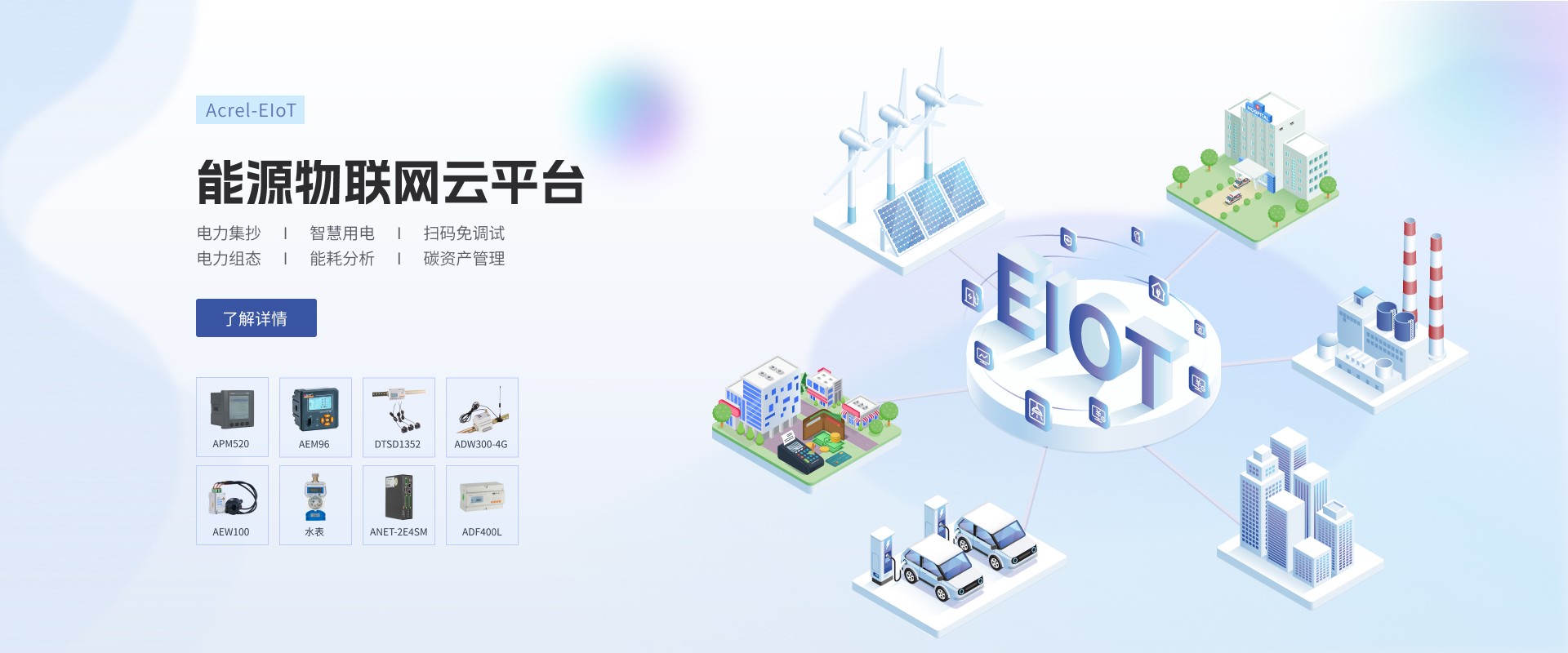
The Acrel-EIoT Energy Internet of Things Open Platform is a platform that, based on an IoT data hub, establishes unified upstream and downstream data standards, providing energy IoT data services to internet users. Users simply need to purchase Acrel-EIoT IoT sensors, select a gateway, install them, and scan a code to access the required industry data services on their smartphones and computers.
The platform offers functionalities such as a data dashboard, electrical safety monitoring, power quality analysis, power consumption management, pre-paid management, charging station management, smart lighting management, alarm and record of abnormal events, and O&M management, while supporting multi-platform, multi-language, and multi-terminal data access.
3.2 Application Locations
This platform is suitable for apartment renters, chain convenience stores, small factories, building management system integrators, small property management companies, smart cities.Substation transformation, building structures, communication base stations, industrial energy consumption, smart beacons.Power operation and maintenance fields.
3.3 Platform Structure
3.4 Platform Features
3.4.1 Power Collection and Reading
The Power Collection and Reading Module enables querying, analysis, early warning, and comprehensive display of various monitoring data, ensuring an environmentally friendly power distribution room. In terms of intelligence, it achieves remote measurement, remote signaling, and remote control for the power supply and distribution monitoring system, providing comprehensive detection and unified management of the system; in data resource management, it can display or query the operation of various equipment in the power distribution room (including historical and real-time parameters), and allows for daily, monthly, and annual report queries or printing based on actual conditions, thereby improving work efficiency and saving human resources.
3.4.2 Energy Consumption Analysis
The Energy Consumption Analysis Module utilizes automation and information technology to achieve automated and scientific management across the entire process of energy data collection, process monitoring, energy medium consumption analysis, and energy consumption management. This integration of energy management, production, and usage throughout the process leverages advanced data processing and analysis techniques for offline production analysis and management. It facilitates unified dispatching of the entire factory's energy system, optimizes energy medium balance, efficiently utilizes energy resources, enhances energy quality, reduces energy consumption, and aims to achieve energy-saving goals and improve overall energy management levels.
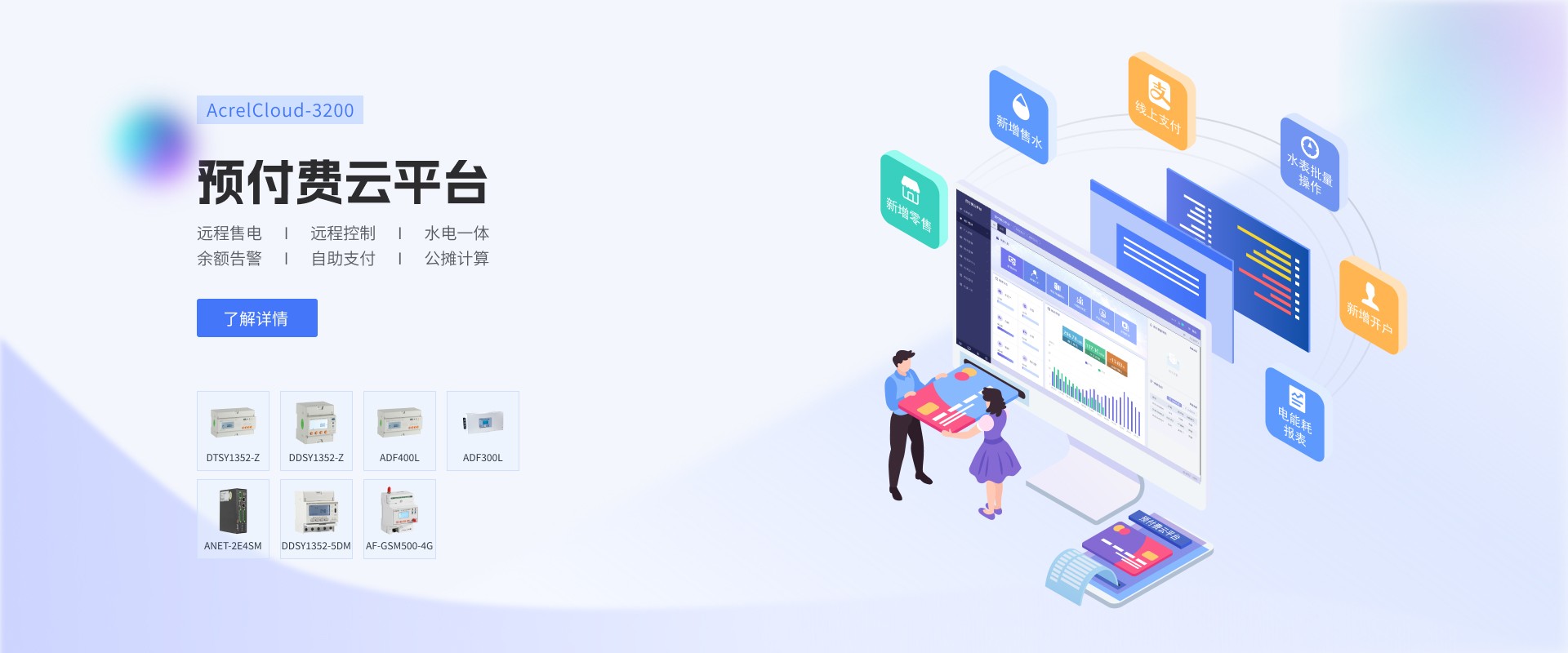
3.4.3 Pre-Payment Management
1) Login Management: Manage operator accounts and permission allocation, view system logs, and more.
2) System Configuration: Configure for buildings, communication management machines, instruments, and default parameters.
3) User Management: Performs operations such as account opening, account closure, remote switching, batch operations, and record inquiries for store users.
4) Electricity Sales Management: Conduct remote operations such as electricity sales, returns, corrections, and record inquiries for meters that have been opened for accounts.
5) Water Sales Management: Remote operations for water sales, returns, and record inquiries for accounts already activated.
6) Reporting Center: Offers queries for financial reports on electricity and water sales, energy consumption reports, alarm reports, etc. All reports and records within this system are supported for export in Excel format.
3.4.4 Electric Vehicle Charging Station Management
Utilizing IoT technology, the system continuously collects and monitors data from charging station sites and individual charging stations. It also provides early warnings for various faults such as over-temperature protection of charging machines, over-voltage and under-voltage of charging machine inputs and outputs, insulation detection faults, and a series of other issues. The cloud platform encompasses all functionalities for charging billing and charging station operation, including city-level large screens, transaction management, financial management, transformer monitoring, operation analysis, and basic data management.
3.4.5 Smart Lighting
Smart lighting continuously monitors the power status of lighting circuits, such as indoor lighting and streetlights in various urban areas, through IoT technology. It also allows for scheduling on/off strategies, remote management from the backend, and mobile management, reducing the maintenance difficulty and costs of streetlight facilities, improving management levels, and achieving energy-saving and emission-reduction effects.
3.4.6 Safe Electrical Usage
Our company employs self-developed residual current transformers, temperature sensors, and electrical fire detectors to continuously track and statistically analyze the main factors causing electrical fires (cable temperature, current, and residual current). We promptly deliver any隐患 information to enterprise management personnel, guiding them to conduct immediate inspections and treatments, thereby eliminating potential electrical fire hazards and achieving the goal of "preventing disasters before they happen."
3.4.7 Smart Fire Protection
Through cloud platform data analysis, mining, and trend analysis, it helps achieve goals such as scientific fire early warning, grid management, and implementing diversified responsibility supervision. It fills the gap of ineffective monitoring for "small nine places" and hazardous chemical production enterprises. It is suitable for all public and civilian constructions and achieves unmanned patrol smart fire protection. It meets the practical needs for smart fire protection to be "automated," "intelligent," and "systematic," as well as for power management to be "refined."
3.5 System Hardware Configuration
4. Closing Remarks
The "Smart Power Management System for Student Dormitories" is a comprehensive technical solution for digital safe power management, specifically designed to cater to the power consumption characteristics of university student dormitories and their urgent need for safe power usage. It employs intelligent mathematical model control technology. While some technical products on the market can meet general centralized power management requirements, there is still room for improvement in terms of intelligent load identification and control technology, as well as real-time tracking and detection methods.
Reference
[1]蔡旭斌, Luo Ling. The Current Status and Development of Automatic Meter Reading Technology for Electric Energy Measurement[J]. Guangdong Power, 2003.
[2] Wei Jianhua, Xu Jin. Student Dormitory Electricity Safety Management System Solution[J]. Modern Electronic Technology, 2004.
[3] Yufei. Analysis of Safety Electricity Management Technology for College Student Dormitories
[4] Ankorri Enterprise Microgrid Design and Application Manual, 2022.05 Edition.