



SummaryThe Smart Power Consumption Community is a pilot project initiated by State Grid Corporation of China to study how advanced smart grid technologies for power consumption can be applied in residential areas, enhance the living standards of the people, improve the intelligence level of the power grid, and elevate the quality of power service. As part of the Smart Power Consumption Community's development, electric vehicles are also increasingly being integrated into the planning and have a promising future.
KeywordsSmart Community; Electric Vehicles; Charging Poles; Development
Electric Vehicle Charging Station Introduction
Electric vehicles offer numerous advantages such as low (or no) emissions, reduced noise, high energy efficiency, and low maintenance and operation costs. Promoting the replacement of fuel vehicles with electric ones will be one effective way to mitigate atmospheric environmental pollution and energy shortages. Our government is actively advancing the application and development of new energy vehicles. Charging stations, as essential supporting infrastructure for the development of electric vehicles, hold significant social and economic benefits. Electric vehicle charging stations function similarly to fuel dispensers at gas stations, and can be mounted on the ground or walls, installed in public buildings (such as malls, office buildings, and public parking lots) and residential community parking lots or charging stations. They can charge various models of electric vehicles based on different voltage levels. As the energy supply device for electric vehicles, the charging performance of charging stations is crucial to the battery pack's lifespan and charging time. Ensuring rapid, safe, and reasonable electricity replenishment for the power battery is a fundamental principle in the design of electric vehicle chargers.
2 Overview of Electric Charging Station Principles
The overall system consists of four parts: electric vehicle charging stations, concentrators, battery management system (BMS), and a charging management service platform. The control circuit of the electric vehicle charging stations is primarily handled by embedded ARM processors. Users can self-service with a card for authentication, check their balance, and view billing information. It also offers a voice output interface for voice interaction. Users can select one of four charging modes from the LCD display: time-based billing, energy-based charging, automatic full charge, and distance-based charging.
Electric vehicle charging station controllers and concentrators communicate data via CAN bus. The concentrators interact with the server platform via wired internet or wireless GPRS networks. For security purposes, electricity metering and monetary data are implemented with secure encryption.
The primary function of the Battery Management System (BMS) is to monitor the battery's operating status (voltage, current, and temperature), predict the State of Charge (SOC) and corresponding remaining driving range of the power battery, manage the battery to prevent over-discharge, over-charge, over-heat, and severe voltage imbalance between individual cells, and utilize the battery's storage capacity and cycle life.
The charging service management platform primarily consists of three functions: charging management, charging operation, and comprehensive inquiry. Charging management involves centralized management of fundamental system data, such as electric vehicle information, battery information, user card information, and charging桩 information. Charging operation mainly handles billing management for user charging sessions; comprehensive inquiry refers to the integrated analysis and query of management and operation data.
3 Types of Charging Poles
There are various methods for installing charging stations, each catering to different charging needs. They can be categorized by installation method, location, and charging type, offering immense convenience during electric vehicle charging. In terms of installation method, there are two types of charging stations: ground-mounted and wall-mounted. By location, they can be public, dedicated, or private charging stations. And in terms of charging type, there are直流 (direct current) and 交流 (alternating current) charging stations.
Direct current (DC) electric vehicle charging stations are fixed outside electric vehicles and connected to the alternating current (AC) grid. They input a three-phase four-wire AC380V±15% voltage at a frequency of 50Hz and output adjustable DC power, which can directly charge the power battery of electric vehicles. As you may know, DC charging stations are powered by a three-phase four-wire system, offering ample power. Moreover, the voltage and current output of DC charging stations have a wide adjustable range, which is why they are considered typical "fast charging" stations. AC charging stations are also fixed outside electric vehicles and connected to the AC grid, but they only provide power output without charging capabilities. To charge electric vehicles, they must be connected to a vehicle-mounted charger, making them typical "slow charging" stations. Currently, the manufacturing cost of DC power sources is higher, resulting in a significantly higher price compared to AC charging stations.
Solution for Electric Supply to Smart Residential Communities with Charging Pile Power Consumption
4.1 Develop public network transformers in residential communities to address the power supply issues for charging stations.
In anticipation of the growth prospects for residential electric vehicles, we are making forecasts and proactively engaging, of course, under the premise of government support and the cooperation of the residential property management. This involves reasonably allocating public transformers based on the actual load of charging stations and implementing a separate meter for each charging post.
4.2 Incorporating APF Active Power Filters
The fundamental idea of using active power filter (APF) for harmonic control in charging stations is to detect harmonic current components from the harmonic currents generated by electric vehicle chargers. A compensating device then produces a current component of equal magnitude but opposite polarity to cancel it out, resulting in the current flowing into the grid containing only fundamental frequency components. The APF unit boasts fast dynamic response, diverse compensation functions, the ability to reduce flicker and compensate for reactive power, and its compensation characteristics are unaffected by grid impedance, being determined by its own computational and control circuits.
4.3 Develop charging stations on the basis of the existing power supply and distribution equipment in the community.
During the initial construction of the existing community, the power distribution facilities were generally designed to accommodate the residents and the electricity needs of the community's public facilities. The transformer load factors were typically around 80%. Adding charging桩 electricity usage on top of this is clearly insufficient, as each charging桩 generally has a capacity of over 7 kilowatts, with some fast-charging桩 requiring up to 30 kilowatts. Calculating this, a community with 100 parking spaces would need 3,000 kilowatts, and charging times usually peak at night. This is because it's convenient to charge while parked, and after 11 PM, the off-peak electricity rates are lower, making it an ideal time for charging. Therefore, the load utilization of the community charging桩 will be high, and this load is beyond the capacity of the existing community power supply and distribution equipment. To address the electricity needs for parking space charging桩, a dedicated transformer supply is necessary. One approach is for the community property management to apply for an increase in capacity based on the required load.
The trend in charging桩 technology is towards intelligence.
To address the challenges of installing charging stations, it's essential to have a basic understanding of their working principles and core technologies. Currently, charging stations in China can generally be categorized into two types based on their charging methods: contact charging stations and non-contact charging stations. The working principle of non-contact charging stations is to charge electric vehicles through magnetic induction, similar to the wireless charging of smartphones. However, contact charging stations are more widely used due to their superior cost-effectiveness and power output compared to non-contact stations. To achieve widespread adoption, charging stations must be made intelligent. This involves intelligent recognition of the battery in the charging equipment, controlling the corresponding charging voltage and current, significantly improving charging efficiency while ensuring device safety. The intelligence of charging stations relies on the programming done by relevant R&D personnel during development, ensuring efficient time management, as extended wait times can lead to loss of patience among users. This is also a consideration during the technological development of charging stations.
6Ankore Charging Station Fee Operation Cloud Platform
6.1 Overview
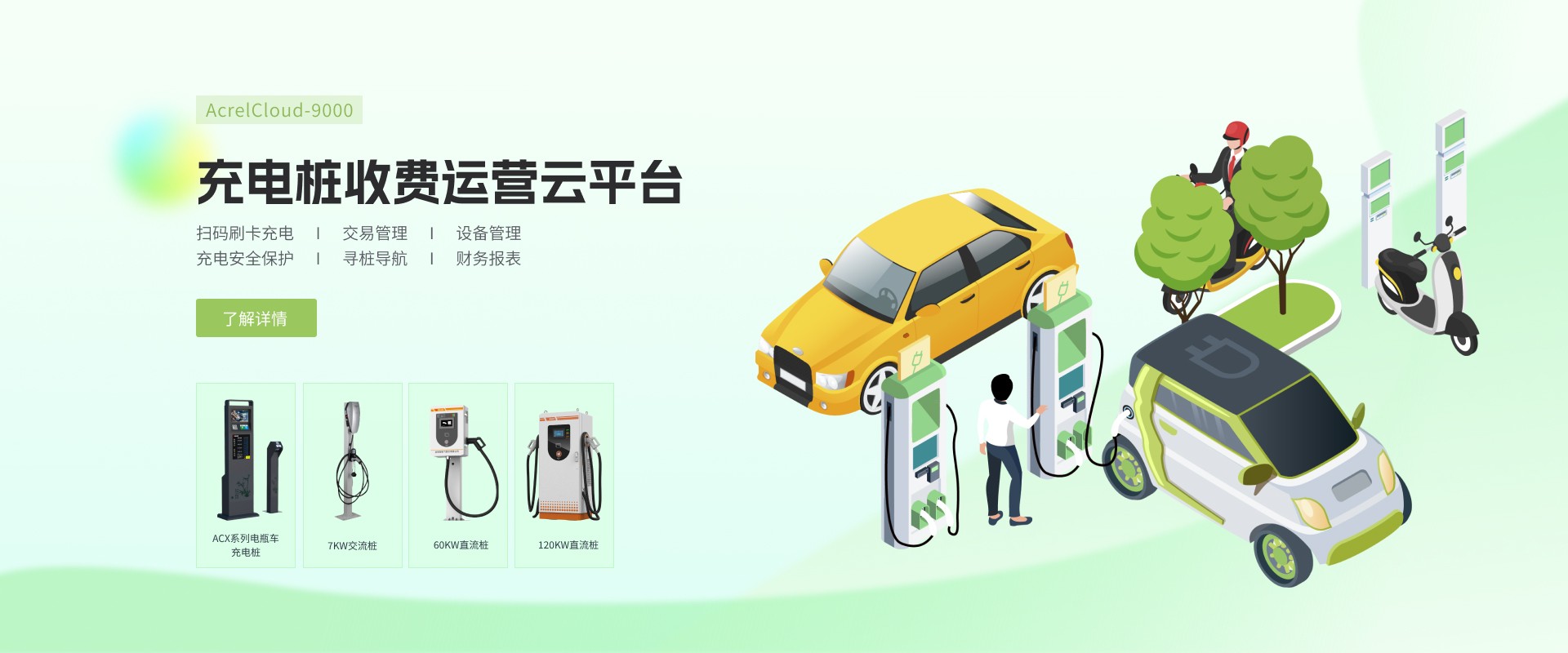
The AcrelCloud-9000 charging桩 fee operation cloud platform system continuously collects and monitors data from charging stations connected to the system, electric bicycle charging stations, and various charging piles using IoT technology. It real-time monitors the operation status of charging piles, manages charging services, payment, transaction settlements, resource management, power management, and detailed inquiries. Additionally, it provides early warnings for various faults such as overheating protection, leakage, input/output overvoltage, undervoltage, and low insulation in charging machines. Charging piles support internet access via Ethernet, 4G, or WIFI, and users can scan and charge through WeChat, Alipay, or UnionPay QR codes.
6.2 Application Scenarios
Ideal for residential communities, various corporate and institutional environments, hospitals, tourist attractions, schools, industrial parks, public parking lots, highway charging stations, bus terminals, shopping centers, commercial complexes, commercial plazas, underground parking facilities, highway service areas, apartment buildings, and office towers.
6.3 System Structure
Field Equipment Layer: Various sensors connected to the network, including multi-functional electrical meters, vehicle charging stations, electric bike charging stations, power quality analyzers, electrical fire detectors, current-limiting protectors, smoke sensors, temperature measuring devices, smart plugs, and cameras.
The Network Communication Layer includes devices such as on-site intelligent gateways and network switches. The intelligent gateway actively collects data from devices in the field equipment layer, performs protocol conversion, data storage, and uploads the data to the established database server via the network. In the event of a network failure, the intelligent gateway can store data locally and resume uploading from the point of interruption when the network is restored, ensuring that data on the server is not lost.
Platform Management: The platform includes application servers and data servers, enabling data exchange among all on-site smart devices. It allows for real-time monitoring of the distribution system's operation status at charging stations, the working status of charging posts, the charging process, and personnel behavior, both on PC and mobile devices. It also supports online payment applications such as WeChat and Alipay.

6.4 Platform Function Description
6.4.1 Charging Services
Charge facility search, charge facility view, map addressing, online self-service payment for charging, charging settlement, navigation, etc.
6.4.2 Home Overview
An overview of the day's and month's account openings, recharge amounts, charging amounts, charging units, charging times, and charging frequency, along with cumulative account openings, recharge amounts, charging amounts, charging units, charging times, and charging frequency, as well as corresponding year-on-year and month-on-month growth rates. Additionally, a map navigation of charging桩 and stations distribution, and this month's charging statistics.
6.4.3 Transaction Settlement
Charging Price Strategy Management, Prepayment Management, Billing Management, Revenue and Financial Reporting.
6.4.4 Fault Management
Fault management features such as fault record inquiries, fault handling, fault confirmation, and fault analysis provide ease for users to manage and query faults.
6.4.5 Statistical Analysis
Statistical analysis supports operational trend analysis and revenue statistics, allowing users to view the charging operation of the posts through tools such as curves and energy consumption analysis.
6.4.6 Operations Report
Analyze the operation of car, electric bike charging stations,桩, transactions, recharge, charging, and alarm and fault conditions according to user-specified cycles, and compile an analytical report.
6.4.7 APP and Mini-program Mobile Support
With the features of fuzzy search and map search, detailed information of available electric charging stations and power stations can be queried. Scan to charge, pay online: scan the QR code of the charging station, complete the payment, and you can start charging after the WeChat payment is completed.
6.4.8 Resource Management
Charging Station Record Management, Charging Pole Record Management, User Record Management, Charging Pole Operation Monitoring, Charging Pole Anomaly Transaction Monitoring.
7 Conclusion
Electric vehicle charging stations, as a key component of intelligent electricity consumption communities, also serve as the primary carrier for the future transformation of new traffic energy routes. The widespread adoption of electric vehicles in future cities and the operation of EV charging stations in electricity consumption communities actually reflect the demand of smart grids for "smart interaction between the grid and users," "encouraging the use of various forms of distributed energy," "developing clean and environmentally friendly power sources," and "promoting a low-carbon economy."
Reference
Yang Yanzhi. Research on Design Optimization Issues of Electric Vehicle Charging and Swapping Projects in the Beijing Area [D]. North China Electric Power University: North China Electric Power University, 2014.
[2] Design and Research of Yaya Electric Vehicle Charging Pile [D]. Nanchang University: National Institute of Science and Technology Information, 2012
Zhao Mingyu, Wu Jun, Zhang Weiguang, et al. Optimal Layout of Urban Charging Piles Based on Temporal-Spatial Constraints[J]. Automation of Electric Power Systems, 2016 (4): 66-70, 104.
[4] GB50966-2014 Standard for Design of Electric Vehicle Charging Stations, Ministry of Housing and Urban-Rural Development of the People's Republic of China, 2015.
Liu Juanjuan, Cao Shenglan. Research on the Operation Model of Electric Vehicle Charging Pile [J]. Science and Technology Management Research, 2015 (19): 202-206.
Lu Fang. A Study on the Location and Capacity Planning of Electric Vehicle Charging Stations Based on Queueing Theory [D]. Beijing Jiaotong University, 2015.
Zhang Xiyu. Modeling of Power Demand for Electric Vehicle Charging Stations [D]. North China Electric Power University, 2014
[8] Ankerui Enterprise Microgrid Design and Application Manual. 2020.06.
