
Summary:China has set a goal to achieve "carbon peak" by 2030 and "carbon neutrality" by 2060. New energy vehicles play a crucial role in achieving these "dual carbon" goals. Currently, China's new energy vehicle industry is flourishing, and with the increase in the number of new energy vehicles, issues such as charging stations have emerged. Resolving the problems related to new energy vehicle charging stations is vital for the future development of China's new energy vehicle industry. This article lists the current challenges faced by charging station companies after analyzing the development trends of new energy vehicles and charging stations in society. It proposes combining public charging stations with big data and adding value-added services to address the prominent issues with charging stations. This research provides theoretical support and recommendations for charging station companies and the government.
Keywords:New Energy; Charging Poles; Dual Carbon Reduction
Current Analysis of New Energy Vehicle Development in Our Country
1.1 Government incentives for new energy vehicles
To actively support the achievement of the "Dual Carbon" goal, local governments have issued purchase subsidies for new energy vehicles, significantly boosting the ownership of new energy vehicles.
In accordance with measures issued by the People's Government of Sichuan Province, new energy vehicles are exempt from purchase tax, and promotional activities for new energy vehicle consumption are underway. Hunan Province's measures indicate an extension of subsidies for the replacement of new energy vehicles, offering a 5,000 yuan welfare policy for individuals who scrap eligible household vehicles before June 30, 2023, and purchase new energy vehicles within the province. The People's Government of Wuhan City has proposed the launch of a new round of consumer vouchers, following the province-wide extension of policies promoting car consumption, and supporting administrative districts in cooperation with car production and sales enterprises to carry out vehicle purchase subsidy activities.
Market Analysis of New Energy Vehicles
Data from the survey shows that the sales of new energy vehicles in our country experienced an explosive growth last year, with production and sales reaching 7.058 million and 6.887 million respectively. The market for new energy vehicles surged, marking a high-speed development phase for the industry. According to survey data, the sales of electric vehicles in China reached 6.887 million in 2022, accounting for 25.6% of the market, up 12.1% from 2021; globally, the sales volume accounted for over 60%. Among them, the sales of new energy vehicles were 5.365 million, up 81.6% from the previous year; the sales of plug-in hybrid vehicles were 1.518 million, a 150% increase from the previous year.
In the context of the "Dual Carbon" initiative, new energy vehicles are a significant step towards future development.
2. The rapid development of new energy vehicles has also brought to the forefront the issues facing us.
2.1 The gap in charging桩桩桩 is still a significant issue.
In an era of rapid growth in the new energy vehicle industry, the supporting facilities have not kept pace with the development of new energy vehicles, particularly in the industry of charging stations. Data shows that in 2015, China had approximately 66,000 electric vehicle charging stations, with about 400,000 electric vehicles, a ratio of 1:6. By last year, there were 4.7 million charging stations, while the number of electric vehicles soared to 12 million, with a ratio of 1:2.5. However, three-quarters of all charging stations are private, indicating a severe shortage of public charging stations. With the current ratio of public charging stations to vehicles, it is far from meeting societal demand and fails to grant drivers "freedom to charge." According to a 2021 survey, 70% of drivers believe there are not enough charging stations, and 40% find the charging process slow and time-consuming.
2.2 The electric charging桩 industry has become a hard-to-dig "Gold Mountain and Silver Mountain."
In the midst of the explosive growth in sales of new energy vehicles, two contradictions urgently need to be addressed. First, new energy vehicle owners are complaining about the lack of charging stations, long queues for charging, and slow charging speeds. Second, current charging station companies are not making a profit, and old residential complexes are not allowing the installation and application of new energy charging stations.
The installation of private charging stations in residential complexes raises questions about the costs of construction, service fees, and operation. Many complexes have outdated electrical systems requiring upgrades, and issues persist. Moreover, the limited range of new energy vehicles has exacerbated "range anxiety" among their owners, making the shortage of charging stations even more pronounced.
The issue of insufficient charging stations has sparked business opportunities for many. According to Terade's financial reports, from 2019 to 2021, Terade Power's total revenue was 2.129 billion yuan, 1.925 billion yuan, and 3.104 billion yuan respectively, while its net profit was -75.12 million yuan, -171 million yuan, and -51.32 million yuan respectively, indicating annual losses. The reasons are as follows: Firstly, the revenue models of charging station companies in the market are too simplistic, with revenue mainly coming from the margin on electricity fees, service fees, and value-added service fees. While electricity fees are the main source of revenue, the varying electricity prices in different regions make the fees dependent on local rates, which companies cannot arbitrarily determine. Secondly, the payback period for charging station companies is too long.
3. AnkoRui Charging Station Fee-Based Operation Cloud Platform
3.1 Overview
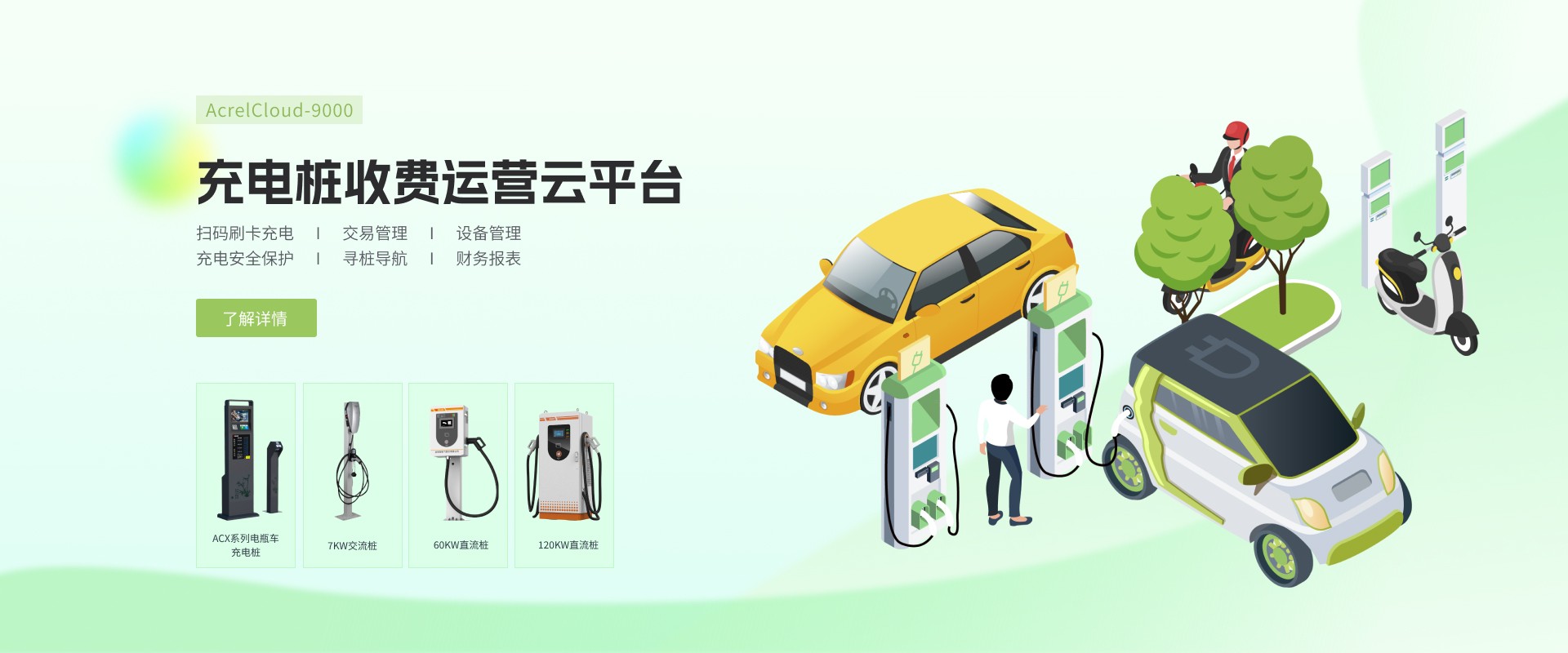
The AcrelCloud-9000 Ankoray Charging Pole Cloud Platform System utilizes IoT technology to continuously collect and monitor data from electric bicycle charging stations connected to the system, as well as various charging methods. It offers real-time monitoring of charging桩 operation, charging services, payment management, transaction settlements, asset management, energy management, and detailed inquiries. Additionally, it provides early warnings for various faults such as overheating protection, leakage, input/output overvoltage, undervoltage, and insulation failure in charging machines. Charging stations support internet connectivity via Ethernet, 4G, or WIFI, and users can scan to charge using WeChat, Alipay, or UnionPay QR codes.
3.2 Application Scenarios
Design for charging infrastructure applicable to civil buildings, general industrial buildings, residential communities, industrial units, commercial complexes, schools, parks, and other similar facilities.
3.3 System Structure
3.3.1 The system is divided into four layers:
1) The data collection layer, network transmission layer, data center layer, and client layer.
2) Data Collection Layer: The electric scooter intelligent charging桩 communication protocol is based on the standard Modbus-RTU. Electric scooter intelligent charging桩 are used to collect power parameters of the charging circuit and perform energy metering and protection.
3) Network Transmission Layer: Upload data to the established database server via 4G network.
4) Data Center Layer: Comprises application servers and data servers, with application servers hosting data collection services and the WEB website, and data servers deploying real-time databases, historical databases, and basic databases.
5) For end-user access: System administrators can access the electric scooter charging station billing platform via a web browser. End-users can initiate charging by swiping a card or scanning a QR code.
The community charging platform primarily covers functions such as intelligent large screens for charging facilities, real-time monitoring, transaction management, fault management, statistical analysis, and basic data management. It also provides an operation and maintenance app for maintenance staff and a charging mini-program for users.
3.4 AnkoRui Charging Station Cloud Platform System Features
3.4.1 Intelligent Large Screen
The intelligent large screen displays the distribution of stations, providing statistics on equipment status, usage rate, charging times, duration, cost, energy, and faults. It also allows for viewing station information, charger lists, charging records, revenue, energy consumption, and fault logs for each station. It centrally manages community charging stations, monitors equipment usage rates, and allocates resources efficiently.
3.4.2. Real-time Monitoring
Real-time monitoring of the operation status of charging facilities, including the operational status of charging stations, circuit status, the amount of electricity charged during the charging process, charging voltage/current, and alarm information from charging stations.
3.4.3 Transaction Management
Platform administrators can manage charging user accounts, performing operations such as account recharging, refunds, freezing, and cancellation. They can also view detailed daily charging transaction information for community users.
3.4.4 Fault Management
Equipment automatically reports fault information. Platform administrators can view and dispatch fault information through the platform. Meanwhile, maintenance staff can receive fault notifications via the maintenance app, and upon completing maintenance work, they will report the results. Charging users can also report on-site issues through the charging mini-program.
3.4.5 Statistical Analysis
Through the system platform, access charging transaction statistics and energy consumption statistics from various perspectives, including charging stations, facilities, time, and methods.
3.4.6 Basic Data Management
Operators can establish and manage user accounts on the system platform, building and maintaining the required sites and charging facilities for their operations. They can maintain charging facility information, pricing strategies, discounts, and promotional activities, as well as manage online card users' recharges, freezes, and unbindings.
3.4.7 Operations APP
For operations personnel, the system allows for management of sites and charging stations, facilitates fault closure processing, checks usage of traffic cards, and inquires about charging and recharge status. It also supports remote parameter settings and can receive fault notifications.
3.4.8 Charging Mini App
Available for charging users, it allows you to view nearby available devices, and includes features such as scanning to charge, account recharge, charging card binding, transaction inquiry, and fault appeal.
3.5 System Hardware Configuration
4. Summary
Industry analysts believe that the new energy vehicle charging桩 sector is transitioning from a "land-grabbing" phase to a "survival-of-the-fittest" critical period. This means that "leading companies" at the forefront will greatly win a vast market if they can seamlessly align with consumer needs in terms of "user experience."
Innovatively redesigning new energy vehicle charging stations to incorporate fast and slow charging options, catering to the needs of diverse groups. We have also rationally adjusted the number and distribution of charging stations based on different provinces and geographical locations, enhancing their effectiveness and contributing to the development of China's new energy vehicle industry. Implementing a reasonable charging fee management system for charging stations, designed with cloud servers to manage fees. Utilizing WeChat/Alipay developer tools, we designed a mini-program that primarily enables user login, navigation to charging stations, and precise location, as well as scanning and paying for the charging service. After completing the overall system design, we conducted partial testing followed by comprehensive system integration testing to ensure the APP is ready for use.
The government will also introduce relevant policies to provide reasonable subsidies, welfare policies, etc., to charging桩 enterprises, promoting their construction of charging桩, serving the people, offering benefits to the public, and advancing the goal of achieving "double carbon" targets.
Reference
Sichuan Provincial People's Government "Several Policies and Measures for Focusing on High-Quality Development and Promoting Overall Improvement of Economic Operation"
[2] Hunan Provincial Government's "Several Policies and Measures for Actively Fighting Economic Growth and Achieving Overall Improvement in Economic Operations"
[3] The Wuhan Municipal People's Government issues "Measures for Stimulating Market主体的 Vitality and Promoting High-Quality Economic Development"
He Feng Lun. Fast-Tracking "Seamless Integration" with Market Demand for Charging Piles [N]. Economic Reference Daily, February 10, 2023 (Page 006).
[Fan Jun. Why the Charging Station Industry Has Become a Difficult-to-Extract "Golden Mine"[N]. Jiangsu Economic Daily, December 28, 2022 (A02).]
DaChuang Project: Dalian University of Technology Paves the Way for Carbon Neutrality with Heartfelt Electric Vehicle Charging Poles
Liudongxin, Sun Hui. Growth in New Energy Vehicles Urges Immediate Breakthrough for Charging Pile Issues
Ankorree Corporate Microgrid Design and Application Manual, 2022.05 Edition.