



Summary:Aggressively developing and promoting electric vehicles is one of the measures to address the increasing fuel supply and demand矛盾 and environmental pollution issues by developing new energy and clean energy. It has accelerated the pace of electric vehicle development, with electric vehicles now entering thousands of households. Consequently, the corresponding electric vehicle charging stations have also become widespread. AC charging stations are devices that provide AC power to electric vehicles equipped with onboard chargers through transmission charging. The power supply and distribution design of charging stations is a powerful guarantee for ensuring the safety of electric vehicle charging and eliminating fire safety hazards. Based on this, this article conducts research on the selection and installation of new energy electric vehicle charging stations for reference.
Keywords:New Energy; Electric Vehicles; Charging Poles; Selection; Installation
Introduction
Automobiles play a crucial role in enhancing people's lives, but their extensive use contributes to urban traffic congestion and environmental pollution. From the perspective of economic sustainability, the issue of vehicle pollution must be addressed. Therefore, at this stage, the research and development of new energy vehicles are being deeply pursued. Compared to traditional fuel vehicles, electric vehicles are cleaner in terms of energy utilization, but they face issues with energy storage during use. Consequently, in current research on electric vehicles, the range problem has become the key focus.
1. Charging Station Construction Standards and Development Trends
The national document [2015]73 clearly outlines the basic principles for the construction of charging infrastructure: "Overall planning, scientific layout; moderate leapfrogging, orderly construction; unified standards, open and common; market-oriented, innovative mechanisms." In principle, new residential buildings should have 100% of parking spaces equipped with charging facilities or reserved for installation, large public buildings should have at least 10% of parking spaces equipped with charging facilities or reserved for installation, and at least one public charging station should be built for every 2,000 electric vehicles. In Hubei Province, to support the development of new energy vehicle charging infrastructure, the construction of new energy vehicle charging facilities has been incorporated into the overall land综合利用 plan and annual land use plan, and a series of support policies have been formulated, including guarantees and preferential treatment for grid projects. Wuhan also requires the planning and allocation of new energy vehicle charging facilities in 20% of new residential and public large-scale parking lots. Other regions have also introduced corresponding measures, requiring the construction standards of new energy vehicle charging piles in newly constructed residential areas. "Hubei Energy Development" issued by Hubei Province indicates that the construction of electric vehicle charging infrastructure will be accelerated. Adhering to the concept of energy internet development as a starting point to meet the demand for urban electric vehicles, intelligent grid technology is adopted to build an interactive service platform for electric vehicles, with the construction of 410 charging stations and approximately 190,000 charging piles. Expand support for grid construction and transformation of charging facilities to ensure barrier-free access, smooth power supply, and meet operational requirements of charging facilities.
Analysis of Charging Methods for Electric Vehicles and the Necessity of Establishing Charging Monitoring Systems
Electric vehicles have gained widespread use in today's society, yet the issues of range and charging have consistently hindered their development. Currently, many companies have proposed using smart charging stations to address range concerns, but upon releasing them, they found that the overall management costs for these stations are high and safety incidents can occur during use. Considering the safety concerns surrounding charging stations, we also prioritize the issue of operational management costs. Therefore, we are committed to constructing smart charging stations and reinforcing the construction of monitoring systems during their design. This ensures that the monitoring system can monitor and control both the charging stations themselves and the charging process, guaranteeing safety for vehicle charging and enhancing management efficiency. In short, the necessity of electric vehicle charging methods and the construction of charging station monitoring systems is evident.
3 Electric Vehicle Charging Station Categories
3.1 Direct Current Charging Poles
Direct current (DC) charging stations are more suitable for fast charging large electric vehicles such as taxis, buses, electric sedans, and hybrid electric buses. They have higher power output and require attention to grid protection during construction, typically located in large parking lots. The input power for DC charging stations is 380VAC ±10% three-phase four-wire, with a frequency of 50Hz ±5%. DC charging stations have the capability for rapid charging, with a charging current greater than 0.2C. Charging at a current between 0.1C and 0.2C is considered slow charging. Fast charging occurs when the current is greater than 0.2C but less than 0.8C. Charging currents above 0.8C are classified as ultra-fast charging. During the charging process, battery status monitoring is essential, with automatic adjustments to charging voltage and current based on battery temperature and voltage, featuring alarm and protection functions. DC charging stations use conduction charging to directly charge the power batteries of electric vehicles, offering the advantage of fast charging speed.
3.2 Communication Piling
AC charging stations provide power to electric vehicles equipped with onboard chargers without adjusting the output. Since the power of onboard chargers in electric vehicles is generally small, AC charging stations cannot achieve rapid charging.
3.3 AC/DC Integrated Charging Pile
The AC-DC integrated charging station features both AC and DC charging capabilities. It allows for the selection of DC fast charging during peak business hours in the day and AC slow charging during low business hours at night. It must be equipped with a function to safely and automatically charge the battery system, reducing damage to the battery during charging. Charging modes can be categorized into timed, fixed-quantity, and intelligent modes. To ensure the safe and reliable operation of the charging station, protection functions such as leakage, short-circuit, and overcurrent must be set. The AC-DC integrated charging station is more intelligent.
Important Considerations for Charging Station Installation
(1) Ensure a safe distance between electric vehicles and charging stations. The charging station must be installed on the vehicle's side, and when the door is closed, the external outline (including collision protection) of the charging station must not be less than 0.4 meters from the front of the electric vehicle. When the charging equipment is installed at the rear of the vehicle, the external outline (including collision protection) of the charging device must be less than 0.5 meters from the front of the electric vehicle. (2) The installation of charging stations should reserve maintenance and operational spaces, with the maintenance work plane being less than 0.8 meters from the structure of the building. (3) When using a ground-mounted installation method for charging stations, the following requirements must be met: ① The foundation of the charging station should be elevated, 50mm to 100mm above ground level, and at least 200mm above the ground level of the outdoor charging station. ② The base should be larger than the external outline (length and width) of the charging equipment, and should be at least 50mm larger. (4) When using a wall-mounted installation method for charging stations, the following requirements must be met: ① The charging station should be installed perpendicularly to the ground plane on a wall that meets load-bearing requirements, and the charging station must be securely fastened. ② The installation height of the equipment should be easy to operate, with the horizontal line of the human-machine interface operation area of the equipment being 1.5 meters from the ground.
Operations Management for 5 Electric Vehicle Charging Poles
5.1 Establish an Integrated Service Network
Electric vehicle charging stations should establish an integrated service network to provide comprehensive information resources for car owners, new energy vehicle enterprises, and relevant departments. This can be done on a city-by-city basis, with charging station operations (regulation) as the main control. The application network is composed of basic information data and operational data of charging stations (piles). An intelligent database should be established, including both real-time and historical databases. The main entities included in the intelligent system are electric vehicles, charging stations, charging piles, users, and accounts.
5.2 Fulfilling Responsibilities, Enhancing Safety Awareness Among Property Owners (Vehicle Owners)
It is crucial in the management of electric vehicle charging stations to enhance the safety awareness of property owners and increase their methods for dealing with accidents. As a real estate service industry, the following measures should be taken: Firstly, conduct educational campaigns by organizing users to watch safety education videos, photos, safety knowledge materials on the use of charging equipment, and WeChat sharing cases. In conjunction with major holidays, hold community events in the neighborhood to raise awareness of the importance of safe usage of new energy vehicle charging stations, and to ensure users understand and master the common safety practices for the safe use of new energy vehicle charging stations. Secondly, implement a safety usage responsibility system. Real estate service enterprises can more clearly define the safety responsibilities and usage requirements of charging stations by signing safety usage agreements between property owners and responsible units for new energy vehicle charging equipment. This strengthens the sense of responsibility among users and reinforces the implementation of safety rules and systems for the use of new energy vehicle charging stations.
5.3 Performance Test of the Smart Charging Pile
The specific operation of intelligent charging stations plays a crucial role in addressing electric vehicle charging issues. A定点monitoring and analysis of the utilization of 15 intelligent charging stations in a certain city revealed two major advantages in performance: Firstly, the utilization of intelligent charging stations is more convenient and the entire charging process is intelligent. Users only need to authenticate their identity, and the charging process can be automated, which is of significant importance in solving the range problem of electric vehicles. Secondly, the utilization of intelligent charging stations is notably safe.
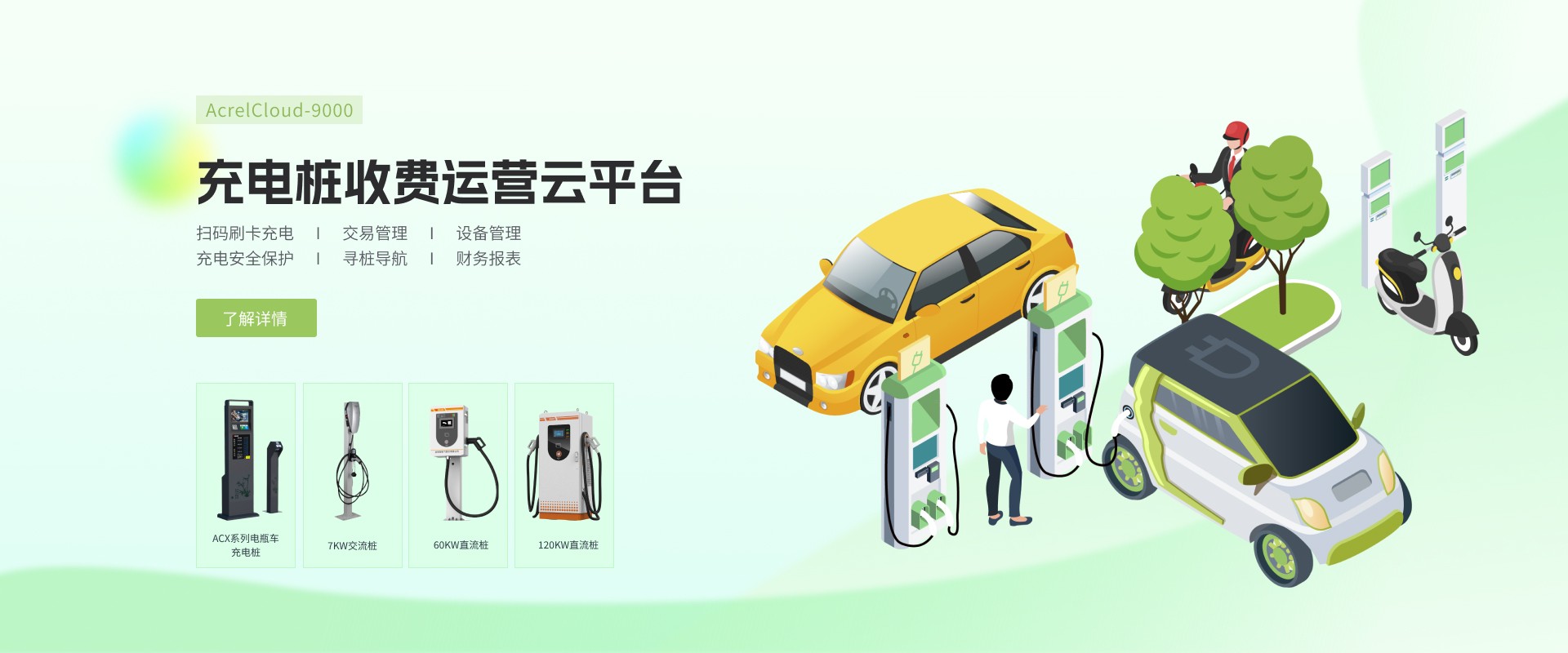
Ankore 6 Charging Station Fee-Based Operation Cloud Platform
6.1 Overview
The AcrelCloud-9000 Ankorai Charging Pole Cloud Platform System continuously collects and monitors data from electric bicycle charging stations connected to the system using IoT technology. It provides real-time monitoring of charging桩 operations, handles charging services, payment management, transaction settlements, resource management, power management, and detailed inquiries. Additionally, it issues early warnings for various faults such as overheating protection, leakage, input/output overvoltage, undervoltage, and low insulation in charging machines. The charging桩 supports internet access via Ethernet, 4G, or WIFI, and users can scan to charge using WeChat, Alipay, or UnionPay Scan.
 6.2 Application Sites
Design of charging infrastructure for civil buildings, general industrial buildings, residential communities, industrial units, commercial complexes, schools, and parks, etc.
6.3 System Architecture
6.3.1 The system is divided into four layers:
1) The data collection layer, network transmission layer, data center layer, and client layer.
2) Data Collection Layer: The electric scooter smart charging station communication protocol is based on the standard Modbus-RTU. The electric scooter smart charging station is used to collect power parameters of the charging circuit and to carry out electricity measurement and protection.
3) Network Transmission Layer: Upload data to the established database server via 4G network.
4) Data Center Layer: Comprises application servers and data servers, with application servers hosting data collection services and WEB websites, and data servers deploying real-time databases, historical databases, and foundational databases.
5) For the client layer: System administrators can access the electric bike charging station billing platform via a web browser. Terminal charging users initiate charging by swiping or scanning a card.
The community charging platform primarily covers functions such as intelligent large screens for charging facilities, real-time monitoring, transaction management, fault management, statistical analysis, and basic data management. Additionally, it provides an operation and maintenance app for maintenance personnel and a charging mini-program for charging users.
6.4 AnkoRe Charging Station Cloud Platform System Function
6.4.1 Intelligent Large Screen
The intelligent large-screen display provides a distribution overview of the stations, offering statistics on equipment status, usage rate, charging frequency, duration, cost, energy, and faults. It also allows for viewing each station's information, list of charging stations, charging records, revenue, energy consumption, and fault logs. It facilitates unified management of community charging stations, monitoring usage rates, and allocating resources efficiently.
6.4.2. Real-time Monitoring
Real-time monitoring of charging facility operations, including charger status, circuit conditions, charge amount during the charging process, charging voltage/current, and charger alarm information.
6.4.3 Transaction Management
Platform administrators can manage charging user accounts, including operations such as recharging, refunding, freezing, and deactivating accounts. They can also view detailed daily charging transaction information for community users.
6.4.4 Fault Management
Equipment automatically reports fault information. Platform administrators can view and dispatch fault notifications through the platform. Meanwhile, maintenance staff can receive fault alerts via the maintenance app, and report the results upon completion of their maintenance work. Charging users can also report on-site issues through the charging mini-program.
6.4.5 Statistical Analysis
Through the system platform, access and query statistics on charging transactions, energy consumption, and other information from various perspectives, including charging stations, facilities, duration, and methods.
6.4.6 Basic Data Management
The system platform enables operators to establish and manage their required sites and charging facilities, maintain charging facility information, pricing strategies, discounts, and promotional activities. Additionally, they can manage online card user top-ups, freezes, and unbindings.
6.4.7 Operations APP
For operations personnel, the system allows management of sites and charging stations, facilitates fault closure processing, checks usage of traffic cards, monitors charging/recharging status, performs remote parameter settings, and can receive fault notifications.
6.4.8 Charging Mini-App
For users of charging stations, the app allows for viewing nearby available devices, and includes features such as scanning for charging, account recharge, charging card binding, transaction inquiry, and fault appeal.
7 Conclusion
In recent years, the rapid development of new energy electric vehicles has been accompanied by issues with charging facilities, such as a lack of public access, incompatibility with EV charging, and high usage costs, all of which have negatively impacted the user experience for charging new energy electric vehicles. There is an urgent need to accelerate the construction of charging infrastructure, as this is a necessity for the times.
Reference
[1] Mai Song Lai. Research on Centralized Energy Planning Technology for Electric Vehicle Charging Piles[J]. Automotive Practical Technology, 2018(24): 9-10.
Zhang Zhenbang. A Brief Discussion on the Current Status and Issues of Electric Vehicle Charging Facilities[J]. Science and Technology Information, 2018, 16(34): 61-62.
Zhang Qian. Key Technology Research and Development of Photovoltaic Charging Piles for Electric Vehicles [D]. Yangzhou University, 2018.
Han Pingjun, Zhang Fang, Zhu Siceng. Design and Intelligent Optimization of Electric Vehicle Charging Pile [J]. China New Technology and New Products, 2018(22): 19-20.
Hu Yuting. Optimal Selection of Electric Vehicle Charging Piles[J]. Digital World, 2018(11): 264.
Ankorri Enterprise Microgrid Design and Application Manual. 2022.05 Edition.
Mothian Yi. Discussion on the Selection and Installation of New Energy Electric Vehicle Charging Poles
