


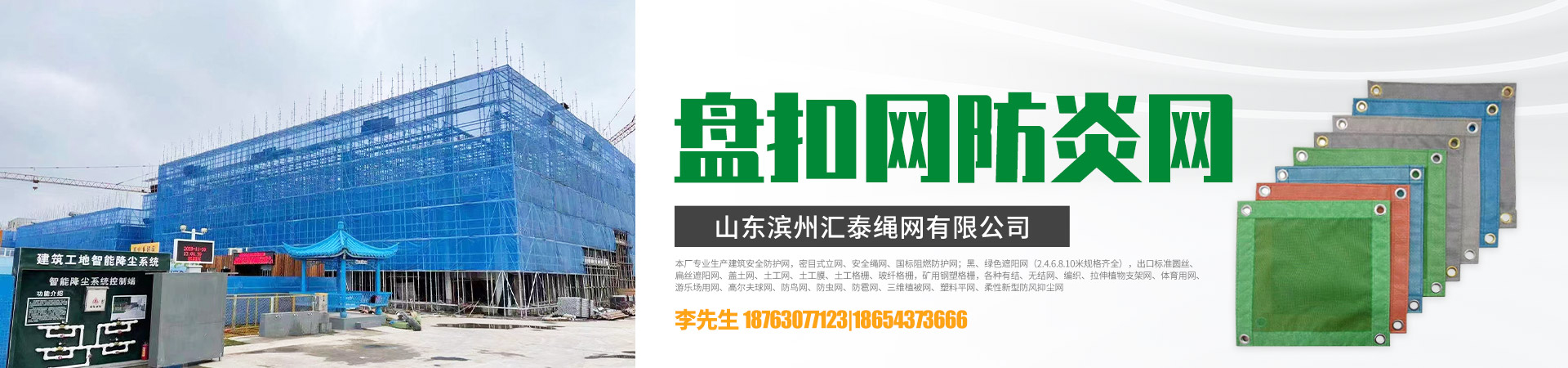

Currently, safety nets used on construction sites are generally categorized into two types based on their function and demand: flat nets and vertical nets. However, due to varying load conditions, there are certain differences in product dimensions, strength, and specifications between the two types of netting. The commonality lies in the composition of the safety net, which consists of netting edge ropes, the core, and circular ring holes. We will discuss the differences between these two types of netting, specifically in terms of their functions.
The function definition of Pingwang (Flat Net): When installing the flat net on the outer side of a vertical building, it should be parallel to the ground. The purpose of this is to prevent significant injury in case people or objects related to building materials fall from height, by increasing the gravity cushioning of the falling objects through the net fabric itself.
The function definition of NaliNet: Installed on the vertical surface of buildings, its purpose is to prevent workers from accidentally falling out of the building during operations. Since unfinished buildings generally lack other safety protections, its role is crucial and vital.
By explaining the specifications of product 2, it can greatly enhance protection. However, when considering all factors, it must select materials that are highly wear-resistant, have high density strength, are lightweight, and also possess certain levels of elongation and service life. You might be surprised to see how many aspects need attention, but it's actually more than that. For instance, the product must be adaptable to various harsh weather conditions, with both cold resistance and heat resistance. For the finished products, the weight cannot exceed 15 kilograms and the impact resistance must be no less than 900N.
The standard specifications for our commonly used products are 1.8 meters by 6 meters or 1.5 meters by 6 meters, but we also offer customization based on customers' special requirements. The mesh fabric for the 1.8 meters by 6 meters size typically weighs no less than 2 kilograms, and the mesh count within a 10 cm by 10 cm area must be at least 1800 meshes. Conversely, a safety net of the same weight but with a mesh count less than 1800 meshes cannot be used for protective safety purposes. It can only be used for dust control, windbreak, or sunshade functions, as its tensile strength and durability are insufficient to withstand the impact force equivalent to a human body when used on the exterior of a building.
Currently, there are numerous safety net manufacturers across the nation, with a chaotic array of specifications and varieties, and the quality of the products is also a matter of concern. Adopting a work attitude that considers no safety accident trivial, it is crucial to check the customized dimensions, quantities, and mesh counts upon our unit's procurement. An essential point is to conduct impact resistance tests and high-altitude penetration inspections.
