
PSA Nitrogen Generator Operation Process

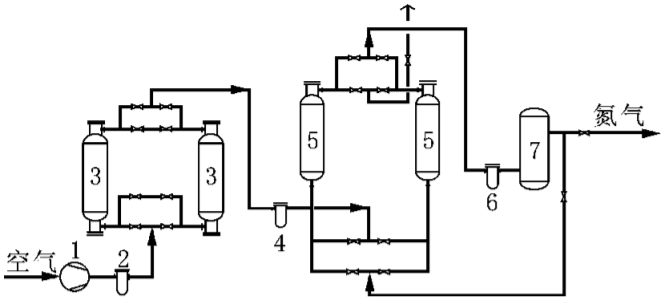
1—Air Compressor; 2—Filter; 3—Drier; 4—Filter; 5—PSA Adsorption Tower; 6—Filter; 7—Nitrogen Buffer Tank
After air is compressed by an air compressor, it undergoes dust and oil removal, and drying before entering an air storage tank. It then passes through an air intake valve and a left suction intake valve into the left adsorption tower. As the tower pressure increases, oxygen molecules in the compressed air are adsorbed by carbon molecular sieve. The unadsorbed nitrogen gas passes through the adsorption bed, then through the left exhaust valve and nitrogen gas production valve into the nitrogen storage tank. This process is known as...Left SuctionThe process lasted for several seconds. After the left adsorption process was completed, the left adsorption tower was connected to the right adsorption tower through the upper and lower equalizing valves, allowing the pressures of both towers to equalize. This process is referred to as...Uniform PressureAfter the equalizing pressure lasts for 2 to 3 seconds, the compressed air passes through the air intake valve and the right suction intake valve into the right adsorption tower. The oxygen molecules in the compressed air are adsorbed by the carbon molecular sieve, and the enriched nitrogen gas is then passed through the right exhaust outlet.
Valves and nitrogen gas production valves are introduced into the nitrogen storage tank; this process is referred to as...Right-hand sideThe duration is several seconds. Meanwhile, the oxygen adsorbed by the carbon molecular sieve in the left adsorption tower is depressurized and released back into the atmosphere through the left exhaust valve, a process referred to asDesorptionIn reverse, when the left tower adsorbs, the right tower simultaneously desorbs. To ensure that the oxygen released during the pressure reduction in the molecular sieve is completely discharged into the atmosphere, nitrogen is blown through an open purge valve to sweep the desorbing adsorption tower, expelling the oxygen from the tower. This process is called reverse blowing and is carried out simultaneously with desorption. After the right adsorption is completed, the equalizing pressure process begins, followed by switching to the left adsorption process, and this cycle continues.
The nitrogen generator's operational process is controlled by a programmable controller that manages ten two-way five-way pilot solenoid valves. These solenoid valves then individually control the opening and closing of ten pneumatic pipeline valves. The ten two-way five-way pilot solenoid valves govern the left suction, pressure equalization, and right suction states. The time sequences for left suction, pressure equalization, and right suction are stored in the programmable controller. In the event of a power outage, the pilot gases of the three two-way five-way pilot solenoid valves are connected to the closing ports of the pneumatic pipeline valves. When the process is in the left suction state, the solenoid valve controlling the left suction is energized, the pilot gas connects to the left suction intake, left suction gas production, and right exhaust valve openings, allowing these valves to open, completing the left suction process while the right adsorption tower desorbs. When the process is in the pressure equalization state, the solenoid valve controlling pressure equalization is energized, with all other valves closed; the pilot gas connects to the upper and lower pressure equalization valve openings, allowing these valves to open, completing the pressure equalization process. When the process is in the right suction state, the solenoid valve controlling the right suction is energized, the pilot gas connects to the right suction intake, right suction gas production, and left exhaust valve openings, allowing these valves to open, completing the right suction process while the left adsorption tower desorbs. In each stage of the process, all valves except the ones that should be open should remain closed.
PSA Nitrogen Generation System Equipment
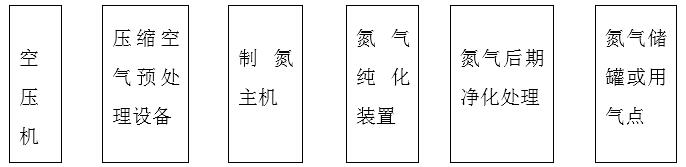
Manufacturing standard purity nitrogen (with purity ranging from 95% to 99.9% or 95% to 99.999%), the PSA air separation nitrogen system consists of the following equipment: (The specific composition may vary according to different user requirements.)

Our high-purity nitrogen (purity >99.9% to 99.9995%) PSA air separation nitrogen system consists of the following equipment (the specific composition may vary according to different user requirements):

Choose Nitrogen Generator Air Compressors
PSA air separation nitrogen production directly extracts nitrogen from the air through pressure adsorption and atmospheric pressure desorption, making the air compressor the power source for gas compression. Currently, the widely used air compressors mainly include screw compressors and reciprocating compressors. Both types of compressors have their own characteristics and can be used in nitrogen production systems. Generally, screw compressors have less gas loss, higher gas production efficiency, lower noise, and less maintenance, but the compressed air usually contains oil and is relatively expensive. For nitrogen production systems, oil-free lubricated compressors are recommended.
The air compressor's discharge volume is determined by the specifications of the nitrogen generator. Generally, to prevent the air compressor from running at full load continuously, there is a certain amount of unloading time, which is beneficial for the long-term effective use of the air compressor. When selecting the air compressor's discharge volume, the screw air compressor's discharge volume is typically 10% to 15% larger than the required air volume of the nitrogen generator, while the reciprocating air compressor's discharge volume is usually 20% to 25% larger than the required volume.
The recommended rated exhaust pressure for air compressors is between 0.8 to 1.0 Mpa (at least ≥0.7 Mpa), as both excessively high and low exhaust pressures are undesirable.
For locations at an altitude of ≥1000m, consider atmospheric pressure when selecting a compressor. Please consult the compressor supplier or contact our company.
The oil content in the compressed air discharged from air compressors must be ≤10ppm; it is recommended to use oil-free air compressors.
The primary power consumption in the PSA nitrogen system is due to the air compressor's power consumption.
The above content is sourced from the internet. If there is any infringement, please contact us.