
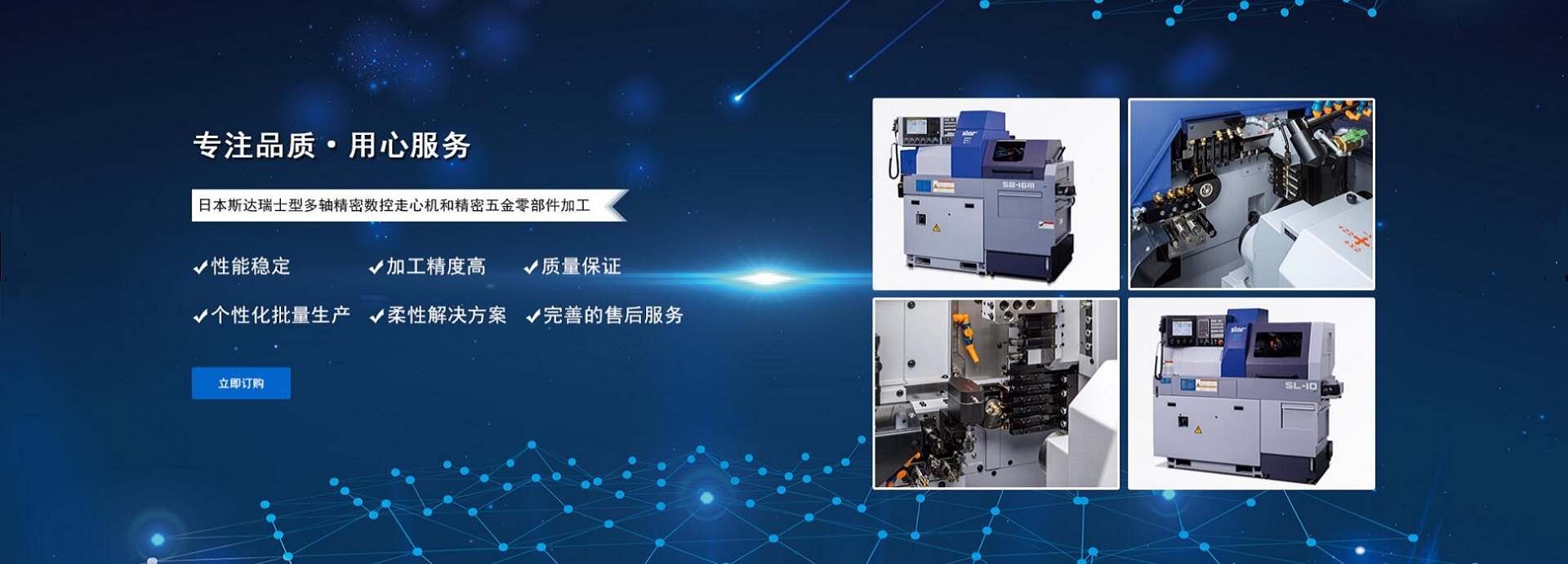
The features of the double-spindle CNC centerless grinding machine:
One, due to the simultaneous operation of five cutting tools and two tailstocks on the double-spindle CNC turning centers during the machining process, this type of machine tool can process parts four to six times faster than CNC machine tools.
Complex parts can undergo simultaneous external cylindrical, spherical, conical, arcuate, stepped, grooved, drilled, threaded, chamfered, and cut processing, completing all operations in one go without manual handling. Automatic feeding achieves full automation, allowing one operator to oversee multiple machines. Additionally, a milling device can be used for external threading, resolving issues with the difficulty of cutting nuts, and it is capable of producing double-ended threads.
The double-spindle CNC centering machine features five tool holders, each equipped with a micron dial for fine adjustment to achieve high precision in workpieces; over ten tools can be mounted based on the workpiece processing procedures. The two-axis setup includes a spindle with an electromagnetic clutch to drive the tapping spindle, utilizing the rotational difference between the high-speed rotation and the mechanical spindle for tapping. The second axis can be swiveled for variable processing, allowing for simultaneous completion of threading and internal/external threading in one operation.
The structure is precise, controlled by cams for production, with each rotation of the cam completing the processing of one part. The cam speed ranges from 1.0 to 36 rotations per minute, adjustable according to different parts to be processed, capable of producing up to 36 parts per minute.
What are the components of a twin-spindle CNC turning center?
1. The drive system, which serves as the power source for CNC machine tool robots, can be motor-driven, hydraulic-driven, or pneumatic-driven, among others.
2. The transmission system, which functions to convey motion and power to various actuating mechanisms, enabling the process operations of CNC machine tool manipulators, also transmits motion to auxiliary mechanisms for auxiliary actions.
3. The actuator, which is a component for the automation and auxiliary operation of CNC machine tools, determines its sequence of action and motion law based on the process principles and requirements.
4. The Control System, which is responsible for regulating the machine's drive system, transmission system, and actuator, distributing motion to each actuator, and ensuring coordinated actions are executed on time and in sequence.
5. The inspection system, which monitors and feeds back to the control system the position, travel, speed, pressure, and flow of the CNC machine tool's mechanical arm.
News Center Co., Ltd.