
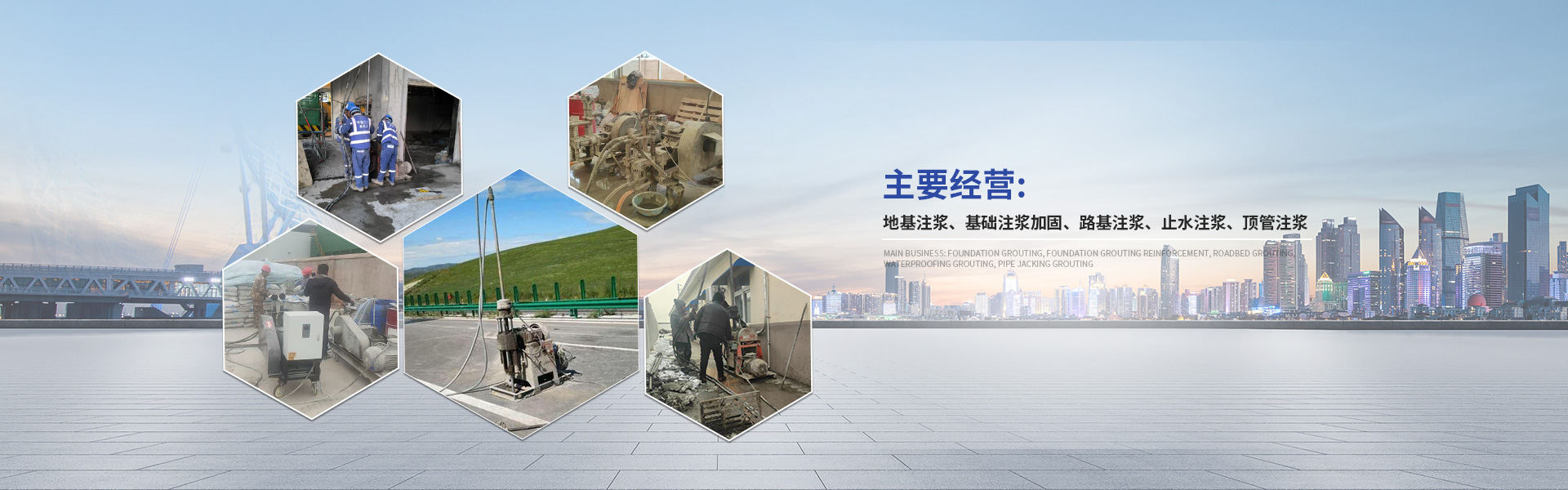
公司主营:Foundation Reinforcement, Grouting Foundation Reinforcement, Foundation Settlement Reinforcement, Roadway Settlement Reinforcement, Foundation Reinforcement, Grouting Foundation
010-68606805
企业资质
No Chinese content provided.
2025-02-26
Reasons for the foundation subsidence
Soil foundation is weak.Insufficient bearing capacity or excessive compressibility of subsoil can't support the weight of buildings, leading to foundation settlement. Soils like soft clay and silt loam are prone to significant settlement under the load of structures.
Ground conditions are uneven.The soil foundation exhibits significant differences in properties horizontally or vertically, resulting in uneven settlement across various parts of the foundation.
Groundwater ChangesThe fluctuation of groundwater levels can affect the mechanical properties of soil foundation. For instance, a drop in groundwater levels can lead to an increase in effective stress of the soil foundation, causing sinking of the foundation; conversely, a rise in groundwater levels may weaken the soil foundation's strength and reduce its bearing capacity.
Construction Quality ConcernsDuring the foundation construction process, insufficient foundation depth, poor concrete pouring quality, and irregular ground treatment can all lead to foundation settlement.
Methods for Foundation Subsidence Reinforcement
Basic reinforcement grouting reinforcementHoles are drilled in the base or side, and slurry (such as cement slurry, epoxy resin, etc.) is injected into the soil beneath the foundation through pressure. This fills the soil pores, enhancing the soil's strength and compactness, thereby increasing the foundation's load-bearing capacity and preventing further settlement. Suitable for situations where the soil beneath the foundation is relatively soft and the settlement amount is small.
Increase the Base Area MethodWhen the foundation's base area is insufficient, causing the foundation to sink, reinforcing can be achieved by increasing the foundation's base area. New concrete foundations are poured around the original foundation to enlarge the bearing area of the foundation, reduce the base pressure, and control the foundation's sinking. This method is suitable for cases where the bearing capacity of the foundation is not significantly different.
Anchor Bolt Static Pressure Piling MethodBy utilizing the self-weight of the building, this method involves drilling pile holes in the foundation, installing anchor rods, and segmentally pressing the piles into the subsoil. Subsequently, the piles are connected to the foundation, with the piles bearing a portion of the building's load, thereby reducing the settlement of the foundation. This technique is suitable for various types of subsoil, particularly for soft soil foundations and renovation or reinforcement projects.
Root-stake Reinforcement MethodAround or beneath the foundation, some small-diameter bored piles (root piles) are set. These piles are connected to the foundation as a single unit, sharing the upper loads. Root piles can be arranged in various forms as needed, such as straight piles or inclined piles, to enhance the stability and load-bearing capacity of the foundation soil. They are suitable for buildings with poor foundation soil, significant foundation settlement, and high requirements for deformation.
Lime Piling MethodBy driving lime piles into the foundation, utilizing lime's water absorption, expansion, heat generation, and ion exchange properties, we improve the physical and mechanical properties of the foundation soil, enhancing its strength and compactness, thereby reducing foundation settlement. Suitable for treating soft clay and silt foundation soils with high water content.
Construction Key Points for Foundation Subsidence Reinforcement
Pre-construction Inspections and AssessmentsPrior to reinforcement construction, a detailed assessment of the building's foundation and subsoil is necessary, including the foundation's dimensions, reinforcement, concrete strength, the properties of the subsoil, and its bearing capacity, to determine the cause and extent of foundation settlement and provide a basis for selecting the appropriate reinforcement method.
Construction Process MonitoringDuring the reinforcement construction process, strengthen monitoring of the building's settlement, tilting, and other deformations, and promptly grasp the dynamic changes of the building. In case of any abnormal conditions, immediately halt the construction, analyze the cause, and take appropriate measures for handling.
Material Quality ControlMaterial quality control is strictly enforced during the reinforcement construction process, including cement, steel, grouting materials, etc., to ensure they meet design requirements and relevant standards and specifications.
Construction MeasuresFoundation sinking reinforcement construction is typically carried out on existing buildings. During the construction process, attention must be paid to the work and necessary protective measures must be taken, such as setting up warning signs and providing support and protection for the building, to prevent accidents from occurring.
任强 (Mr.)
010-68606805
13466562881
1728111219@qq.com
2 Group 284, Wanglou Village, Dazha Town, Daming County, Handan City, Hebei Province
www.114global.com © Zhongshang 114 Hebei Network Technology Co., Ltd.Address: Room 6009, Oriental New World Center, No.118 East Zhongshan Road, Qiaoxi District, Shijiazhuang City, Hebei ProvincePlatform Service Hotline: 4006299930
