

In the selection of central air conditioning systems, the choice between water-based and refrigerant-based systems has always been a focus for users. With the increasing demand for energy efficiency in buildings and users' emphasis on comfort, the technical differences and applicable scenarios of the two systems are gradually becoming key factors in decision-making.Tianxiang EditorIn-depth analysis of the core differences between the two from three dimensions: working principle, performance comparison, and scenario adaptation.
I. Differences in the Underlying Logic of Technical Principles
Water System Air Conditioning
With water as the refrigerant medium, chilled through chillersHeat is transferred to the terminal fan coil units. The water circulation system requires a cooling tower (for refrigeration) or a boiler (for heating) to regulate indoor temperature through secondary heat exchange. It essentially belongs to an indirect heat exchange mode with a high level of system openness.
2. Fluorine System Air Conditioner
Rely on RefrigerantsR410A and other chlorofluorocarbon derivatives are directly evaporated for heat absorption, and the refrigerant circulation between the indoor and outdoor units of multi-split systems is achieved through copper pipes. Utilizing a single heat exchange method, it falls under a closed-loop system where the refrigerant undergoes phase change heat transfer within the pipes.
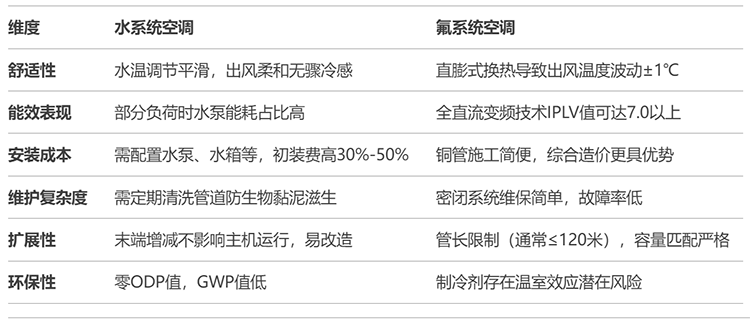
Core Performance Comparison Analysis
III. Typical Application Scenario Compatibility Guide
Advantages in Water System Fields
Large commercial complexes (over 50,000 square meters)
Facilities requiring isothermal humidity accuracy greater than ±0.5℃ in the laboratory.
Buildings requiring simultaneous cooling and heating for transitional season operations
Geothermal Heat Pumps and Other Renewable Energy Coupling Projects
2. Optimal Fluorine System Scenarios
Small to Medium-Sized Office Buildings (Single-Level Area < 2,000 sqm)
Residential spaces with restricted floor heights, such as apartments and villas
- Renovation Project of Existing Building (No extensive piping work required)
Extreme climate areas (heating needs at -25℃ temperatures)
IV. Trends in Technological Evolution
- Smart Water System Upgrade: Magnetic levitation compressor + variable frequency pump achieve an integrated energy efficiency ratio exceeding 5.8, with an IoT platform enabling automatic adjustment of hydraulic balance.。
- Fluorine System Environmental Transformation: Low GWP Refrigerants like R32/R290 Gain Widespread Adoption, CO₂ transcritical cycle technology Enters Commercial Phase。
Innovative Hybrid Systems: Water-Fluoride Composite Systems Begin to Be Applied in Special Environments Such as Data Centers, Balancing Local Precision Temperature Control and Overall Energy Efficiency。
Choosing between a water system and a fluorine system is fundamentally a comprehensive consideration of the total lifecycle cost of the building.For public buildings over 20,000 square meters, it is recommended to use water systems to leverage scale benefits, while for commercial spaces under 3,000 square meters, opting for a fluorine system is more economically viable.
