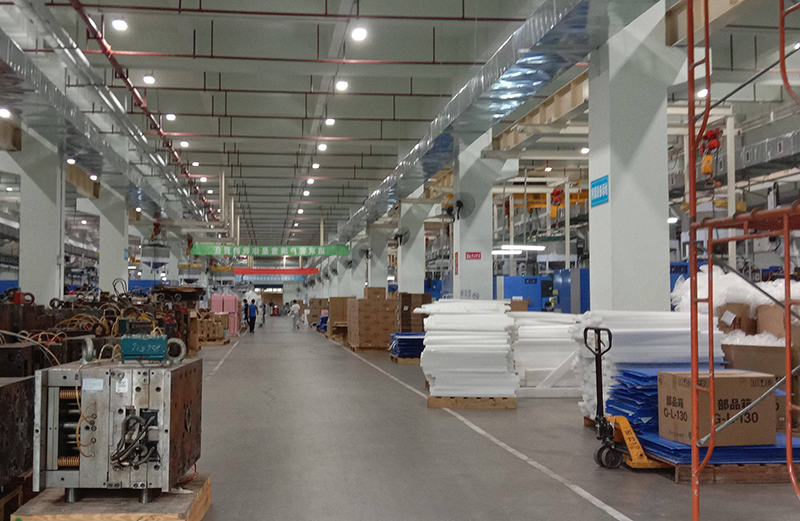
In modern factory production and management, the rational configuration of the central air conditioning system plays a crucial role in enhancing the comfort of the production environment, ensuring stable operation of equipment, and controlling energy costs. When it comes to a 1,000-square-meter factory, selecting an appropriate central air conditioning system requires considering various factors, including the factory's functional layout, spatial utilization, energy efficiency, and budget costs.

Here are three recommended cost-effective system solutions:
One-to-one Air Duct Machine System Solution
System Composition
The One-to-One Ducted Air Conditioning System consists of an outdoor unit and an indoor ducted unit. The outdoor unit is installed in an appropriate location outside the factory, such as on the roof or on the ground. The indoor ducted unit is connected to the outdoor unit via ductwork and is installed in the factory areas requiring air conditioning, distributing cold and hot air to various locations through the ductwork.
For instance, in the production workshop of the factory, the indoor ducted air conditioner can be installed above the ceiling, distributing cold and hot air evenly to each work area through the ducts.
2. Advantages
Initial investment costs are relatively low. Compared to multi-split systems, the procurement costs for a single-split ducted air conditioning system may be lower, as its system composition is relatively simple, consisting of only one outdoor unit and one indoor ducted air handler.
Installation is convenient. The installation of the one-drag-one duct system is relatively simple, requiring only the connection of the duct and electrical lines between the outdoor main unit and the indoor duct unit, with a relatively short installation period.
The ventilation is excellent. The ducted air handler can evenly distribute cold and hot air throughout the factory using the ductwork, achieving a good ventilation effect and improving indoor air quality.
Two, Multi-LinkVRV System Solutions
System Composition
The multi-split system consists of one or more outdoor units and multiple indoor units. The outdoor units are typically placed in an appropriate location outside the factory, such as on the roof or on the ground. The indoor units can be selected in various forms, including embedded, wall-mounted, or ducted, based on the factory's layout and functional zones.
For office areas within the factory, wall-mounted indoor units can be installed as they take up minimal space and are visually appealing. For larger production workshops, ducted indoor units are recommended, which distribute chilled and warm air to various locations through ducts.
2. Advantages
The system offers high energy efficiency. The multi-split system can automatically adjust the compressor's operating frequency based on the load conditions of different indoor units, achieving energy-saving operation. For instance, when there are no people or equipment in operation in certain areas of the factory, the corresponding indoor units can automatically reduce power, thereby cutting down energy consumption.
Flexible installation. It can accommodate factory buildings with various structural and spatial layouts. The indoor and outdoor units can be connected through refrigerant pipes, with the pipe length adjustable within a certain range, facilitating installation at different locations.
Ease of control. With multiple indoor units, a centralized control system can be used to manage them collectively, such as simultaneously turning on or off units in certain areas or setting parameters like temperature centrally.
Three: Air-Cooled Modular Unit + Air-Cooled Coil System Solutions
System Composition
The air-cooled module unit is an outdoor unit, typically installed in a suitable outdoor location, such as near the factory's exterior wall or on the roof. The fan coil indoor units are distributed throughout the factory in areas requiring air conditioning, connected to the outdoor unit via pipes to utilize the chilled and hot water produced by the main unit for cooling and heating purposes.
Outdoor air-cooled module units are connected to the fan coils inside the factory through water pipes. The fan coils exchange cold or hot water with indoor air, thereby achieving the purpose of regulating the indoor temperature.
2. Advantages
Initial investment costs are relatively low. Compared to multi-machine systems, the air-cooled module units offer the same cooling and heating capacity. The procurement cost for the fan coil system may be lower.
The indoor unit of the fan coil is compact in size, occupying minimal indoor space, and easy to install. It is particularly convenient for installation in factory renovations or limited spaces.
Outdoor main units are relatively easy to maintain. Air-cooled module units are typically centralized for convenient maintenance and repair, with relatively low maintenance costs.
When selecting a central air conditioning system for a factory, it's crucial to consider factors such as the factory's actual use, architectural structure, local climate conditions, power supply, and future expansion needs.