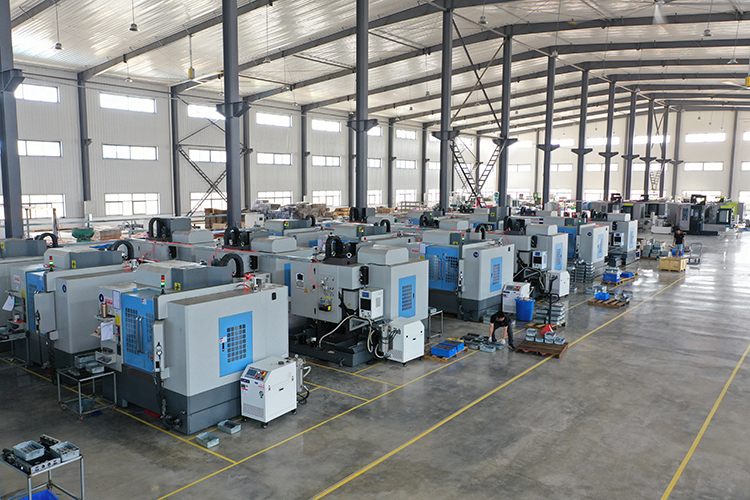
In industrial production and business operations, the comfort and suitability of the workshop environment play a crucial role in production efficiency, product quality, and the physical and mental well-being of employees. For a facility spanning For a 2,300-square-meter workshop, the installation of a central air conditioning system has become a crucial step to enhance the overall environment of the workshop.

Option 1: One-to-One Duct Air Conditioning System
Composed of an outdoor unit and an indoor ducted unit. The outdoor unit is installed in an appropriate location outside the workshop, such as on the roof or ground level; the indoor ducted unit is connected to the outdoor unit via ducts and installed in the workshop areas requiring air conditioning, distributing cold and hot air to various locations through the ducts.
Advantages
Initial investment costs are relatively low: the system composition is relatively simple, consisting of only one outdoor unit and one indoor ducted machine, which may have a lower procurement cost than multi-split systems.
Installation Ease: The installation process is relatively straightforward, requiring only the connection of the ductwork and electrical lines between the outdoor main unit and the indoor air handler, with a relatively short installation period.
Ventilation Excellence: Cold and hot air can be evenly distributed to every corner of the workshop through ducts, achieving excellent ventilation and improving indoor air quality.
Applicable Conditions
If the workshop has low requirements for zonal control of air conditioning and a limited budget, a single-split ductless system is a good choice. However, forA 2,300-square-foot workshop may require multiple systems to be combined.
Option Two: Multi-connectionVRV System
Comprised of one or more outdoor units and multiple indoor units. The outdoor units are typically placed in suitable locations outside the workshop, such as on the roof or on the outdoor ground. The indoor units can be selected in various forms, including built-in, wall-mounted, or ducted, based on the workshop's layout and functional zones.
Advantage
High Energy Efficiency: The system can automatically adjust the compressor's operating frequency based on the load conditions of different indoor units, achieving energy-saving operation. For instance, when there are no people or equipment in operation in certain areas of the workshop, the corresponding indoor units can automatically reduce power to minimize energy consumption.
Flexible Installation: The workshop can accommodate various building structures and spatial layouts. Indoor and outdoor units can be connected via refrigerant pipes, with pipe lengths adjustable within a certain range, facilitating installation in different locations.
Convenience of Control: In cases with multiple indoor units, centralized control systems can be used for unified management, such as simultaneously turning on or off indoor units in certain areas, or setting parameters like temperature centrally.
Applicable Conditions
If the workshop is well-zoned with specific functional areas and has higher requirements for zoned air conditioning control and energy saving, a multi-split system is a more suitable choice.
Option 3: Air-cooled Modular Unit + Air Handler Coil System Solutions
The air-cooled modular unit is an outdoor unit, typically installed in a suitable outdoor location such as near the workshop exterior wall or on the roof; the fan coil indoor units are distributed throughout the workshop in areas requiring air conditioning, connected to the outdoor unit via pipes to utilize the chilled and hot water produced by the main unit for cooling and heating.
Advantages
Good energy efficiency: The main unit can be modularly combined based on actual load requirements, effectively reducing energy consumption during partial load operation.
High Flexibility: The number and placement of fan coil units can be flexibly configured to meet the specific requirements of different areas in the workshop.
Applicable Conditions
If the workshop is spacious and there's a demand for both comfort and energy efficiency, a fan-cooled module unit The fan coil system is a viable solution.