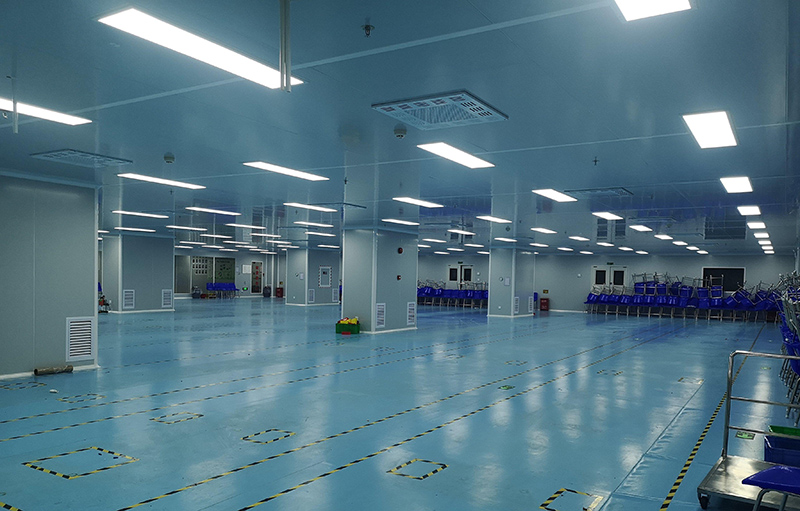
The comfortable environment in the workshop plays a crucial role in enhancing work efficiency, ensuring employee health, and guaranteeing the smooth operation of equipment.The 5,000-square-meter factory, serving as the space for numerous production activities, has always been a focus for managers regarding the installation costs of its air conditioning system. A rational air conditioning system not only provides the workshop with suitable temperature and humidity conditions but also optimizes air circulation, creating a favorable environmental foundation for various operations within the workshop.

One,Central Air Conditioning Refrigeration Capacity
This is the most critical factor in determining cost, far beyond just the area.
1. Height: The larger the volume, the greater the required cooling capacity.
2. Workshop Characteristics: Different production processes generate varying heat loads (equipment heat, personnel heat dissipation, lighting heat).
Insulation Condition: Poor insulation requires a greater cooling capacity to compensate for heat loss or intrusion.
4. Personnel Density: The number of people working simultaneously within the workshop.
5. Equipment Heat Output: Large machinery, furnaces, welders, etc., generate significant heat.
6. Presence of heat sources: Does the facility have equipment such as ovens, boilers, large motors, etc., that continuously dissipate heat?
Location and Climate: The highest outdoor temperatures and humidity levels in summer directly impact the cooling load.
8. Ventilation Requirements: Do you need to supplement a significant amount of fresh air? (This will significantly increase the load.)
9. Target Temperature: How low does it need to go? There's a significant load difference between 25°C and 18°C.
Central Air Conditioning System Types:
Chilled Water System: Chiller unit (screw, centrifugal, etc.) + Cooling Tower + Air Handling Unit (AHU), Ceiling Cassette, Fan Coil Unit, etc. Advantages: High energy efficiency (especially for large systems), stable operation, suitable for large spaces and harsh environments. Disadvantages: High initial investment, requires机房 and cooling tower location, complex installation, and high maintenance requirements. This is one of the most common choices for a 5,000 square meter workshop.
2Air-cooled modular unitScrew Chiller: Outdoor Unit (Air-Cooled Chiller) + Air Conditioning Terminal (Water-Cooled). Advantages: No need for cooling towers and machine rooms (space-saving), relatively easy installation. Disadvantages: Typically slightly lower energy efficiency than water-cooled, especially in high-temperature environments; outdoor unit is louder; moderate to high initial investment.
3Multi-split System: Large commercial multi-split systems (one large outdoor unit with dozens of indoor units). Advantages: Flexible design, good zoning control, relatively easy installation. Disadvantages: Energy efficiency and cost may not be as competitive on super-large areas compared to water-cooled systems.Air-cooled module systems have advantages with limited refrigerant piping length and drop. For a 5,000-square-meter area, multiple large systems may be required.
4Large Industrial Split-Type Air Conditioners/Case Units: Combination of multiple high-power split air conditioners or case units for industrial use. Advantages: Lower initial investment (especially for small systems), easy installation. Disadvantages: Lower energy efficiency (compared to central systems), decentralized management and maintenance, excessive piping affecting aesthetics, and a large number of outdoor units requiring more space. Suitable for situations with light loads, clear zoning, and extremely limited budgets. However, this solution is inefficient and difficult to manage for an overall area of 5,000 square meters.
5Roof-top Air Conditioners: Integrate cooling, heating, and air distribution functions into a single unit mounted on the roof. Advantages: Saves ground space, relatively quick installation (high structural requirements). Disadvantages: Maintenance requires roof access, high roof load-bearing and waterproofing requirements, limited individual unit capacity, may require multiple units, energy efficiency and noise levels must be considered.
ThreeCentral Air ConditioningBrand and Quality
International top brands' equipment (such as Daikin, Carrier, Trane, McQuay, Gree, Midea, etc.) are significantly more expensive than domestic second- or third-tier brands. The quality of the core components (compressors, control systems) also varies greatly.
FourInstallation Difficulty and Engineering Volume
Ductwork System: Central air conditioning requires extensive duct installation, with higher workshops and more complex layouts leading to increased costs for duct materials and installation (galvanized steel, insulation materials, labor).
Piping System: The water system requires the installation of chilled water pipes, condensate pipes, and insulation. The longer and more complex the pipes, the higher the cost.
Chilled Media Pipe System: Multi-split or split systems require extensive copper piping and insulation.
V. Air Conditioning Costs for the Workshop
Multi-split central air conditioning Price, higher per square meter Approximately 300-350 yuan for a 5,000 square meter workshop, the cost would be around 1.5 to 1.75 million yuan.
Water-Cooled Screw Chiller Unit + Air-cooled Ceiling Cassette: Priced lower than multi-split systems, approximately 200-250 yuan per square meter, with a total cost of around 1 million to 1.25 million yuan.
Air-Cooled Screw Chiller Unit + Air Handling Unit: More affordable pricing at 150-200 yuan per square meter, with total costs around 750,000 to 1,000,000 yuan.