

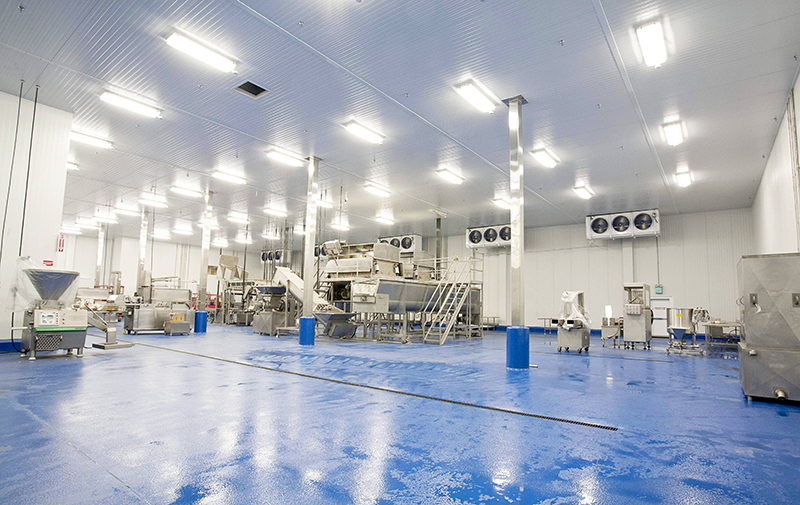
In the modern industrial landscape, large factories are no longer mere assemblages of steel and concrete; they are the convergence points of precise production processes and stringent environmental control. High-temperature equipment operates around the clock, production lines are bustling with workers, and storage areas and assembly spaces have vastly different thermal requirements.The traditional "one-size-fits-all" cooling method not only consumes a huge amount of energy but is also more likely to lead to a sharp drop in the yield of high-quality products due to uncontrolled temperature and humidity.
The following is a systematic design process and key points:
Initial needs research and load calculation
- Factory Floor Parameters: Precise measurements of area, height, orientation, and zoning for use (production, warehousing, office, etc.).
- Thermal Source Analysis: Statistical data on equipment heat dissipation (e.g., welding, injection molding equipment), personnel density (each person dissipates approximately 100-120W), lighting, and heat transfer coefficients of the enclosing structures.
Load Calculation: Total cooling load is determined through professional software (such as Hongye Load Calculation), with industrial buildings typically estimated at 100-150W/m³, and high-temperature workshops requiring an increase of 20%-30%.
Section II: System Type Selection
Select an appropriate system based on factory size and requirements.
1. Water-cooled screw chillers are suitable for workshops over 5,000 square meters with high heat loads, offering high energy efficiency and stability. They require a cooling tower and machine room.
2. Air-cooled modular unit suitable for medium to large areas and water-scarce regions; flexible installation, but efficiency decreases in high-temperature environments.
3. Multi-split (VRV) systems meet the needs for independent control in separate zones (such as office areas), offering energy efficiency and precision with a higher initial investment.
4. Centralized air conditioning systems are suitable for complex, large-scale factory structures with wide coverage and strong stability, requiring professional maintenance.
ThreeCentral Air Conditioning SystemKey Design Elements
1. Host and terminal layout
- Preferred Host Location: Opt for an outdoor area with good ventilation and weight-bearing capacity (≥1.5 tons/m²), away from heat sources and windward sides.
Terminal Air Distribution
- Tall Spaces (≥8 meters): Equipped with swirl diffusers or jet air-handling units, the throw can reach over 15 meters.
Layered Control: For factories with a height of 10 meters or more, a layered air conditioning system can be designed (controlling only the working area height of 2-4 meters), achieving over 30% energy savings.
2. Pipeline and Airflow Organization
Wind Speed Design: Main pipeline at 8-10 m/s, branch pipeline at 4-6 m/s; reduce elbows and reducers to decrease resistance.
- Airflow Method: Side-to-bottom for narrow and long workshops; top-to-bottom for large single-story factories.
Cold Condensation Prevention: For low-temperature air supply pipelines (such as food factories), use 25mm thick rubber and plastic insulation, and wrap it with an aluminum foil moisture-proof layer.
3. Intelligent Control System
- Zone Control: Achieves independent temperature control for workshops and office areas through PLC or DDC systems, supporting remote monitoring and time scheduling.
-Energy-saving Strategy: Dynamically adjust fresh air volume using CO2 concentration sensors, and activate the free cooling mode (utilizing the low outdoor air temperature) during transitional seasons.
Construction and Inspection Precautions
- Installation sequence: Main unit → Pipe (pressure test ≥1.6MPa) → Duct (leakage light detection) → Insulation → System debugging.
- Acceptance Standards:
-Temperature Deviation: ±2℃ in the work area;
Noise: ≤65dB (production area), ≤45dB (office area)
- Efficiency Ratio: Water-cooled unit COP≥5.0, Air-cooled unit COP≥3.2.
