In the HVAC field, we often encounter such as...A series of professional terms: VRV, VAV, KRV, VWV, FCU, AHU, PAU, RCU, MAU, FU, HRV, FAU, OAC, and EAF. What concepts do these letter combinations represent? And what are the differences between them?

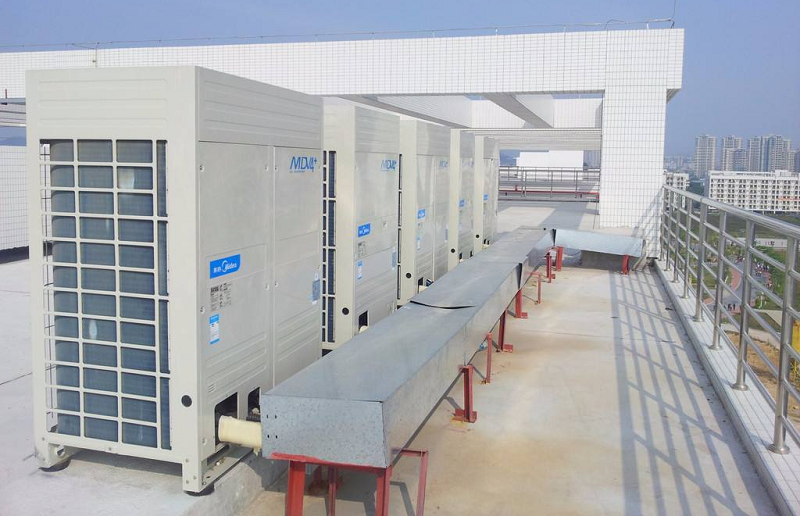
VRV (Variable Refrigerant Volume Multi Split Air Conditioning System)The VRV represents a variable refrigerant volume multi-split air conditioning system, which meets indoor heating and cooling needs by regulating the refrigerant circulation amount of the compressor and the refrigerant flow into the indoor heat exchanger, belonging to a direct evaporative refrigeration system. The system was launched by Daikin Industries in Japan in 1982, and "VRV" has become the registered trademark of Daikin's variable refrigerant flow multi-split system, hence the industry often uses "VRF" to refer to similar systems. VRV adopts the method of one outdoor unit corresponding to multiple indoor units, controlling the refrigerant flow by adjusting the compressor speed of the outdoor unit based on the number of indoor units in use.
VAV (Variable Air Volume) SystemThe VAV system, which adjusts indoor temperature and humidity by modifying the airflow, originated in the United States in the 1960s. Due to its significant advantages, it has rapidly gained popularity worldwide, now accounting for 30% of the global air conditioning market and becoming the mainstream trend in air conditioning development. The usage rate in foreign high-rise buildings has reached 95%. This system is particularly suitable for scenarios with large and frequent differences in cooling and heating loads in air conditioning areas, such as environments that require constant supply of cold air in the interior zones of buildings.
KRV (Air-to-Air Exchangers, Heat Recovery Ventilators):The KRV Full Heat Energy Recovery Ventilator effectively exchanges indoor stale air for fresh air, utilizing the micro-pores on the panel for humidity exchange, ensuring both ventilation performance and uniform indoor humidity.
VWV (Variable Water Volume System)The VWV Variable Water Volume system is more mature in research and application compared to the VAV system. The VWV and VAV share many similarities in characteristics, and in actual engineering, the same control strategies can be employed.
FCU (Fan Coil Unit):Terminal equipment of air conditioning systems, the fan coil circulates indoor air and cools (or heats) it by passing it through a chilled (or hot) water coil, maintaining stable indoor temperatures. It relies on a fan to force air circulation, enhancing the convective heat transfer between the radiator and the air, thereby quickly adjusting the indoor temperature.
AHU (Air Handling Unit)Air-handling units, also known as air conditioning boxes or air handling cabinets, utilize fans to drive the exchange of heat between indoor air and the coil within the unit, while filtering impurities in the air. This process controls the temperature and airflow of the outgoing air, maintaining the indoor temperature, humidity, and air cleanliness. Equipped with fresh air functionality,AHU can also perform heat and moisture treatment, as well as filtration for fresh or recirculated air. The air handling units come in various configurations, including ceiling-mounted, vertical, horizontal, and modular types.
FAU (Air Handling Unit)The FAU air handling unit is designed to provide fresh air, available in both residential and commercial models. It draws in fresh outdoor air, processes it through dust and moisture removal (or addition), cooling (or heating), and then circulates it indoors to replace the existing air. Compared to AHU, the FAU primarily focuses on fresh air treatment, while the AHU encompasses both fresh and return air conditions.
PAU (Pre-Cooling Air Unit):Pre-cooled air conditioning units are typically paired with fan coil units.Using FCU in conjunction, pre-treat the outdoor fresh air before delivering it to the FCU to enhance the overall efficiency of the air conditioning system.
RCU (Recirculating Air Conditioning Unit)The circulating air conditioner box, also known as an indoor air circulation unit, is primarily responsible for吸入 and 排出 indoor air, ensuring smooth circulation of the indoor air.
FFU (Fan Filter Unit)Fan and High-Efficiency Filter AssemblyThe combination of HEPA or ULPA filters creates an autonomous-powered terminal purification unit. It draws air in from the top, filters it through HEPA, and then distributes clean air uniformly across the entire exhaust surface at a consistent wind speed.
OAC (Outdoor Air Handling Unit)The OAC outdoor air handling unit is referred to in Japan, primarily used to supply fresh air into enclosed factory buildings, akin to the domestic fresh air treatment units MAU or FAU.
EAF (Exhaust Air Fan)The EAF Air Conditioning Exhaust Fan is primarily used in public areas of floors, such as corridors and stairwell vestibules, responsible for expelling stale indoor air and maintaining air circulation.
MAU (New Type Air Handling Unit):The new air handling unit is another device designed to provide fresh air, capable of achieving constant temperature and humidity according to the requirements of the usage environment or simply supplying fresh air. Its working principle is as follows:Similar to FAU but more comprehensive in functionality, with a higher cost.
DCC (Dry Cooling Coil)Dry-cooled tube, also known as dry tube or dry cooling tube, is mainly used for eliminating the sensible heat load in indoor environments.
HEPA (High-Efficiency Particulate Air) FilterThe HEPA High-Efficiency Filter meets HEPA standards with a filtration efficiency of up to 99.998% for particles as small as 0.1 and 0.3 micrometers. It allows air to pass through while effectively blocking fine particles, with an efficiency of over 99.7% in removing particles larger than 0.3 micrometers. It serves as an effective filter for pollutants such as smoke, dust, and bacteria. HEPA filters are widely used in high-purity environments such as operating rooms, animal laboratories, crystal experiments, and aviation.