




 通过中商114认证
Axial flow pumps operate based on the fundamental theory of air resistance in fluid mechanics. As the impeller rotates at high speed, the liquid's harmonic motion within the pump casing is subjected to the axial thrust force from the impeller, allowing the flow to move along the axial direction.
Axial flow pumps resemble a water pipe in appearance, with the pump body diameter similar to the suction port diameter. Axial flow pumps can be categorized into three structural forms based on the position of the pump shaft during operation: vertical, horizontal, and inclined. Due to their small footprint, even wear of rolling bearings, and impellers submerged in water, vertical shaft pumps do not require water to start and can also be supported by a split base method, allowing the motor to be installed at a higher position to prevent submersion. Therefore, most axial flow pumps are designed with a vertical column structure.
Mixed-flow pumps are a type of pump that falls between centrifugal and axial-flow pumps. The liquid in the pump casing undergoes harmonic motion, subjected to both centripetal force and radial air resistance. The direction of the water flow from the impeller is oblique. Depending on the design of the pressure chamber, they are generally categorized into two types: vortex casing and guide vane, with the vortex casing being more commonly used. Visually, vortex casing mixed-flow pumps resemble single-suction centrifugal pumps, as shown in Figure 2-12; guide vane mixed-flow pumps resemble vertical-axis axial-flow pumps. The components of these mixed-flow pumps are quite similar, with the only differences being the shape of the impeller and the support method of the pump casing.
Mixed-flow pumps are suitable for processing factories, mining operations, urban construction water supply and drainage, and agricultural irrigation. Submersible污水pumps are primarily composed of three parts: an electric motor, a centrifugal pump, and a water lifting pipe. The electric motor is connected to the centrifugal pump and operates completely submerged in water. The suction inlet is located at the bottom of the pump, while the discharge outlet is set horizontally. A vertical submersible electric motor is directly connected to the pump casing.
Axial flow pump impellers are equipped with 2 to 7 blades and rotate within a circular steel tube casing. A stationary guide blade is set at the top of the pump body to eliminate the rotational motion of the fluid, allowing it to transition to an axial flow motion, and converting the rotational mechanical energy into working pressure energy. Axial flow pumps are typically single-stage, with a wide flow range of 180 to 36 cubic meters per hour, with heads generally below 20 meters. Axial flow pumps are usually vertical, with impellers submerged in water, available in horizontal or inclined configurations. When small axial flow pump impellers are installed at the river surface, they must be started using a mechanical pump. The two types of axial flow pump blade structures are fixed and adjustable. Large and medium-sized axial flow pumps often require significant changes in operating standards (mainly flow rate) during operation, and adjusting the blade installation angle can maintain efficiency at different operating standards.
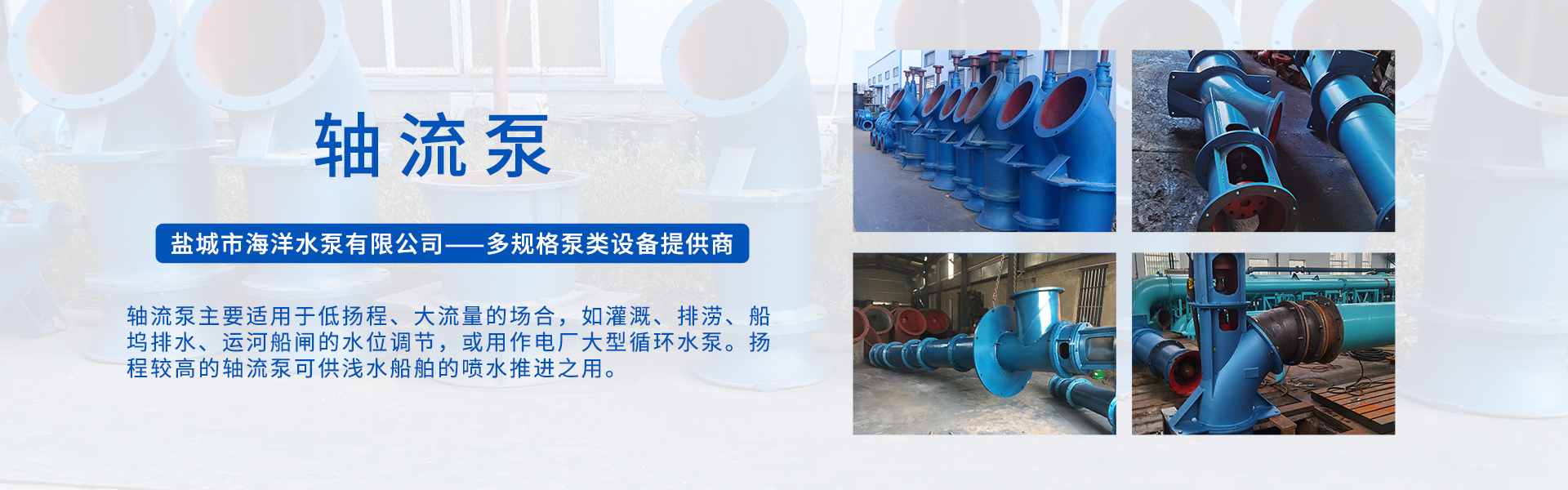
The view angle of small pump impeller installations is generally fixed. Axial flow pumps belong to high specific speed pumps with power outputs ranging from 500 to 1600. The total flow pump head and total flow-motor power characteristic curve is steep in the low total flow region, and it should be avoided to operate in such unstable low total flow areas. When the axial flow pump is at zero total flow, a higher motor power is required, thus this pump must first open the valve on the exhaust pipe before beginning to reduce the startup power output. Axial flow pumps are primarily used in low pump head and high flow applications, such as adjusting water levels in irrigation, drainage, harbor drainage, and canal locks, or as circulating pumps in large and medium-sized power plants. Axial radial flow pumps (which are essential, two-stage) can be used to propel vessels in shallow water areas.
