


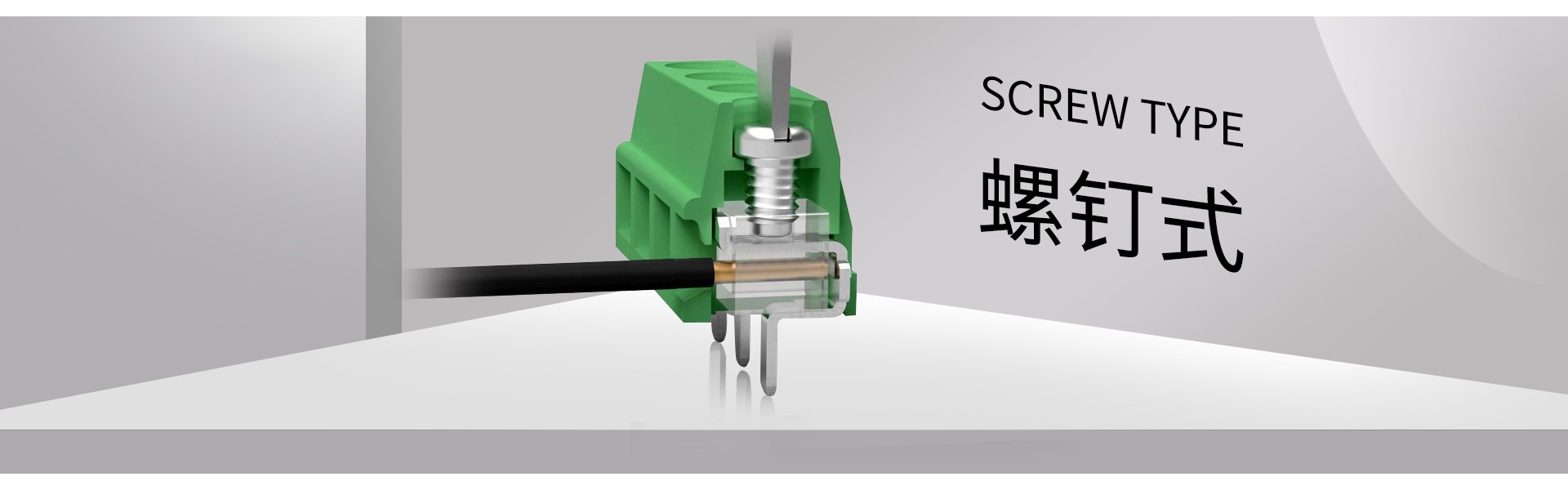

During the entire assembly process of terminal blocks, they must withstand the high temperatures in the preheating zone and the temperature transferred to the terminal itself during wave soldering. The solder paste should not affect the terminal, should be easily removable, and must not leave any residue. They can be cleaned with tap water during assembly. Preheating temperatures often reach up to 100°C or higher, with peak temperatures rarely exceeding 280°C. The穿孔 welding needle must be precisely positioned, properly sized, evenly placed, and have excellent solderability, which is beneficial for insertion and welding. The assembly must withstand the high temperature shock caused by heat treatment, and during welding, it is crucial to use infrared and convection preheating to transfer heat to the interface between the welding needle and the soldering pad to melt the solder paste. The contacts have poor resistance to soldering, and when the motor is turned on or a circuit short circuit occurs, a large electric current causes the contacts to weld securely and not release. Pure silver contacts are particularly prone to soldering. The main contacts of the AC contactor should use silver-based alloys with strong anti-soldering capabilities, such as silver-iron, silver-nickel, etc.
Terminal connectors in optical fiber communication (transmission) external links are necessary to achieve different modules. To meet the demand for flexible connections between machinery and systems, there must be a component capable of conducting removable (mobile) connections between fibers, allowing the optical path to transmit safely through a required channel, thereby fulfilling预定 or anticipated objectives and needs. Such components are referred to as connectors. Terminal connectors ensure a highly accurate connection of the two ends of the optical fiber, enabling a significant amount of the optical power emitted by the transmitting fiber to couple into the receiving fiber, while minimizing the impact on the system due to the intervention in the optical link. This is the fundamental specification of an optical fiber connector.
Terminal blocks maintain their connection characteristics even under significant temperature fluctuations. This is due to their ability to prevent varying levels of thermal deformation caused by differences in the thermal expansion coefficient of raw materials, thereby preventing the creation of mechanical stress within the terminals and the loosening of connections. The "Reakdyn principle" is employed to prevent the terminal screws from loosening themselves. In the selected terminal series with cross-sectional areas up to 10 mm2, the wire frames are all equipped with a telescopic cylinder structure. Their operating principle is based on the so-called "telescopic cylinder principle." The continuously improved PCB technology has significantly increased the amount of electrical current that the terminal blocks installed on the panel can carry.
News Center Co., Ltd.
