
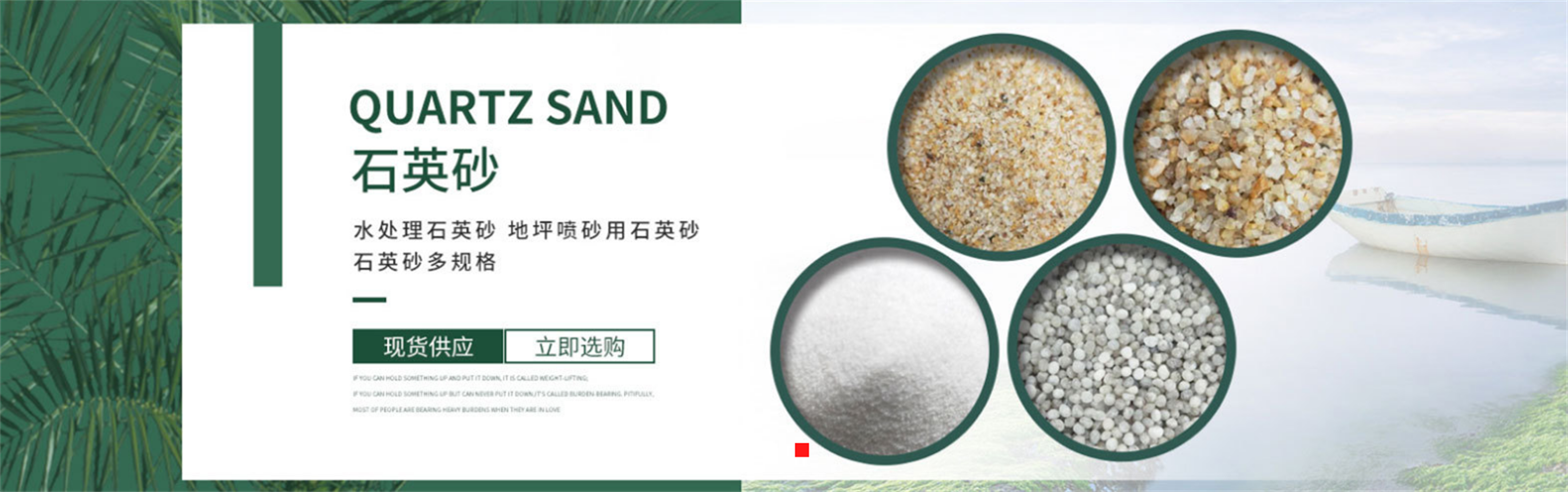

Ying Sand is a hard, wear-resistant, and chemically stable silicate mineral, primarily composed of SiO2. Quartz sand is milky white or translucent, with a hardness of 7, brittle without cleavage, having a conchoidal fracture, an oily luster, a density of 2.65, and a bulk density ranging from 1.6 to 1.8 for particle sizes between 1-20 mesh, and 1.5 for sizes between 20-200 mesh. It exhibits significant anisotropy in its chemical, thermal, and mechanical properties, is insoluble in acid, slightly soluble in KOH solution, and has a melting point of 1750°C.
Standard specifications include: 0.5-1mm, 1-2mm, 2-4mm, 4-8mm, 8-16mm, 16-32mm, 10-20 mesh, 20-40 mesh, 40-80 mesh, 100-120 mesh.
Quartz sand is a variant of colorless and transparent quartz, known as "Krystallos" by the Greeks, which means "white ice." They believed quartz to be a durable and solid ice. Ancient Chinese people thought that chewing on cold quartz could quench thirst. Quartz sandstone is a consolidated clastic rock with over 95% quartz content, derived from various igneous, sedimentary, and metamorphic rocks. Heavy minerals are scarce, with associated minerals including feldspar, mica, and clay minerals. Quartzite is divided into sedimentary and metamorphic types, with the former having an indistinct boundary between clastic grains and cement, and the latter referring to quartzite ores with a high degree of metamorphism and purity. Vein quartz is formed by hydrothermal action, composed almost entirely of quartz, with a dense, massive structure. The mineral content in quartz sand varies greatly, with quartz being the primary component, followed by feldspar, mica, rock fragments, heavy minerals, and clay minerals.
