



This Issue's Perspective
High proportion of large vehicles on national and provincial roads, slow acceleration, and low traffic efficiency have become key bottlenecks restricting the improvement of road traffic capacity. This case is based on the collection and analysis of large-scale traffic flow data, and by extracting the optimal solutions for mixed traffic flows.Green Wave SpeedThe company has prioritized the smooth and continuous passage of large vehicles under the Green Wave coordination control, effectively reducing the losses caused by queuing and starting at intersections. During the optimization design process, comprehensive consideration was given to the traffic demand characteristics of the路段, with scientific settings for key coordination parameters such as signal cycles, green-to-red ratios, and phase differences, thereby enhancing the overall traffic efficiency of national and provincial trunk roads.
This Issue's Intersection Coordinates:De Yang City, Luojiang District, Sichuan Province
This issue's optimization focuses on two main roads in Luojiang District, Deyang City, Sichuan Province, through...Green Wave BeltEnhance TechnologyPlease provide the Chinese content to be translated.108 National Highway (Dingzi Intersection to Zhangjiawan Intersection), Wan'an Road (Expressway Entrance to Binjiang Huafu)Implementing systematic regulation.
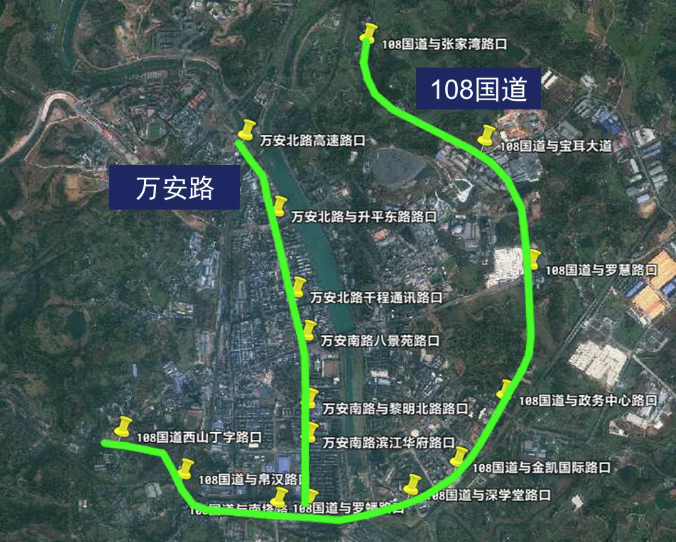
After multiple field tests and on-the-road measurements, we have collected and compared data on the sections of both 108 National Highway and Wan'an Road before and after optimization.Peak-to-Off-Peak Round-Trip + Evening Peak Round-TripFor the time period in question,Overall成效is remarkable:Total parking occurrences reduced from 21 to 5.Achievement rate increased by 76%.Total travel time reduced from 73 minutes to 57 minutes and 30 seconds.The improvement rate is 21%.Average journey speed increased from 34km/h to 43km/h.The improvement rate is 26%.
These data conclusively demonstrate that Green Wave technology can reduce parking delays, increase traffic flow speed, and effectively alleviate urban traffic congestion.
108National Highway
The "Traffic Jam Dilemma" of the Perimeter Ring Road and the "Way Out"
Highway 108 (from Xishan Intersection to Zhangjiawan Intersection), optimizationThe road is approximately 7.9 kilometers long.[No Chinese content provided, please provide the text to be translated.]10 intersectionsNo Chinese content provided.Loop City RingTowards. It serves asCommuter Transit Main ArterialThe facility is surrounded by industrial areas, residential zones, and village roads, carrying a substantial load of...Daily CommuteNo Chinese content provided.Transit TrafficRequest for Needs.
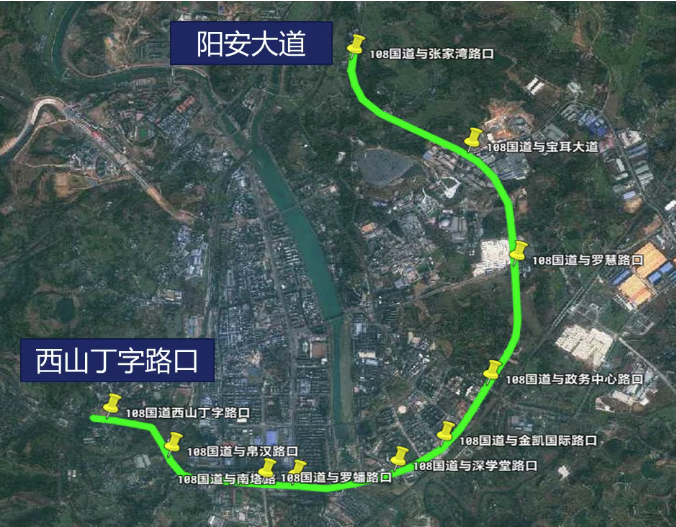
Traffic Congestion Challenge Analyzed
The 108 National Highway features a significant number of large vehicles, with considerable fluctuations in vehicle speed. Motor vehicle laneThere are two-lane and four-lane options in both directions.There are apparent traffic bottlenecks. Moreover, the roads...No central hard isolation facilities,Quantitative open crossings and crossings without traffic light controlAdditionally, the relatively narrow width of the two-way, two-lane road further exacerbates fluctuations in vehicle speed.
Lack of coordination between intersections, inconsistent signal cycles, and random starting and stopping of vehicles at adjacent intersections. Some existing solutions at certain intersections have not beenRefined time segmentationDesign-wise, some intersections utilize the same scheme throughout the day, offering significant room for optimization and improvement.

During the evening rush hour, overall traffic volume exceeds that of the morning rush hour; the Luopan and Nantai intersection sees high traffic during peak periods.Saturation nearing 1.0The market is basically in an oversaturated phase, with saturation levels peaking during peak hours.Beyond the scope of the Green Wave applicabilityThe traffic pressure can be imagined.
Breaking Strategies and Achievements
To address these issues, the Hisense Vision Control Optimization TeamWith the fewest two-way parking occurrencesA series of optimization efforts have been initiated to focus on the main control objectives.
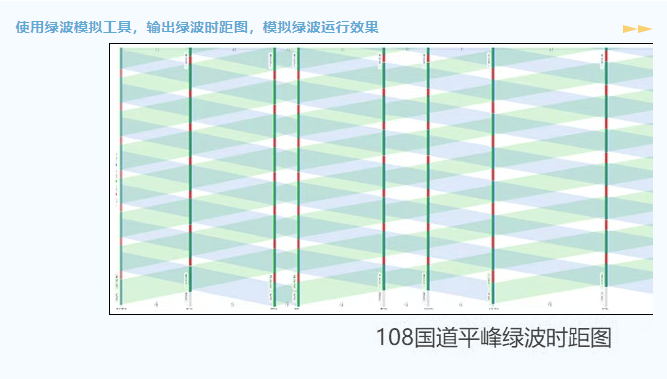
In terms of control strategies, we combine the existing plan with the characteristics of traffic flow changes.Single-point timing calculationIdentify key intersections and unify the coordination control cycle. During peak periods, a uniform 150-second cycle is adopted, while during off-peak periods, a uniform 130-second cycle is used. Simultaneously, based on traffic flow, the scheme periods are divided accordingly.Peak7:00 - 9:00 / 5:00 - 7:00 PM, other timesPeak SeasonPeriod. Additionally, it also includes configuration.Winter and summer vacation plan、Holiday Emergency PlanSwitch to the corresponding plan during the specified date and time period.
Through on-site vehicle road testing, based on actual measured speeds of 50-60 km/h during off-peak hours and 45-50 km/h during peak hours.Set Intersection Phase Shift。
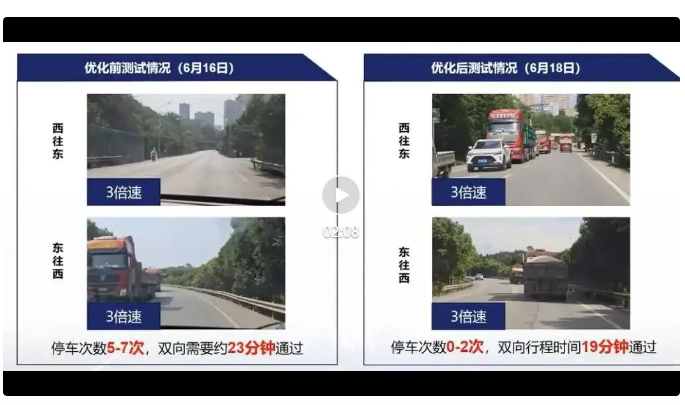
△Optimized Comparison Video During the Evening Rush Hour
Significant optimization achieved. During off-peak periods,The total number of parking instances has been reduced from 6 to 1.,Average travel time reduced from 23 minutes to 19 minutes.,Average travel speed increased from 40km/h to 49km/h.。
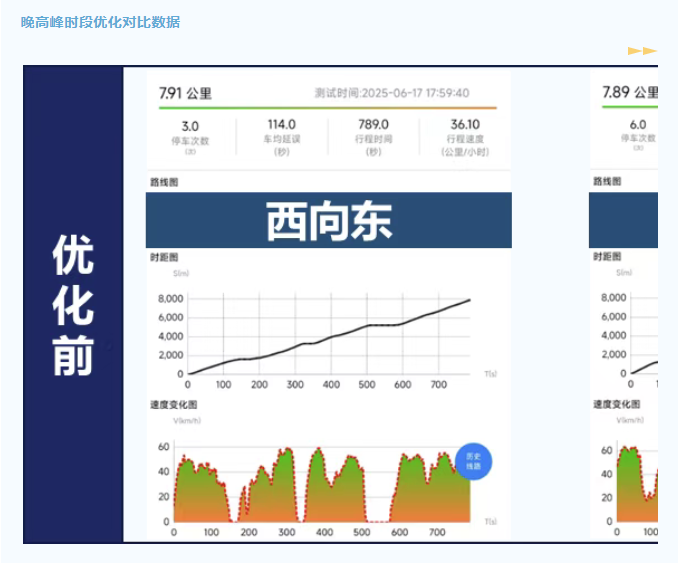
Evening rush hourThe total number of parking instances has been reduced from 8 to 2.,Average travel time reduced from 29 minutes to 22 minutes.,Average travel speed increased from 33km/h to 42km/h.Now, driving along National Highway 108 saves a considerable amount of time and enhances the driving experience.
Wan'an Road
The "Revitalization Journey" of the North-South Commuting Corridor
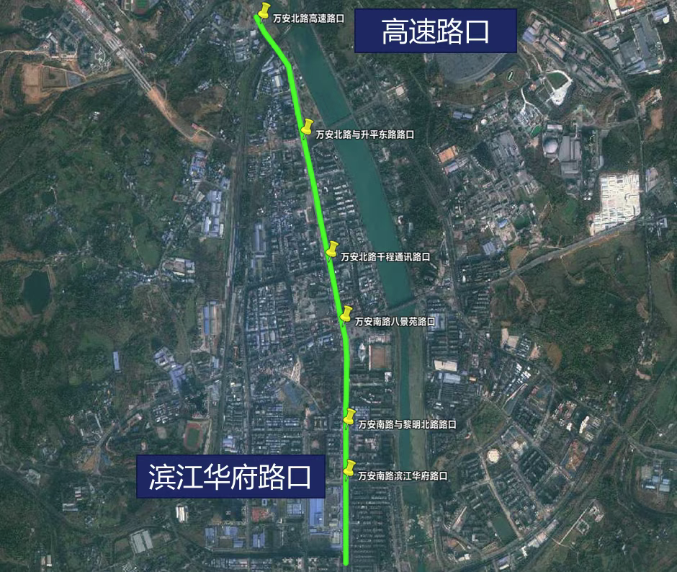
Wan'an Road (from the expressway intersection to the Binjiang Huafu intersection), optimizedThe road measures approximately 2.8 kilometers in length., including6 intersectionsThe road primarily runs north-south and serves as a main commuting artery. It is flanked by shops, hospitals, and residential areas, experiencing significant fluctuations in daily traffic volumes, which can impact vehicle speeds.
Current Traffic Conditions and Challenges
Similar to the 108 National Highway, there is no coordination between intersections on Wan'an Road, with inconsistent cycles and random vehicle starts and stops. Some intersection plansThe division of time periods is not refined.,Some intersections have a single scheme implemented throughout the day.The subsequent areas for optimization and improvement are substantial. Overall,Excessive and random parking, along with long waiting times, lead to an unsatisfactory driving experience.。

However, during the evening rush hour on Wanshan Road, the overall traffic volume is higher than during the morning rush hour, but the peak hours...Intersections are generally under a saturation level of 0.7.Please provide the Chinese content to be translated.Green Wave is suitable within the saturation range.This provides favorable conditions for the Green Wave scheme design.
Optimization Measures and Achievements
The control strategy primarily aims to minimize the number of two-way parking occurrences. By integrating the existing plan and considering the characteristics of traffic flow, key intersections are identified, and a unified control cycle is coordinated based on single-point timing calculations.Peak SeasonUnified use of 110s.Peak PeriodUnified at 108s. The plan divides the time into peak periods from 7:00 - 9:30/17:00 - 19:00, with the remaining time as off-peak hours.
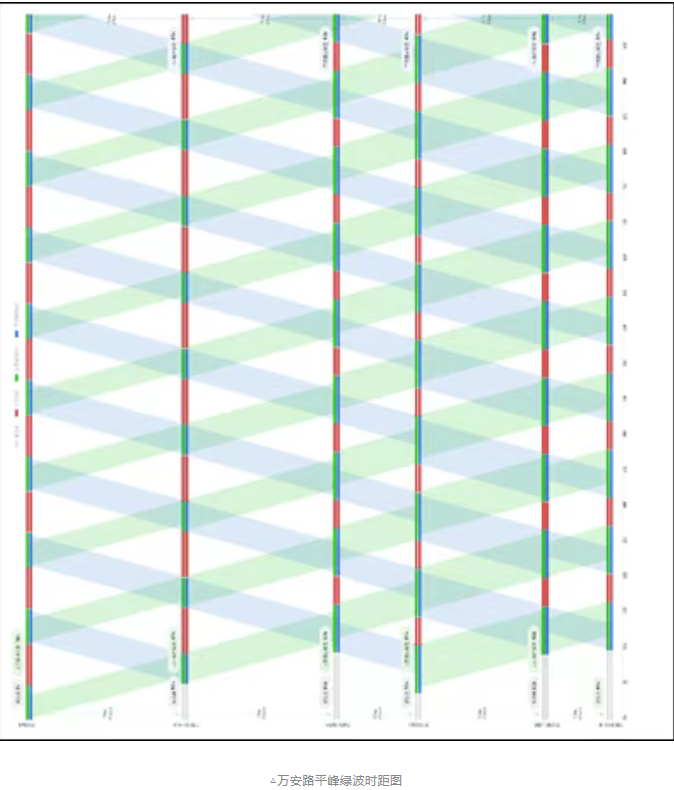
Through on-site vehicle road testing, phase differences at intersections are set based on actual measured speeds of 45-50 km/h during off-peak hours and 40-45 km/h during peak hours.
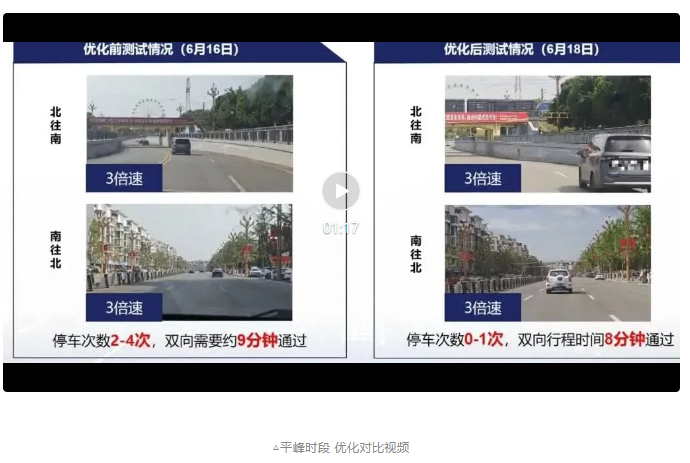
Optimized, off-peak hoursTotal parking occurrences reduced from 3 to 1.,Average travel time reduced from 9 minutes to 8 minutes.,Average travel speed increased from 36km/h to 41km/h.。
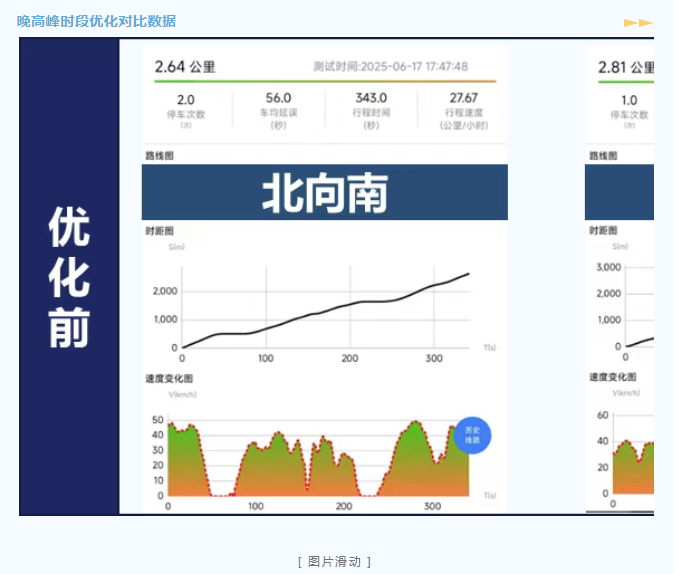
During the evening rush hour, in totalParking sessions reduced from 4 to 1.,Average travel time reduced from 12 minutes to 8 minutes and 30 seconds.,Average journey speed increased from 28km/h to 40km/h.Now, walking along Wan'an Road, one can also feel the convenience and comfort brought by smooth traffic.
What is the saturation range applicable for green wave?
Green Wave's Applicable Saturation RangeRoad traffic flow zones where traffic signal coordination and control technology (i.e., "green wave") can effectively optimize, are typically recommended.Intersection saturation ranges from 0.6 to 0.9.Within this range, traffic flow is relatively stable and there are certain gaps for passage, which can be achieved through signal timing optimization for continuous vehicle movement. If the saturation rate is below 0.6, it indicates a lower traffic volume, with fewer instances of vehicles stopping, making green wave optimization not very necessary. However, if the saturation rate exceeds 0.9 or approaches 1.0, the intersection traffic is in a state of oversaturation or congestion, with long vehicle queues and insufficient intervals for passage. Green wave coordination becomes difficult to effectively implement, and it is then necessary to combine other traffic management measures for comprehensive treatment.
