
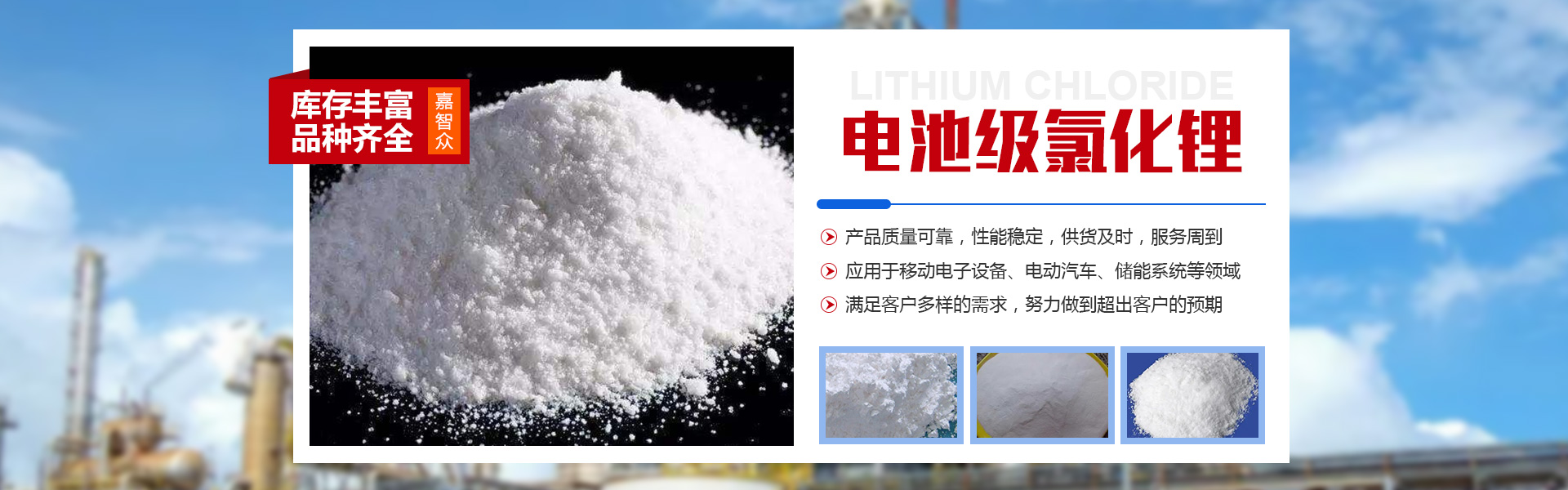

Lithium chloride is widely used in industries such as batteries, biology, and food. Anhydrous lithium chloride is a crucial lithium salt product, utilized not only as an air conditioner dehumidifier, in industrial applications, for lithium-ion batteries, metal alloy welding agents, or flux but also plays a particularly significant role in the production of lithium metal.
Lithium chloride plays a decisive role in the blending system's blending performance. Typically, the continuous phase exhibits the fundamental properties of the community, particularly mechanical properties and stress-strain characteristics, such as the impact on model elasticity, strength, and swelling. The influence of dispersion on these properties is relatively limited. However, dispersion has a significant impact on properties such as internal friction heat, tensile strength, gas diffusion, heat transfer, permeation, adhesion, and optical properties.
Factors affecting the structural morphology of lithium chloride: blending ratio, viscosity, cohesive energy density.
The relationship between the structural parameters of a dispersion system and its performance is critical in polymer blending. Typically, two systems are formed, with the structural parameters of the dispersion system having a significant impact on the performance of the blended material. This includes uniformity of distribution, particle size of the dispersion system, and the elastic modulus or hardness of the dispersion system.
Factors Affecting the Particle Size of Dispersed Systems: Mixing Time and Concentration of Dispersant, Polymer Viscosity, Solubility Parameter, Structural Similarity, Processing Temperature, Compatibility Agents, and Blending History.
