
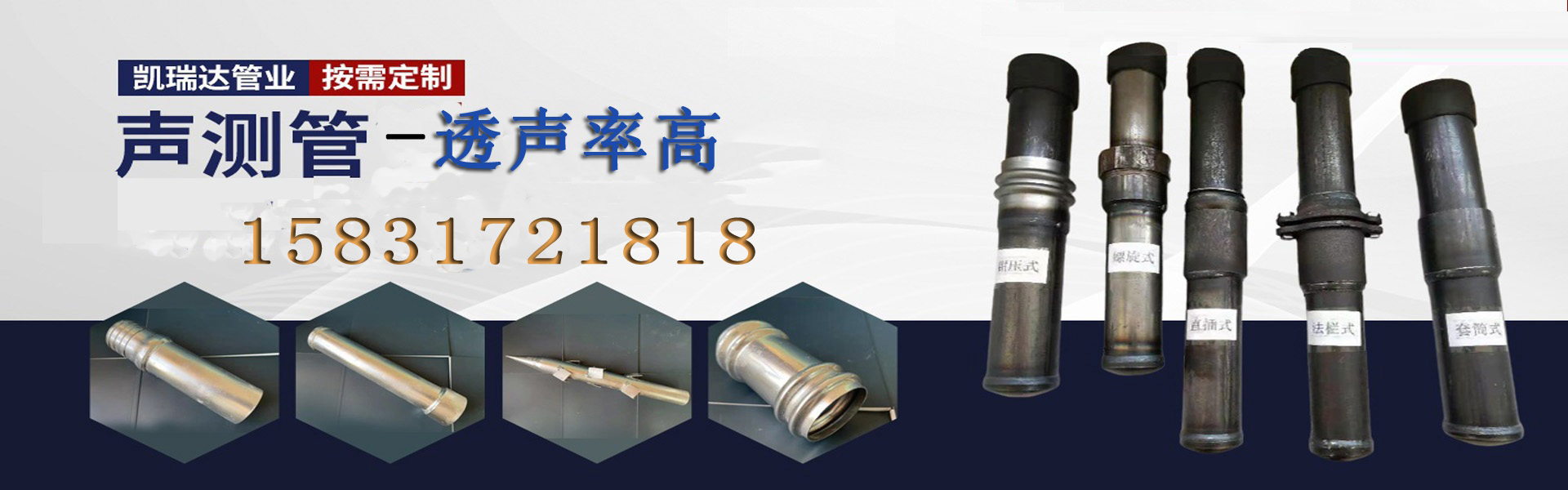

In recent years, acoustic pipes have become increasingly prevalent in our daily lives. However, issues often arise during their use. How can we address these problems to maximize the benefits of acoustic pipes? Below, let's explore some common issues and their solutions when using acoustic pipes, making them more convenient for us.
Firstly, during the use of the acoustic testing tube, it may occur that the testing machine does not reach the rated testing force. The main reasons for this are two-fold: one is that the oil supply valve may be obstructed by foreign objects, preventing smooth operation; the other is the possibility of leakage in the hydraulic system. To address these issues, you should disassemble and clean the oil supply valve, using a toothbrush for hard-to-clean areas. If there is oil leakage, tighten the leaking area or replace the gasket. This will make the acoustic testing tube equipment safer and more convenient during use. Secondly, the equipment may also experience difficulties in the smooth lifting of the moving beam. The primary reasons for this are also two-fold: one is insufficient lubrication or obstruction between the screw and the base hole, and the other is the loosening of the locking screw on the lower nut of the screw. To resolve this problem, simply remove the lower nut of the screw, start the oil pump, use the piston to push the screw out, and then clean it, or apply lubricant and reinstall. If this is the case, it is even easier to fix—just check and retighten the screws to secure them.
The synthesis of prestressed acoustic pipes is not easy.
Pre-stressed acoustic pipe is made from high-carbon steel wire rod, which is cold drawn into wire after surface treatment. A certain number of wires are then twisted together to form strands according to the structure of the acoustic pipe, followed by a stress-relieving stabilization process. To enhance durability, the wire can be coated with metal or non-metallic coatings or plating, such as galvanized coating or epoxy resin coating. The surface of Tianjin's acoustic pipe may have grooves to increase the grip with concrete. The pre-stressed acoustic pipe, after being twisted, undergoes a mold compression process to become more compact in structure and its surface is more suitable for anchor gripping. To produce unbonded pre-stressed acoustic pipe, a standard pre-stressed acoustic pipe is coated with anti-corrosion grease or paraffin and then wrapped with high-density polyethylene.

