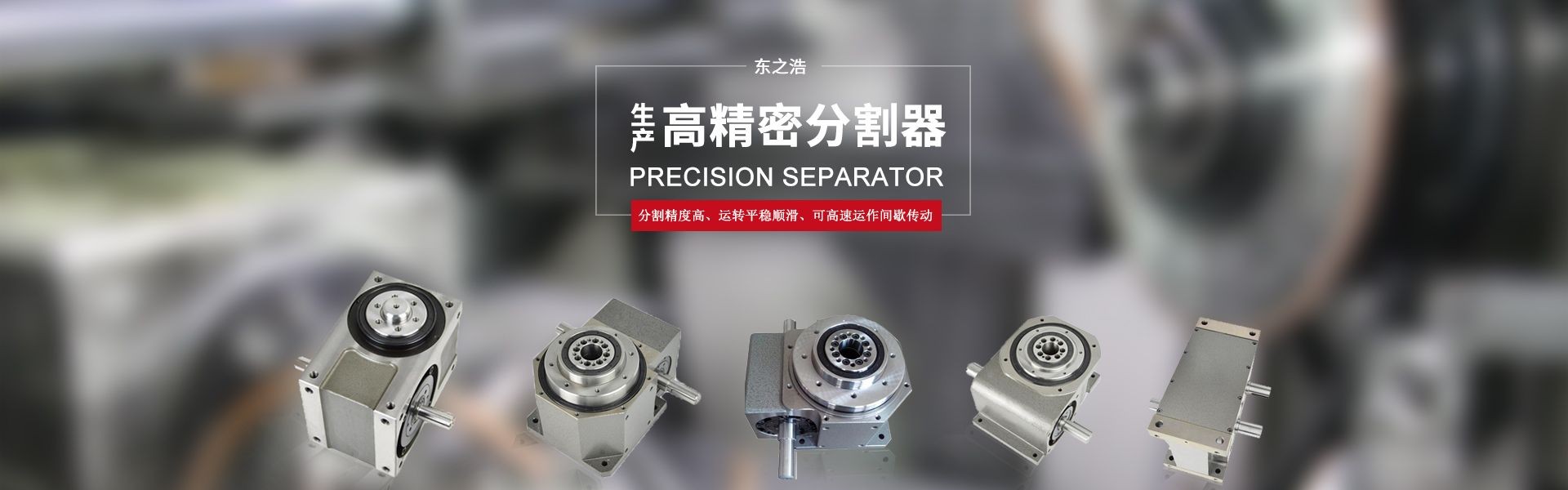
公司主营:Specializing in the research, design, and manufacturing of precision cam cutters.
15895651313


企业资质
Knowledge about Cam Splitter Drive Angle
2024-06-07
The cam separator drive angle. To explain the working principle of the separator, as a type of rotary equipment, the separator rotates continuously under the action of the motor as the driving source, thereby achieving intermittent, oscillating, lifting, or continuous motion on the output shaft. The drive angle mentioned here is only related to the input shaft.
In theory, to describe the driving angle with a complete mechanical motion, one revolution of the input shaft by 360 degrees constitutes a cycle. At this point, the output shaft completes a motion-halt action. The motion of the output shaft is accomplished by the input shaft. The angle through which the output shaft rotates is the driving angle relative to the angle the input shaft has rotated. Therefore, when the input shaft rotates 90 degrees, the output shaft rotates to one work position. The remaining 270 degrees are the stationary angle of the input shaft, which also corresponds to the stopping process of the output shaft. By extension, when the driving angle is 120, 150, 180, 210, 240, 270, 300, 330, or 360 degrees, the corresponding stationary angles are 240, 210, 180, 150, 120, 90, 60, 30, and 0 degrees, respectively.
How to Choose the Drive Angle? When selecting the drive angle, it's essential to consider the actual usage requirements, with speed and load being significant factors. As shown in the figure, within the 360-degree rotation cycle of the input shaft, it can be observed that a larger drive angle θh results in a longer slope of the curve and a longer spiral groove curve on the cam, making the motion curve smoother. This allows for a平稳 transition of the buffer force between the cam and roller at the intersection of the input shaft's drive line and the stop line. Conversely, with a smaller θh, the curve slope is steeper, leading to greater impact at the intersection of the drive line and stop line. Therefore, a larger drive angle generally ensures a more stable operation of the entire drive mechanism. Hence, it is advisable to opt for a larger drive angle for greater stability. For high-speed separators, such as those with 0.1 or 0.2-second dynamic stop times, the drive angle can also affect the separator's operating speed. Thus, higher quality requirements are placed on the separator itself, such as the cam material, processing technology, and equipment. In practice, equipment vibration due to inappropriate drive angle selection, separator quality, and other factors is quite common in high-speed running systems. For applications with lower speed requirements and longer processing times, it is generally recommended to choose a larger drive angle, as the output shaft stop angle of the separator in such automated systems usually requires an automatic control device.
蔡晓东 (Mr.)
15895651313
15895651313
szdongzhihao@126.com
568 Xin Nan Middle Road, Kunshan High-Tech Industrial Development Zone, Suzhou
www.114global.com © Zhongshang 114 Hebei Network Technology Co., Ltd.Address: Room 6009, Oriental New World Center, No.118 East Zhongshan Road, Qiaoxi District, Shijiazhuang City, Hebei ProvincePlatform Service Hotline: 4006299930