




On November 28th, the official account of Tesla Robotics shared a new update: prepping new hands for Black Friday. In the video, Optimus securely catches a tennis ball thrown at it and places it down, with fingers that bend relatively flexibly.
The dexterous hand is the most striking feature of Tesla's second-generation Optimus. Tesla Optimus engineer Milan Kovac calls the newly showcased dexterous hand "a milestone achievement."
Compared to the previous generation, this new wrist/forearm boasts double the degrees of freedom (22 in the hand and 3 in the wrist/forearm). Note: A human hand is typically considered to have 27 degrees of freedom, with higher degrees of freedom allowing for more complex and refined movements.
Kovac stated that the aforementioned video was completed in real-time through remote operation in the lab, and Tesla will soon produce robots equipped with the new dexterous hands.
Additionally, the team still has some work to wrap up before the end of the year, particularly focusing on expanding tactile sensor integration (the new generation covers a much larger surface area than the previous one) and achieving finer control through tendons. Since all the drives are moved to the forearm, this increases its weight, and the team is looking for ways to reduce the weight of the forearm. An interesting challenge is to provide a protective layer that is sufficiently soft and supple for the fingers and palm without affecting the tactile sensing.
Musk replied under the post, "Great job, Optimus team."
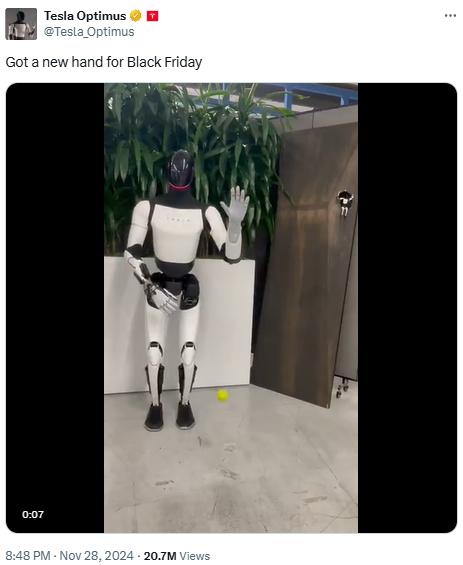
The 22-degree-of-freedom dexterous hand is finally "here after much anticipation."
The previous generation of Optimus' dexterous hand features 11 degrees of freedom, focusing on the flexibility of the forearm. Compared to the first-generation Optimus prototype, which struggled to perform simple operational tasks, the Optimus equipped with the 11-degree-of-freedom dexterous hand can complete tasks such as folding shirts and sorting items in a factory.
The 22-degree-of-freedom dexterous hand has finally arrived. In May, the Optimus team released a progress video showcasing the robot sorting batteries and moving around the office. Musk commented below the video, revealing for the first time that Optimus' hands would soon have 22 degrees of freedom.
At Tesla's shareholder meeting in June, Musk reiterated Tesla's goals (During the Q1 earnings call on April 23rd, Musk stated that Tesla anticipates by the end of this year, the Optimus units will be performing a series of useful tasks in the factory, and the company aims to sell these robots to the public by the end of 2025), i.e., plans to start small-scale production of Optimus robots by the end of 2024, with an expected production of thousands to tens of thousands of units throughout 2025, for both internal use and training. He also mentioned again the key improvement of Optimus – its hands will have 22 degrees of freedom, "It can play the piano, even the guitar."
At Tesla's "werobot" launch event held in October, the 22-degree-of-freedom dexterous hand made its debut, showcasing a new posture of extension/retraction in addition to flexion/extension. The rope-driven structure of the dexterous hand is prominently featured, with the actuator externally mounted on the forearm, allowing the wrist to rotate flexibly.
CITIC Securities stated that this aligns with its expectations for Tesla's use of the "hollow cup + screw + rope drive" scheme. The 22 degrees of freedom consist of 5 fingers with each finger having 4 degrees of freedom and the wrist with 2 degrees of freedom, which to the greatest extent imitates the structure of the lowest joint of human fingers with over 1 degree of freedom.
Flexible hands are a crucial component for humanoid robots, with both domestic and international companies actively developing their own technologies.
Dexterous hands have now become one of the core components of humanoid robots. Major humanoid robot manufacturers tend to develop their own technology, such as Tesla (Optimus), Apptronik (Apollo), UboTech (Walker S), Zhipu AI (Expedition A1), and Sanctuary AI (Phoenix).
The Huahai Securities research report indicates that the performance and cost of dexterous hands are jointly influenced by their three core components: the drive, transmission, and sensing devices. With the advancement of robotic technology, the freedom of movement in dexterous hands is upgrading and accelerating, moving increasingly towards higher integration and intelligence. According to an incomplete count by the "Science and Technology Innovation Daily":
On October 16th, the National Intellectual Property Administration revealed that Zhiyuan Robotics filed a patent named "Dexterous Thumb, Dexterous Hand, and Robot" in June this year. The patent abstract indicates that this application is in the field of robotics technology, specifically involving a dexterous thumb, dexterous hand, and robot that addresses the issue of a dexterous thumb with three degrees of freedom being unable to simultaneously consider joint decoupling and size. Notably, the dexterous hand in Zhiyuan Robotics' new product released in August has reached 19 degrees of freedom, with the active degrees of freedom increasing from 6 in the previous generation to 12.
This year's first half saw Star Era launch its independently developed Xhand dexterous hand, featuring 12 active degrees of freedom, a fully driven design, and equipped with tactile sensors on its fingertips.
Figure AI recently launched the second-generation humanoid robot, Figure02, in August, equipped with the fourth-generation mechanical arm. According to the information on their official website, Figure02's dexterous hand features 16 degrees of freedom and is described as "having a load capacity comparable to humans, capable of picking up objects weighing up to 25 kilograms."
1X Technologies, an early-stage company backed by OpenAI, launched the test version of its human-shaped robot NEO designed for home use in early September. The robot's hands have 20 degrees of freedom and can lift objects weighing more than twice its own body weight.
Guojin Securities previously released a research report stating that the changes in Tesla's third-generation dexterous hand compared to the second generation are as follows: (1) The hand has gained more degrees of freedom, increasing from 11 to 22, which may correspondingly raise the number of motors from the original 6 to between 13 and 17; (2) the location of the driver has been moved from the hand to the wrist.
Guojin Securities states that, based on functionality and long-term objectives, the trend is moving towards the development of dexterous hands resembling human hands. Taking Tesla's dexterous hand as an example, the firm analyzed the elastic links in the industrial chain brought about by increased degrees of freedom.
On the drive unit, it is expected that hollow cup motors and brushless slotless motors will become mainstream. Assuming a single-handed usage of about 13 to 17 units, the current dual-handed value ranges from 34,000 to 153,000 yuan.
On the transmission device, we are currently at a critical juncture of switching from the rope to the screw. Assuming a single-handed usage of 13 to 17 sets, the current value for a two-handed operation ranges from 55,000 to 130,000 yuan.
On the sensor assembly, the tactile sensors are the most valuable component, with an estimated value of approximately 5 sets for one hand, and about 1351 yuan for both hands.
