

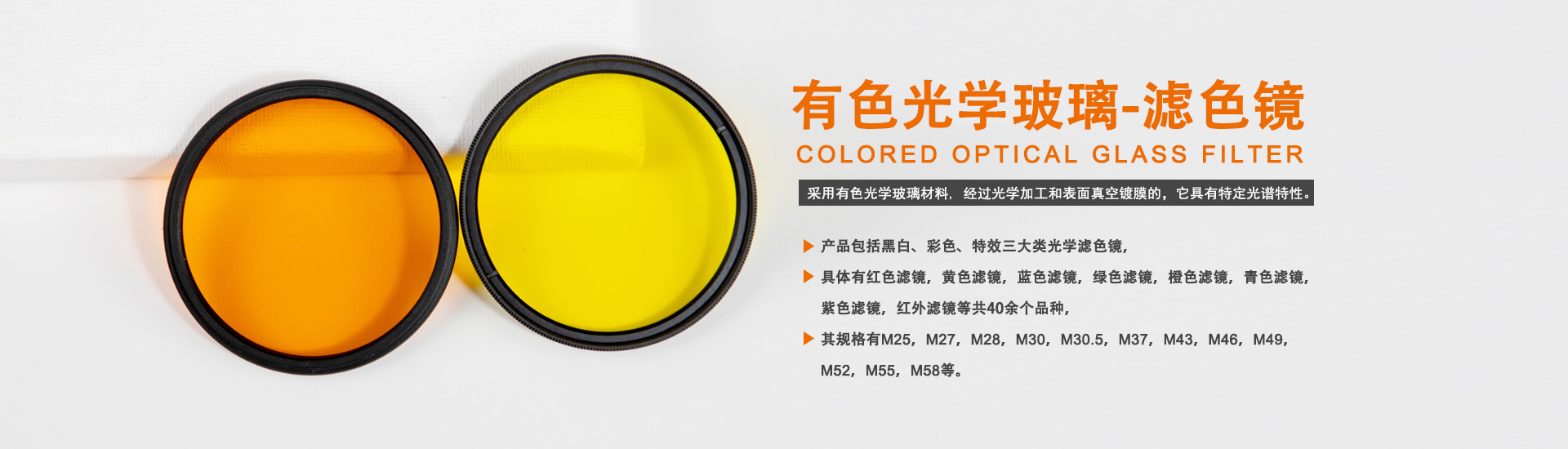

Lenses are made by adding special dyes to plastic or glass plates. A red lens only allows red light to pass through, and so on. The refractive index of glass is originally similar to that of air, allowing all colors of light to pass through, making it transparent. However, after dyeing, the molecular structure changes, causing the refractive index to alter, thus affecting the transmission of certain colors. For instance, when a beam of white light passes through a blue lens, it emits a beam of blue light, with less green and red light, most of which are absorbed by the lens.
The role of filters is significant, widely used in the photography industry. Why do some master photographers' landscape paintings always highlight the main subject so vividly? It's all thanks to the use of filters. For instance, if you want to take a photo of a yellow flower with a blue sky and green leaves in the background, shooting it as usual wouldn't emphasize the "yellow flower" theme, as the flower's image isn't prominent enough. However, by placing a yellow filter in front of the lens, blocking some of the green light from the green leaves and the blue light from the sky, while allowing the yellow light from the flower to pass through, the yellow flower becomes strikingly clear, effectively highlighting the theme of the "yellow flower."
Film optical filters are divided into two types: thin-film absorption filters and thin-film interference filters. The former involves chemically etching a specific substrate material to position the absorption line precisely at the required wavelength. These typically transmit longer wavelengths and are commonly used as infrared filters. The latter consists of a substrate with alternating layers of high-index or low-index metal-dielectric-metal films, or all-dielectric films, forming a low-order, multi-stage solid Fabry-Perot interferometer. The choice of material, thickness, and arrangement is determined by the required central wavelength and transmission bandwidth λ.
Metallic medium membrane filter films have a lower peak transmittance than full medium membrane filters, but the latter experiences more severe secondary peak and sideband issues. There is also a circular or strip-shaped variable interference filter in the thin-film interference filters, suitable for space astronomical measurements. Furthermore, there is a dual-color filter, placed at a 45° angle to the incident light beam, which can split the light beam into two different colors with perpendicular directions through high and uniform reflection and transmission rates, making it suitable for multi-channel multispectral photometry. Interference filters generally require vertical incidence, and as the incidence angle increases, they move towards the short-wavelength direction. This feature can be used to adjust the central wavelength within a certain range. Since both λ and peak transmittance change significantly with temperature and time, great caution is needed when using narrowband filters. Due to the difficulty in obtaining large, uniform films, the diameter of interference filters is generally less than 50 millimeters. Someone has obtained an interference filter as large as 38 cm square by splicing method, installed on a British Schmidt telescope with a 1.2-meter aperture, used to capture monochromatic images of large-scale nebulae. This technology can control the camera, infrared lights, filters, and color-to-black synchronization switching. Stability features include automatic positioning and anti-vibration functions, ensuring no flickering at the zero point. The quick switch is one-step and won't be stopped by resistance or cause filter misalignment. It won't shift due to changes in the tripod rotation, stopping, or vibrations. It won't bounce back and cause inaccurate positioning due to collisions during high-speed switching.
The image color restoration function of the color filter. Crystal color filters can effectively address issues such as false color and color drift. Adding AR-COOTRMG heavy coating to the crystal achieves 98% light transmission. Switching to the crystal color filter during the day allows for excellent detection of visible light, blocking infrared and other light interference, resulting in vivid and realistic colors. Cameras detect more infrared, and the majority of wavelengths can pass through, causing the camera to switch from color to black, thus providing a longer and clearer infrared distance.