

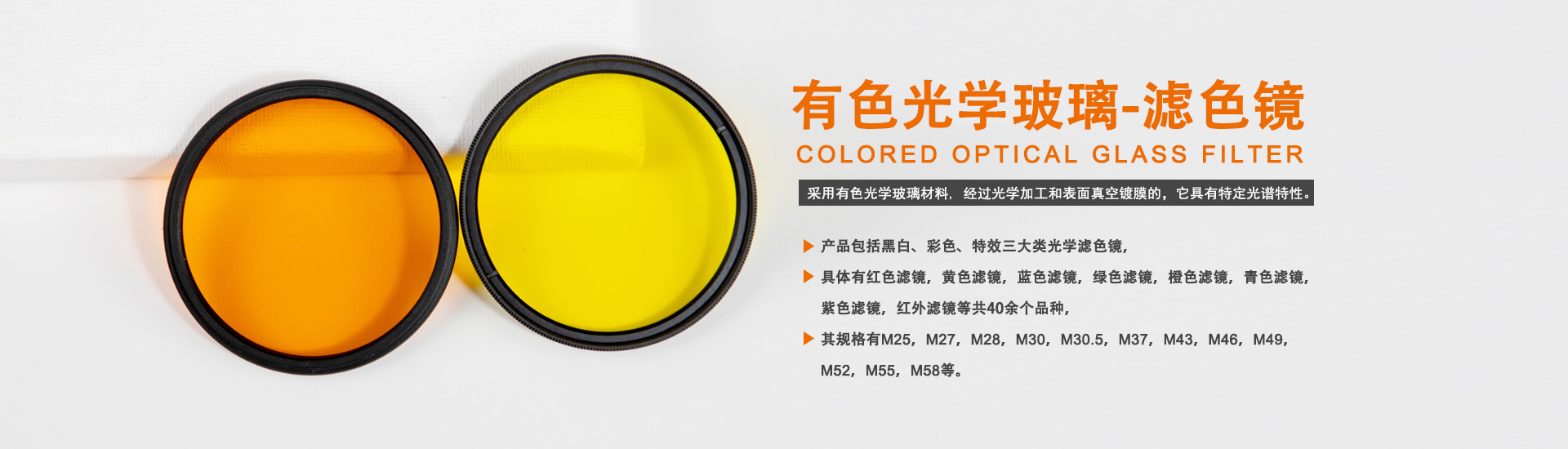

The refractive index of glass is originally similar to that of air, allowing all colors of light to pass through, hence its transparency. However, after dyeing, the molecular structure changes, causing a shift in refractive index, which alters the transmission of certain colors of light.
For instance, a beam of white light passing through a blue filter produces a blue light beam, with less green and red light, most of which are absorbed by the filter. Filters are used to remove light within a certain wavelength range, acting as monochromators, but they cannot produce true monochromatic light.
The role of filters is significant, widely used in the photography industry. Why do some master photographers' landscape paintings always feature a prominent main subject, and how do they achieve this effect?
This is where the filter lens comes into play.
For instance, if you want to capture a daisy with a camera, set against a backdrop of blue skies and lush greenery, shooting it as usual won't highlight the theme of "daisy," as its image isn't sufficiently prominent.
However, if a yellow filter is placed in front of the camera, blocking some of the green light emitted by the green leaves and the blue light emitted by the blue sky, while allowing a large amount of yellow light from the yellow flowers to pass through, the yellow flowers will become very prominent, highlighting the theme of "yellow flowers."
The function of the filter lens:
Filter out infrared rays.
2. Refined incoming light
Filter out infrared radiation:
Color CCDs can also detect infrared light; however, due to this ability, the D.S.P. is unable to calculate the correct color. Therefore, a filter must be added to separate the infrared portion of the light, making it necessary for color CCDs to have a filter installed, while black and white ones do not require one.
Refine Light Entry
Because the CCD is composed of individual photo-sensitive cells (CELLS), light enters directly. However, to prevent interference with neighboring cells, the light needs to be adjusted. Therefore, the filter is not made of glass but quartz, which utilizes the physical polarizing properties of quartz to retain the direct light component and reflect the oblique light component, thereby avoiding affecting adjacent photo-sensitive points.
Remove Infrared Radiation:
Available coating methods include vacuum coating and chemical coating, with the latter involving immersing quartz plates in a solvent for electroplating, which is cost-effective but prone to uneven coating thickness and detachment. Vacuum coating, on the other hand, utilizes vacuum evaporation and ensures even coating with minimal detachment, although it is more expensive.
Above, we refer to it as IR Coating, its purpose being to filter out infrared light. Additionally, we apply an AR-Coating, which is designed to enhance light transmission. As light passes through different mediums (such as from air into a quartz plate), it undergoes some refraction and reflection. With the AR-Coating, the filter can achieve 98-99% light transmission, whereas without it, the transmission rate is only 90-95%. This, of course, affects the sensitivity of the CCD.
Additionally, blue glass is used for its infrared filtering capabilities by absorbing infrared light. In contrast, IR-Coating filters infrared light by reflecting it, but this reflection can cause interference. If infrared filtering is the primary concern, blue glass is a superior choice.
However, as mentioned above, glass cannot reshape light, hence the so-called "two-piece" filter consisting of a piece of blue glass and a quartz plate. The blue glass is used to filter infrared light, while the quartz plate reshapes the light, so only an AR-Coating is needed on the quartz plate.
2. Tweak Lighting
The aforementioned mentioned, utilizing the physical birefringence properties of quartz, incoming light is retained in its direct component while the oblique component is reflected away. However, this process can only be corrected in one direction; typically, cameras only consider horizontal resolution, thus only performing horizontal adjustments to light. Therefore, when applying the filter, the direction must be correct and cannot be reversed.
If vertical light needs to be corrected as well, it's quite simple—just stick two pieces together, rotate one by 90 degrees, and voilà! You have what's also called a "two-piece" filter. One piece is used for horizontal correction, the other for vertical, with one piece further treated with an IR-Coating to filter infrared light.