
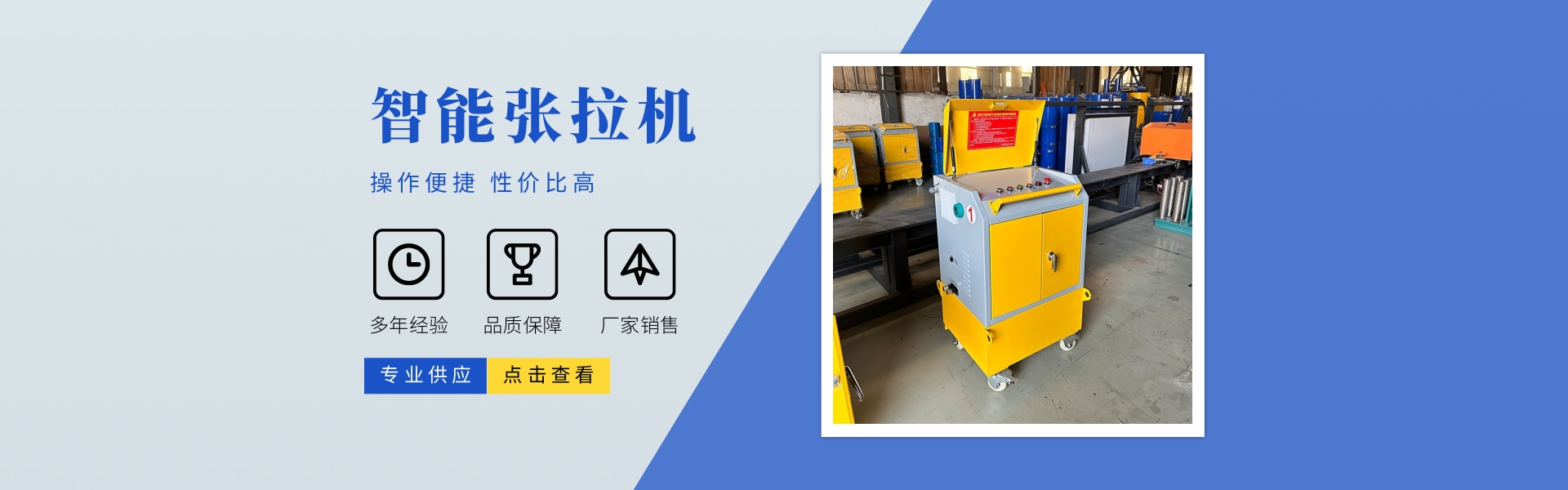





The precision of the intelligent tensioning machine significantly impacts the quality of construction work in the following aspects:
Pre-stress Application Accuracy
Tension Force AccuracyThe intelligent tensioning machine boasts high precision, accurately applying the tension force required by the design. Insufficient tension force prevents the prestressed tendons from reaching the designed stress, leading to excessive deformation during use and reducing the structure's crack resistance and load-bearing capacity; excessive tension force may cause the prestressed tendons to exceed their yield strength, potentially leading to fractures, severely impacting the structure's safety.
Stability during the tensioning processHigh-precision tensioning machines maintain a stable tension force output during the tensioning process, avoiding fluctuations in tension force. Unstable tension force can cause uneven stress distribution in prestressed tendons, with some areas experiencing excessive stress and others insufficient stress, affecting the overall performance of the structure. Over time, areas with uneven stress are prone to fatigue damage, shortening the service life of the structure.
Component Size and Shape Control
Reduce Component DeformationPrecise control of tensile force and elongation ensures uniform stress distribution during tensioning, effectively reducing deformation caused by uneven tension. For instance, in bridge engineering, if the web and flange plates of box girders lack sufficient tensioning accuracy, they may experience distortions, lateral bends, and other deformations, affecting the appearance and performance of the bridge, and also increasing the cost of later repairs.
Ensure component size accuracyThe high precision of the intelligent tensioning machine ensures the dimensional accuracy of components. For prestressed components with strict size requirements, such as crane beams in large industrial factories, precise control of the applied prestress allows the components to meet the designed length, width, and height after tensioning, ensuring the accuracy of component installation and the overall structural stability.
Structural durability
Prevent Reinforcement CorrosionPrecise pre-stressing of concrete components ensures uniform pre-compression stress, effectively counteracting tensile stresses caused by external loads during use, thereby reducing the occurrence of concrete cracks. Cracks are a significant factor in the corrosion of steel reinforcement. High-precision tensioning machines, by controlling cracks, can enhance the structure's impermeability and resistance to erosion, thereby extending the service life of steel reinforcement within the structure and improving its durability.
Delay Concrete AgingHigh-precision tensioning machines ensure that concrete remains in a reasonable stress state, preventing local damage or accelerated aging due to stress concentration or excessive tensile stress. Over the long-term, concrete maintains excellent performance, contributing to the integrity and stability of the structure and reducing structural performance degradation caused by concrete aging.
Structural integrity performance
Enhance structural rigidityPrecisely applied prestress can reduce deformation under service loads, enhancing the stiffness of the structure. For instance, in long-span bridges, high-precision intelligent tensioning machines can ensure that the vertical deformation of the main beam is controlled within the design limits under the effects of vehicle loads, ensuring the normal operation of the bridge and traffic safety.
Enhanced structural integrityTension forces and elongation of all prestressed components are precisely controlled, enabling the components within the structure to work协同 together, collectively bearing loads and enhancing the overall integrity of the structure. During earthquakes and other natural disasters, the structure can better withstand external forces, reduce the extent of damage, and improve its seismic performance.
