




Product Description
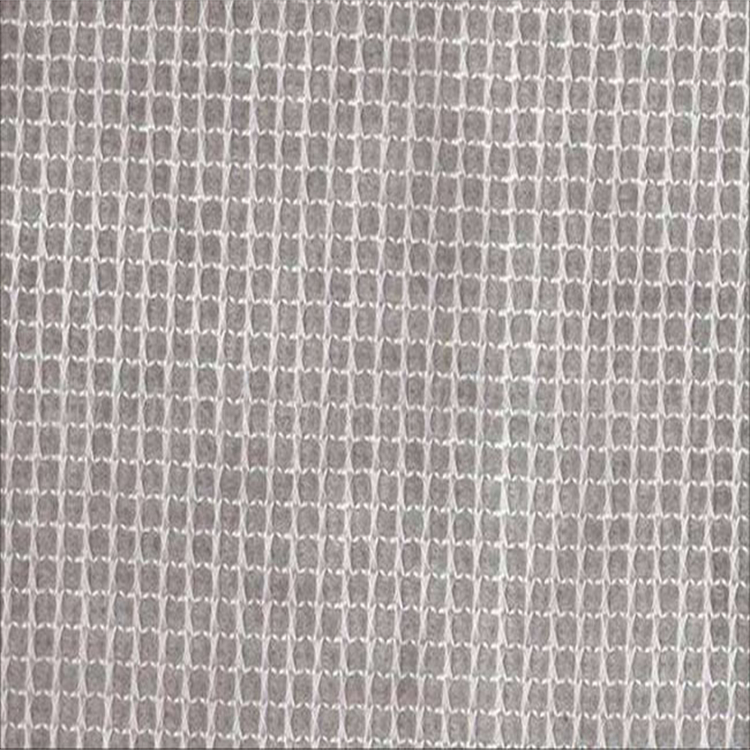
Reinforced composite geotextile is a new type of geosynthetic material made by combining glass fiber (or synthetic fiber) as the reinforcing material with needle-punched nonwoven fabric.
Reinforced composite geotextile differs from ordinary woven fabrics. Its distinct feature is that the intersection points of the warp and weft threads do not bend, but remain straight. By binding them securely with tie lines, they can uniformly and simultaneously withstand external forces and distribute stress. Moreover, when the material is torn instantly under applied force, the yarns will gather along the initial tear, enhancing the tear resistance.
During the reinforced composite process, reinforcing binding lines are repeatedly passed through the fiber layers between the warp, weft yarns, and short fiber needle-punched geotextile, integrating them into a single structure. Consequently, the reinforced composite geotextile boasts high tensile strength and low elongation, while also retaining the properties of needle-punched nonwoven fabric. Therefore, it is suitable for reinforcement and enhancement, isolation and protection, with excellent water retention in both three-dimensional normal and horizontal directions. Due to its continuous solid matrix and pores, it exhibits a multi-porous filtering effect, making it a multifunctional geosynthetic composite material.
II. Product Features
High tensile strength, low elongation, even transverse and longitudinal deformation, high tear resistance, excellent wear resistance, high permeability, and strong anti-backflow properties.
Section 3: Main Functions of Reinforced Geotextile
Reinforcement, Drainage, Anti-Filtering, Protection, Isolation
(1). Reinforcement and stabilization: It enables the local stresses acting on the soil to be transmitted or distributed over a larger area, stabilizing and limiting the deformation and settlement of geotechnical engineering over an extended period of use.
(2). Isolation Function: Use geotextiles to isolate different geosynthetic materials, forming a stable interface that allows each material to function according to design specifications, showcasing their individual properties and overall effectiveness.
(3). Protective Function: Geotextiles possess excellent puncture resistance, thereby offering superior protective properties.
(4). Drainage and filtration function: Geotextile allows water to pass through while blocking the loss of soil particles, functioning to prevent fine silt particles from flowing in a channel carrying suspended particles, while allowing the liquid to pass through.
Section 4: Engineering Applications of Reinforced Geotextiles
(1). Used for filter protection on retaining walls, road embankments, reservoir dams, earth and rock revetments, tunnels, and drainage ditches.
(2). Used for drainage between road embankments, subgrades, the backside of retaining walls along mountain roads, the sublayer of railway ballast, and between the subgrade and pavement of highways.
(3). Used for isolation between soft soil and boulders in temporary cofferdams, docks, and revetments; protection between the bottom of landfill sites and impermeable layers; separation between filter material and waste in landfills; and isolation and reinforcement of asphalt pavements from subgrades.
(4). Used for reinforced drainage in road and railway slope layers, as well as for drainage reinforcement in backfilling of roadbeds and embankments.
(5). Used for the protection of impermeable layers in anti-seepage projects such as artificial lakes, rivers, reservoirs, etc.
(6). Used for isolation between the base and the green planting layer in landscape greening projects.
(7). Used for drainage on soft foundations and reinforcing the load-bearing capacity of subgrades.

