


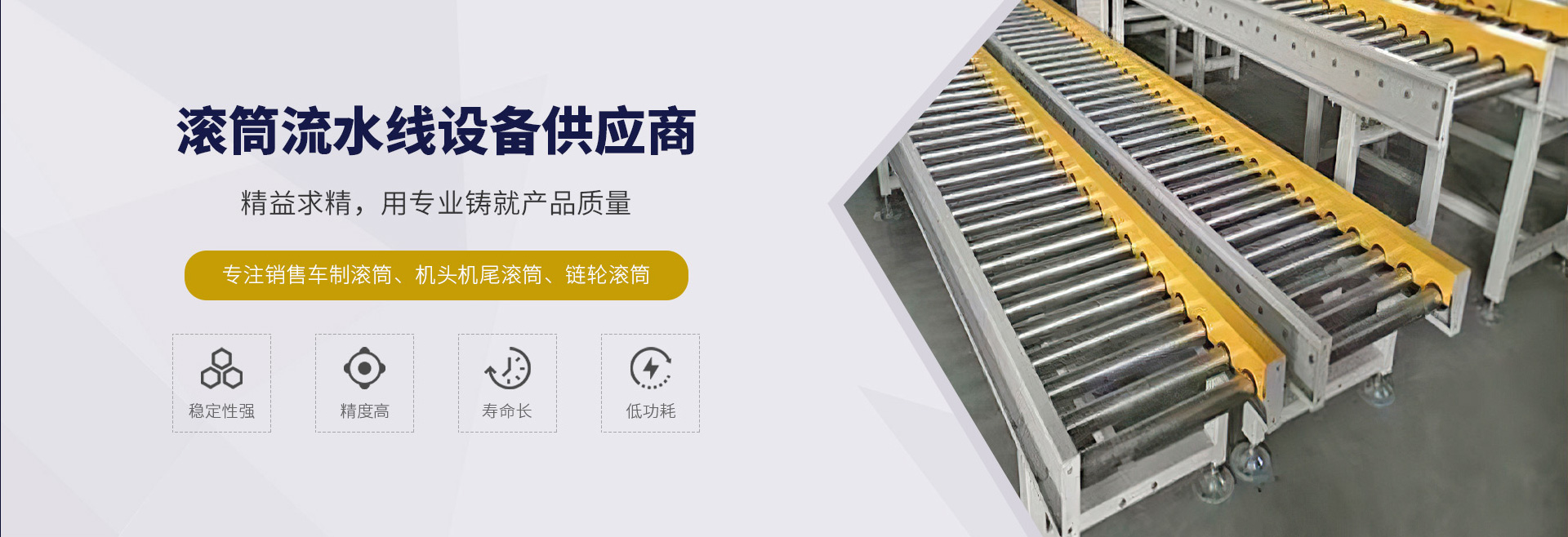


As society continues to advance, the demand for modern logistics in automated production handling is on the rise. The introduction of handling conveyors effectively avoids the issue of overexertion caused by manual handling, thereby reducing labor costs. The invention of bulk conveying equipment has undoubtedly been a significant boost for humanity's transition to industrialized production.
By the mid-1980s, China's rapid industrial advancement spurred the growth of emerging industries, which in turn catalyzed the innovation of roller conveyors. Since then, roller conveyors have seen rapid development, with their manufacturing levels and scale now reaching a new stage, nearly present in the assembly lines of all industries.
Roller Conveyer Belt
The roller conveyor is a commonly used conveying machinery in the transportation of goods. With the advancement and development of the industry, various general-purpose rollers for roller conveyors have been fully developed, offering an extensive range of specifications and varieties.
Scope of Application for Roller Conveyors
Screw conveyor systems are particularly suitable for transporting flat-bottomed items, with their applications spanning across various industries such as food, military, chemical, construction materials, warehouses, and distribution centers. They enable multiple concurrent conveyance functions, and the interconnection between screw conveyors is easy and filter-friendly. Multiple screw conveyor lines, along with other conveyors or specialized machines, can be used to form complex logistics systems to meet various process requirements. Notable features include high throughput, fast speed, and smooth operation.
Difference Between Powered and Unpowered Drum Lines
1. Power Drum Conveyer Line
The power drum conveyor belt, as a major conveying component in conveying equipment, is a cylindrical assembly that drives the conveyor belt automatically or changes the conveying method. Compared to other types of conveyors, this conveyor features telescopic folding structures on both sides of the body, powered by multi-section motors for enhanced power and greater load-bearing capacity. Additionally, its simple structure makes it easy to maintain and care for, resulting in lower operating costs.
The powered roller conveyor has a wide range of applications, suitable for nearly any industry requiring transportation. It is an ideal choice for logistics operations involving loading and unloading of boxes, bags, pallets, and bottles, as well as for managing inventory in warehouses.
2. Driveless Drum Conveyer Line
The powered roller conveyor line is a conveying equipment used in the assembly production line of automation, primarily composed of rollers, frames, and guide edges. According to the product process requirements, manual pushing is used to transfer the product, thereby fulfilling the necessary functions. As the operator pushes or pulls workpieces, or as workpieces are pressed against each other, they move on the freely rotating rollers. The conveyor system utilizes the automatic driving characteristics of the rollers to achieve the conveying function, thereby meeting the required production process. The application scope of the powered roller conveyor line is mainly in the field of automated assembly production lines.
In summary, the application of drum conveyors is highly versatile. Various enterprises should select the appropriate equipment based on their actual needs to maximize their benefits to the fullest extent.
