
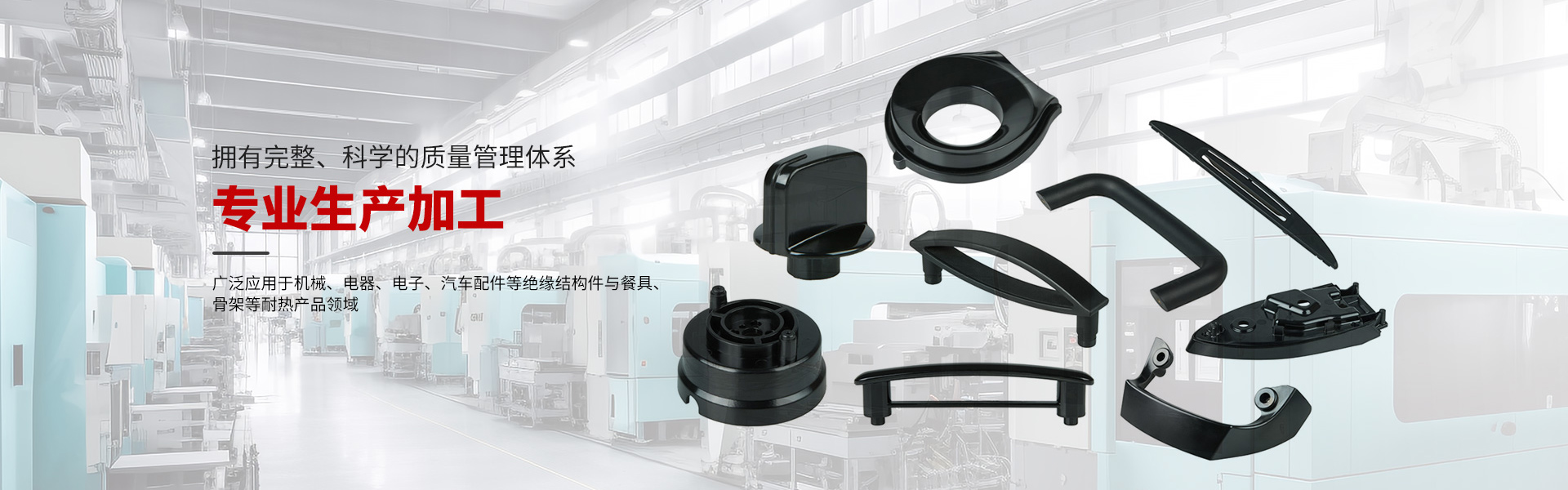
The correct term for "electrical wood mold" should be "bakelite mold." Some of you might think that bakelite molds are made by pressing bakelite powder, but the vast majority of bakelite molds are produced using injection molding machines. The main difference between bakelite molds and plastic molds lies in the fact that bakelite molds must be made as hard molds, with larger gating channels and gating bushes, and the gating channels usually require inserts. Another difference is that bakelite molds have a higher molding temperature, necessitating heating, so heating pipes should be included in the mold. In contrast, plastic molds are generally cooled. During molding, the parting surface of bakelite molds has a certain gap, which is very small and depends on the product size and quality requirements; products will have flash at the breakdown area. The electrical wood molds used for injection are not significantly different from plastic molds; just a few minor variations.
The material for the electrical plastic mold requires grades 8407, 635, and SKD61, which must maintain excellent quality and hardness under high temperatures.
2. Electrical wood molds are prone to wear, so they need to be heat treated to around HRC60, which is similar to the hardness of cutting tools. Of course, if the quantity is not large, NAK80-type pre-hardened steel with an HRC of about 40 can also be used.
3. The areas most prone to wear are the injection points, so it's advisable to create inserts at these points, either in white steel or black steel. While black steel is preferable, it is brittle and can only be processed using wire cutting or grinding. The inserts are designed to be replaceable to facilitate easy replacement after wear.
4. Since molds require heating, heat pipes or heating sheets must be added.
To prevent the heat from being absorbed by the injection molding machine, it is necessary to add an insulating panel on both the top and bottom plates. This can be made of asbestos or electrical board.
Due to thermal expansion when the mold is heated, to prevent the mold from sticking, the guide pin and guide sleeve of the mold are slightly looser than the plastic mold.
7. Epoxy molding is prone to sticking, so all molds are made smooth, and the mold cavity surface is plated with hard chrome. The cutting surface must be free of patterns, while the top surface, if relatively smooth, can feature some decorative patterns.
8. The steel used for the bakelite mold is different from that for the plastic mold. Each side of the mold's top and bottom plates should be covered with an insulating board.
9. Bakelite is a thermosetting material. The temperature of the Bakelite powder in the barrel is 100 degrees, at the gate 160 degrees, and inside the mold 180 degrees. The Bakelite injection mold must be heated to 160 degrees before injection, thus requiring a heating element.
