

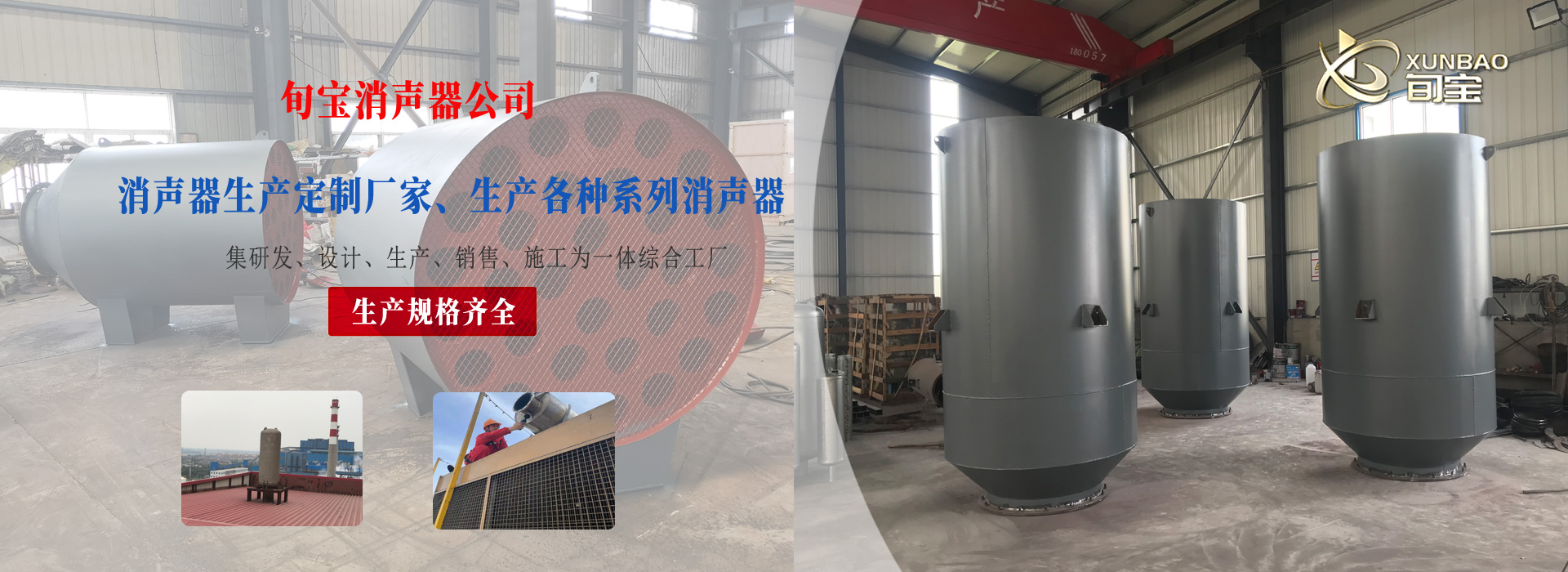

The spectrum of wind turbine noise is a composite spectrum, which is the superposition of blade passing frequency and broadband aerodynamic noise components. Wind turbine silencers are devices designed to reduce wind turbine noise, and they are categorized into resistive silencers and reactive silencers.
In practical noise control engineering, noise is often in a wide frequency band. Typically, a combination of resistive sound absorption and resistive silencing structures is used to control intense wideband noise.
The mufflers for fans, exhaust pipes, and induced draft fans are all designed using the resistive sound absorption and noise reduction principle that is effective for mid-to-high frequency broadband characteristics, as well as the reactive noise reduction principle that is beneficial for low and mid-frequency as well as pulsating characteristics, along with micro-perforated mufflers and impedance composite mufflers.
A resistive silencer is an absorbent type of silencer, which is generally categorized into different structures such as straight tube, sheet, corrugated plate, honeycomb, acoustic flow, labyrinth, and elbow styles based on the air flow channel design. By utilizing the friction and viscosity resistance of sound waves as they propagate through porous sound-absorbing materials, a resistive silencer converts sound energy into thermal energy and dissipates it, thereby achieving the purpose of noise reduction. It is one of the most widely used types of silencers among all available options.
The Resonant Damping muffler differs from the Resistive Damping muffler in its noise reduction principle; it does not directly absorb sound energy but instead utilizes the abrupt interfaces or auxiliary resonance chambers on the pipe. This causes certain frequencies of sound waves propagating along the pipe to reflect and interfere at the interfaces, thereby achieving the purpose of noise reduction. It is categorized into two types: the Expansion Chamber muffler and the Resonant muffler.
In practical noise control engineering, noise is often宽带in nature. Typically, a combination of resistive sound absorption and reactive noise reduction structures is employed to control intense宽带noise.
The structural principle of the blower muffler:
Based on the spectral characteristics data obtained from actual field noise source tests of various industrial fans, we determine the required noise reduction levels in specific frequency ranges for designing the main acoustic absorption bodies and fluid channels. Additionally, we employ narrow rectangular channels with large acoustic material coatings to enhance absorption effectiveness. Furthermore, when the noise sources of the fans are at higher noise levels, their spectral values are often not limited to one type, and the noise reduction requirements for different frequency bands vary accordingly.
The GF series ventilation duct silencers and exhaust fan silencers are both of impedance type, utilizing resistive structures that absorb and reduce high and medium-frequency noise, as well as resistive structures that reduce and suppress medium and low-frequency noise. Additionally, the resistive channels incorporate both high and low-frequency sound-absorbing and noise-reduction zones to maximize the broadening of the noise reduction frequency band, achieving excellent sound absorption and noise reduction effects.
The GF series exhaust silencers and induced draft fans are suitable for various centrifugal, axial flow, Roots blowers, and air compressors.
