

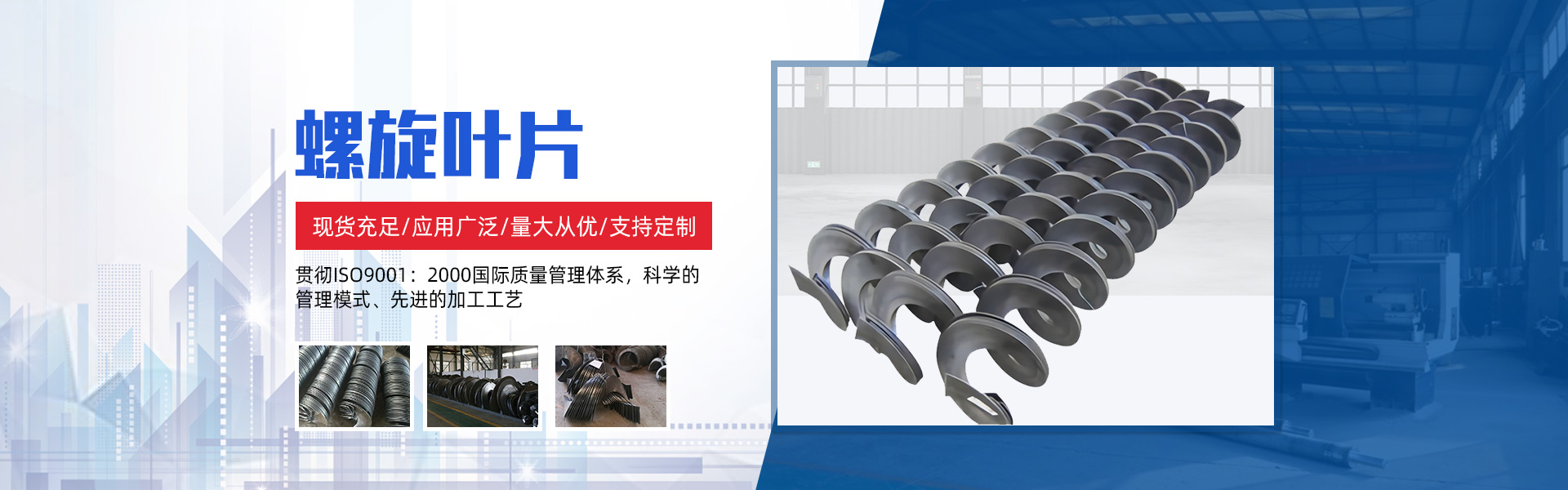


Spiral blades are one of the crucial components on conveyors. Every step in their production plays a decisive role, and their shapes vary. They utilize specialized molding techniques. So, what are these molding techniques?
Continuous Cold Rolling Forming Technology
Characterized by high spiral forming efficiency, high material utilization in mass production, easy and quick welding assembly for users, and excellent overall strength.
2. Segmented Equal Thickness Shaping Technology
This proprietary technology was developed to address the challenges of controlling the rolling forming process for large diameters, thick sections, and special-sized dimensions, as well as the difficulties in forming wear-resistant and stainless steel materials using the rolling process. It boasts excellent forming accuracy and high product pass rates, particularly suitable for the production of spiral blades for large sizes, thick sections, and materials such as wear-resistant steel and stainless steel.
3. Continuous Constant Thickness Shaping Technology
Primarily to meetHelical bladesA new technology developed to overcome the limitations of low forming precision and low yield rate in certain specifications of rolling technology. High forming precision, with consistent outer and inner wall thicknesses. Spiral forming efficiency is comparable to continuous cold rolling technology.
That concludes the three molding techniques for spiral blades. When in use, you can judge which molding technique is better according to your specific needs. During the molding operation, it is usually from the few techniques mentioned above that we choose.
News Center Co., Ltd.
