
babjehec知名液化石油气储罐厂家
Use Instructions
1. Cylinders must be stored in well-ventilated areas and kept at a distance of at least 1.5 meters from any fire or heat source. Do not use fire to heat, scald with boiling water, or expose to direct sunlight. Regularly inspect the cylinder valves and pipeline joints for leaks, ensuring no gas escapes. Typically, check for leaks using soap and water, and strictly prohibit using open flames for leak testing.
2. When lighting, ignite the primer first, followed by opening the gas; do not reverse the sequence. There should be someone supervising during use; do not leave the area to prevent boiling water from spilling and extinguishing the flame, which could cause the liquefied gas to escape and lead to an explosion. After using the gas cylinder, make sure to close the valve tightly to prevent gas leakage.
3. The liquefied gas inside the cylinder should not be completely exhausted; a certain residual pressure must be maintained. The residual pressure should generally be greater than 49.03 kPa (i.e., 0.5 kg/cm2, gauge pressure) to prevent air from entering the cylinder. After the LPG is used up, the remaining residue in the cylinder is also a flammable substance and should not be poured out arbitrarily to avoid fires caused by the flow and evaporation of the residue.
4、Liquefied Petroleum GasCylinders are pressurized containers that require proper maintenance and regular inspections. During handling and use, they should be prevented from falling or colliding. It is forbidden to open the valve by striking it with a metal object, and they should be protected from direct sunlight and prolonged exposure to rain. Cylinders are typically inspected every 2 years.
5、PetroleumThe explosion range of liquefied gas is not very wide, but due to its low limit, it's easy to ignite and explode upon leakage. Also, as LPG is heavier than air, it tends to flow downwards in the air, accumulating in low-lying areas and posing a hidden danger of gas explosion. Therefore, in areas prone to gas leakage, relying solely on window ventilation is insufficient; attention must also be given to lower-level ventilation.
6. Upon discovering a liquefied gas leak indoors, promptly open windows and doors for ventilation, allowing it to disperse away from any open flame. Strictly prohibit any fire nearby. Use the product only after the fault is rectified and the distinctive odor has dissipated. Dispose of any leaked liquid on the ground by covering it with sand and soil before removing it to a safe location. In case of a gas cylinder fire, immediately close the valve, move it to an open area outdoors, and extinguish it using dry powder extinguishers, carbon dioxide extinguishers, or by covering it with a wet sack.
7. Educate children not to play with gas cylinders carelessly, and users must be aware of the safety knowledge when handling gas cylinders.

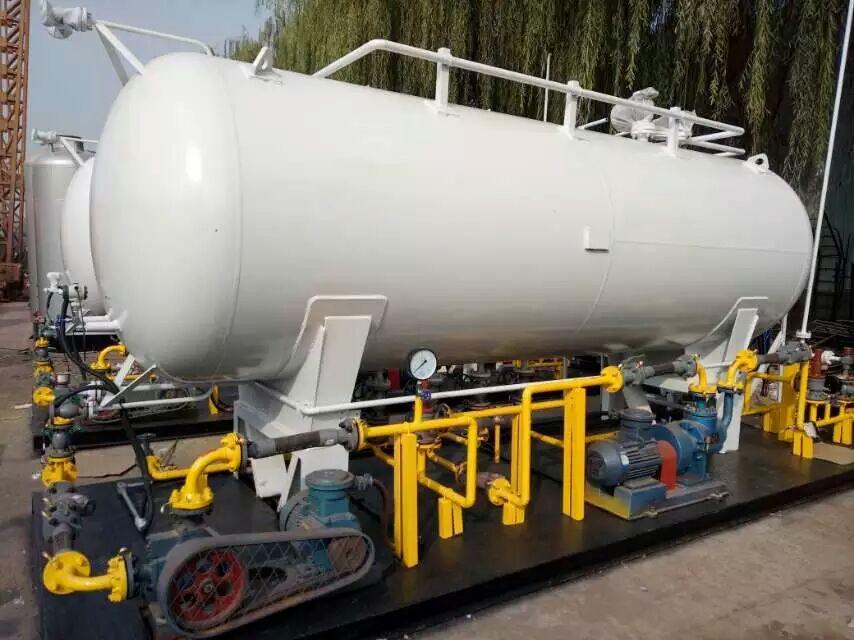
Liquefied Petroleum Gas Storage TankWe offer compressed gas or liquefied gas storage tanks.Liquefied Petroleum Gas TankFixed-volume storage tanks and variable-volume storage tanks, categorized by the change in container capacity, with large fixed-volumeLiquefied Petroleum Gas (LPG) Storage TankManufactured into spherical shapes, smaller ones are made into cylindrical shapes. The mobile volume storage tank, also known as a low-pressure gas storage tank or commonly referred to as a gas holder, has a variable geometric volume. It is tightly sealed to prevent gas leakage and serves the functions of balancing air pressure and regulating gas supply, with the pressure generally not exceeding 60 MPa.
Liquefied gas storage tanks undergo strict quality assessment for the material of pressure components, external dimensions, weld quality, operational quality, installation quality, internal fittings, and safety accessories.
Routine physical and chemical testing of the drum material, such as mechanical properties and chemical composition.
The welding joints, seams, tank end caps, and the mutual geometric positions of all pressure components are rigorously inspected through X-ray non-destructive testing and magnetic particle inspection. Tests are conducted on the product's sealing, pressure resistance, and all technical indicators that could affect the safe operation of the product.