


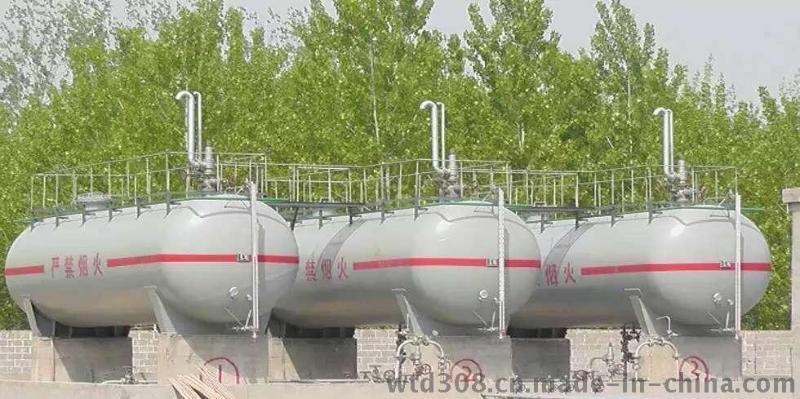
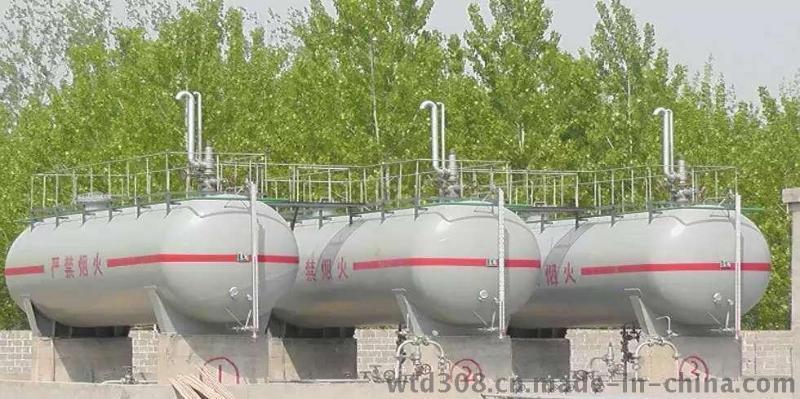
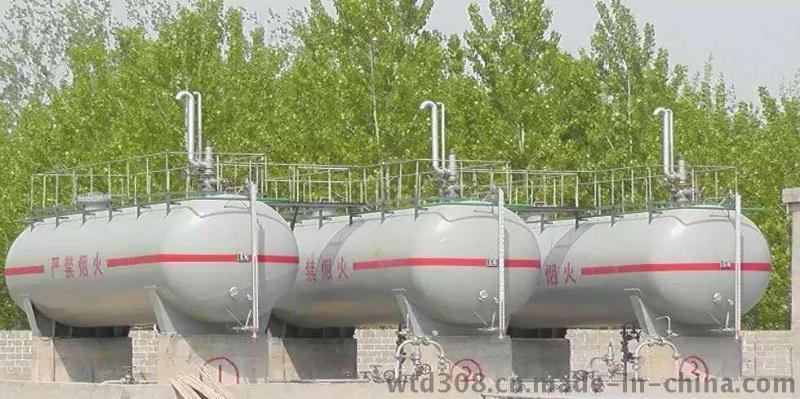
Babjehec specializes in the production of natural gas storage tanks.
Cautionary Notes
1. Cylinders must be stored in well-ventilated areas and kept at a distance of at least 1.5 meters from any fire or heat source. Absolutely no fire should be used to heat, scald, or expose them to direct sunlight. Regularly inspect the cylinder valves and pipeline joints for leaks, ensuring airtightness at all times. Use soap and water to check for leaks; under no circumstances should an open flame be used for leak testing.
2. When lighting, always ignite the primer first, followed by opening the gas, never reverse the order. There should be someone supervising during use; do not leave the area to prevent boiling water from overflowing and extinguishing the flame, which could cause the liquefied gas to escape and lead to an explosion. After using the gas cylinder, make sure to close the valve tightly to prevent gas leakage.
3. The liquefied gas in the cylinder should not be fully exhausted; a certain residual pressure must be maintained. The residual pressure should generally be greater than 49.03 kPa (i.e., 0.5 kg/cm2, gauge pressure) to prevent air from entering the cylinder. After the LPG is used up, the remaining residue in the cylinder is also a flammable material and should not be poured out自行. This is to prevent fires caused by the flow and evaporation of the residue.
4. LPG cylinders are pressurized containers that require proper maintenance and regular inspections. During handling and use, they should be prevented from falling or being struck. It is forbidden to use metal tools to strike the valve open, and they should be protected from direct sunlight and prolonged exposure to rain. Cylinders are typically inspected every 2 years.
5. Although the explosive range of liquefied petroleum gas (LPG) is not very wide, its lower limit is small, making it easy to ignite and explode upon leakage. Additionally, as LPG is heavier than air, it tends to flow downward upon leakage in the air, accumulating in low-lying areas and posing a hidden danger of gas explosion. Therefore, in areas prone to gas leakage, relying solely on window ventilation is insufficient; attention must also be given to lower-level ventilation.
6. When液化gas is detected indoors, promptly open windows and doors for ventilation, allowing it to disperse away from any open flame. Strictly prohibit any fire nearby. Only use the area after the fault is resolved and the distinctive odor has dissipated. Dispose of any leaked liquid on the ground by covering it with sand and soil before removing it to a safe location. In case of a gas cylinder fire, immediately close the valve, move it to an open area outdoors, and extinguish the fire using dry powder extinguishers, carbon dioxide extinguishers, or by covering it with a wet sack.
7. Educate children not to tamper with gas cylinders carelessly, and users must be aware of the safety knowledge for using gas cylinders.

Key Player in Energy Structure Adjustment
The relatively clean nature of natural gas has indeed accelerated its penetration into various fields, including daily life and corporate operations, with continuous growth in market demand across regions. The National Energy Administration has published articles stating that under the increasingly tight constraints of resources and the environment, the green transformation of energy is becoming increasingly urgent, necessitating a significant increase in the share of natural gas. In June this year, the National Development and Reform Commission and the National Energy Administration, among 13 other ministries, jointly issued "Opinions on Accelerating the Utilization of Natural Gas," which clearly outlines the gradual development of natural gas as one of the main clean energy sources in China's modern clean consumption energy system. According to the National Development and Reform Commission's statistics, from January to October this year, China's natural gas production reached 121.2 billion cubic meters, up 11.2% year-on-year; the import volume was 72.2 billion cubic meters, up 27.5%; and the consumption volume was 186.5 billion cubic meters, up 18.7%.
Peak introduced that with the continuous increase in China's natural gas consumption level, imported natural gas has become one of the important sources of China's natural gas supply. According to customs statistics, from January to October this year, China's natural gas imports reached 54.165 million tons, a year-on-year increase of 24.9%. Of this, gaseous natural gas was 25.073 million tons, up 5.9% year-on-year; liquefied natural gas was 29.092 million tons, setting a historical record and up 47.7% year-on-year.
The increase in natural gas consumption has also witnessed the adjustment of energy structures in various regions. Taking Beijing as an example, according to the Beijing Statistical Yearbook, the total energy consumption in Beijing increased from 63.595 million tons of standard coal to 69.617 million tons of standard coal between 2010 and 2016. The proportion of coal consumption decreased from 29.6% to 9.8%, a decrease of more than 60%, while the proportion of natural gas consumption increased from 14.6% to 31.7%, an increase of about 50%.


