


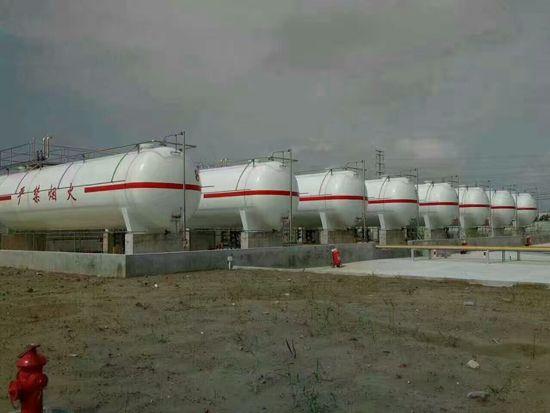
Product Description
Brand Huoguo Group Model CFW-30/0.8
Material: Stainless Steel, Diameter: 2916mm
Application Range: -162℃; Volume: 30,000L
Heat Exchange Area - See drawing sq. m, Ambient Temperature - See drawing °C
Wall Thickness: 8/10mm, External Dimensions: 2916*8289mm
Origin: Shandong Heze
Horizontal LNG Storage Tank 30 Cubic LNG Storage Tank 60 Cubic LNG Storage Tank 100 Cubic Natural Gas Storage Tank

The low-temperature LNG storage tank is a double-layer structure, with the inner shell storing low-temperature natural gas liquid, withstanding the pressure and low temperatures of the medium. The material of the inner shell is SS30408. The outer shell serves as a protective layer for the inner shell, maintaining a certain gap to form an insulating space, withstanding the gravitational loads of the inner shell and the medium, as well as the vacuum negative pressure of the insulating layer. The outer shell does not come into contact with the low temperature and is made of container steel. The insulating layer is mostly filled with mica sand, and high vacuum is drawn. The evaporation rate of the low-temperature LNG storage tank is generally less than 0.2%.

Low-Temperature LNG Storage Tank Structural Design
1.1 Liquid Filling System
The liquid addition is divided into top feed and bottom feed, with a quick connector CN-1 and a four-way connector connecting to the top feed valve V3 and the bottom feed valve V2, respectively. Tubes and transition connectors are connected to the inner cylinder.
Tubes are selected in φ28×2 and φ45×3.5 sizes.
1.2 Drainage System
The valve V6 can directly discharge fluid, connected from the bottom of the cylinder; the pipe is selected in φ45×3.5. V6 is chosen with 32gDA25C, with a specification of DN40 PN4.0.
1.3 Vacuum Degree Measurement System
VR vacuum silicon tubes, used for measuring the vacuum level of the tank's sandwich layer, are connected to the evacuation tube of the sandwich. The sandwich should be re-evacuated when the vacuum level of the vacuum layer exceeds 3 Pa to ensure the vacuum level of the sandwich and enhance the insulating effect.
1.4 Vacuum Insulation Panel System
VV vacuum vent, using CF-40 with DN size of 40, used for vacuuming, closes when the vacuum level reaches the required standard, maintaining the interlayer vacuum.
1.5 Level Measurement System
Two pipelines are extracted from the top and bottom parts of the cylinder, with the top being the gas phase and the bottom the liquid phase, connected together by the level gauge valve. The L1 level gauge valve PS×Z-1 is connected to a pressure gauge valve and a pressure gauge, with the liquid level measuring range of 0 to 6 meters of water column.
1.6 Full Mouth Measurement
Install the pipeline by the set liquid level. When the liquid level reaches the set value, it flows downward through the pipe to the fill valve MV. When filling, this valve opens until liquid starts to flow out, indicating the tank is full. Close the valve. Use a 32gDA10C valve, specification: DN20 PN4.0.
1.7 Self-pressurizing System
The pressure booster valve V1 is connected to the supercharger PBC-1, which uses the CFB03-00. It vaporizes a portion of the liquid flowing from the tank and introduces it into the inner tank, thereby increasing the pressure inside the tank, causing the liquid to be expelled under pressure.
1.8 Gas Venting System
When the pressure at the top of the container increases, gas is released through the pipeline, passing through the vent valve E1, then to a one-way valve CV. Since gas can only flow out, a one-way valve is used to prevent backflow. Therefore, a flame arrester is connected after the one-way valve, as gas release and contact with air may cause sparks. The flame arrester is to prevent sparks from entering the inner tank with the gas, causing a fire and explosion.

Horizontal LNG Tank, 30 Cubic LNG Tank, 60 Cubic LNG Tank, 100 Cubic Natural Gas Tank

Product Description
Brand Hegu Group Model CFW-60/0.8
Material: Stainless Steel, Diameter: 2916mm
Application Range: -162℃; Volume: 60,000L
Heat Exchange Area - See drawing m², Ambient Temperature - See drawing °C
Wall Thickness: 8mm, Outer Dimensions: φ2916*14929mm
Origin: Shandong Heze

60-cubic-meter LNG Tank, Horizontal LNG Storage Tank, Professional Manufacturer of Liquefied Natural Gas Storage Tanks
LNG tanks are atmospheric pressure, low-temperature, large storage containers, typically featuring a flat bottom and double-walled cylindrical design. The inner cylinder is generally made of 9% nickel alloy steel, but can also be constructed from all aluminum, stainless steel film, or pre-stressed concrete. The outer wall is made of carbon steel or pre-stressed concrete. The suspended thermal support platform at the top of the wall is aluminum, while the tank roof is made of carbon steel or concrete. The main thermal insulation materials inside the LNG tank include expanded perlite, elastic glass fiber felt, and foam glass bricks.
LNG Tank Characteristics Requirements
Low-temperature resistance
The boiling point of liquefied natural gas at atmospheric pressure is -162°C. Therefore, LNG storage tanks must have excellent low-temperature resistance and insulation properties.
(2) High safety requirements
Due to the storage of low-temperature liquids inside the tank, in the event of an accident, the refrigerated liquid would volatilize in large quantities, with the vaporization amount being approximately 625 times that of the original refrigerated state, forming an explosive mixture in the atmosphere. Therefore, it is required that the tank be constructed with a double-walled structure and utilize the sealing concept. In the event of a leak in the first layer of the tank, the second layer can completely seal off the leaking liquid and the evaporated gas, ensuring storage safety.
(3) Special material.
The inner tank must be able to withstand low temperatures and is made of Austenitic stainless steel, while the outer cylinder is made from Q345R plain low-carbon alloy steel plate.
(4) Strict thermal insulation measures.
Due to the maximum temperature difference between the inside and outside of the drum reaching up to 200℃, the drum must have excellent insulation properties to maintain an internal temperature of -160℃. High-performance insulation material should be filled between the inner and outer drums. The insulation material at the drum bottom must also have sufficient pressure-bearing capacity. (5) Good seismic performance
General building seismic requirements are to crack but not collapse under specified seismic loads. To ensure the safety of storage tanks under accidental loads, they must have excellent seismic performance. Ensure that the tank body remains undamaged under the given seismic intensity. (6) Strict construction requirements
Tanks' weld seams must undergo 100% magnetic particle testing (MT) and 100% vacuum leak testing (VBT). Strict selection of insulation materials is required, and the prescribed procedures must be followed during construction.
Huzhou Boiler Factory Co., Ltd. is a key enterprise designated by the China National Quality Supervision, Inspection and Quarantine Administration for the production of boiler pressure vessels, a vice-president unit of the China Industrial Boiler Industry Association, a member unit of the China Association of Heating, Ventilation and Drainage, and possesses B-grade boiler manufacturing (certification number TS2110587-2011), third-class pressure vessel manufacturing (certification number TS2210916-2013) and design qualifications (certification number TS-), and has passed the ISO9001 international quality management system certification.
Huzhou Boiler Factory Co., Ltd. main products:
Chemical Storage Tanks (liquefied gas tanks, LPG tanks, liquid ammonia tanks, propane tanks, propylene tanks, isobutane tanks, chloromethane tanks, etc.); Non-standard Pressure Vessels (towers, heat exchangers, autoclaves, reaction vessels, stainless steel containers, etc.)
Refrigeration Auxiliary Equipment (evaporative coolers, ammonia storage tanks, condensate drums, circulating drums, oil separators, separators, condensers, intermediate coolers, siphon tanks, economizers, etc.)
Boiler equipment (including steam boilers, hot water boilers, thermal oil boilers, fuel-gas boilers, waste heat boilers, etc.)
Low-temperature Storage Tanks (Liquid Oxygen Tanks, Liquid Oxygen Vessels, Liquid Nitrogen Tanks, Liquid Nitrogen Vessels, Liquid Argon Tanks, Carbon Dioxide Tanks, LNG Tanks, Liquefied Natural Gas Tanks)

60-cubic-meter LNG Storage Tank, Horizontal LNG Tank, Professional Manufacturer of Liquefied Natural Gas Storage Tanks


